We had discussed three Single Input Multiple Output (SIMO also known as receive diversity) schemes – Selection combining, Equal Gain Combining, Maximal Ratio Combining and a Multiple Input Single Output (MISO, also known as transmit diversity) scheme – Alamouti 2×1 STBC. Let us now discuss the case where there a multiple transmit antennas and multiple receive antennas resulting in the formation of a Multiple Input Multiple Output (MIMO) channel. In this post, we will restrict our discussion to a 2 transmit 2 receive antenna case (resulting in a 2×2 MIMO channel). We will assume that the channel is a flat fading Rayleigh multipath channel and the modulation is BPSK.
2×2 MIMO channel
In a 2×2 MIMO channel, probable usage of the available 2 transmit antennas can be as follows:
1. Consider that we have a transmission sequence, for example
2. In normal transmission, we will be sending in the first time slot,
in the second time slot,
and so on.
3. However, as we now have 2 transmit antennas, we may group the symbols into groups of two. In the first time slot, send and
from the first and second antenna. In second time slot, send
and
from the first and second antenna, send
and
in the third time slot and so on.
4. Notice that as we are grouping two symbols and sending them in one time slot, we need only time slots to complete the transmission – data rate is doubled ! 🙂
5. This forms the simple explanation of a probable MIMO transmission scheme with 2 transmit antennas and 2 receive antennas.
Having said this, some of you will wonder – the two transmitted symbols interfered with each other. Can we ever separate the two out? The rest of the post attempts to answer this question. 🙂
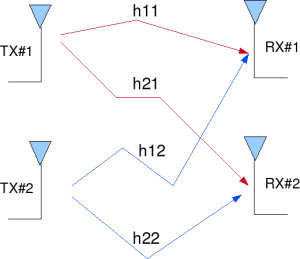
Figure: 2 Transmit 2 Receive (2×2) MIMO channel
Other Assumptions
1. The channel is flat fading – In simple terms, it means that the multipath channel has only one tap. So, the convolution operation reduces to a simple multiplication. For a more rigorous discussion on flat fading and frequency selective fading, may I urge you to review Chapter 15.3 Signal Time-Spreading from [DIGITAL COMMUNICATIONS: SKLAR]

2. The channel experience by each transmit antenna is independent from the channel experienced by other transmit antennas.
3. For the transmit antenna to
receive antenna, each transmitted symbol gets multiplied by a randomly varying complex number
. As the channel under consideration is a Rayleigh channel, the real and imaginary parts of
are Gaussian distributed having mean
and variance
.
4. The channel experienced between each transmit to the receive antenna is independent and randomly varying in time.
5. On the receive antenna, the noise has the Gaussian probability density function with
with
and
.
7. The channel is known at the receiver.
Zero forcing (ZF) equalizer for 2×2 MIMO channel
Let us now try to understand the math for extracting the two symbols which interfered with each other. In the first time slot, the received signal on the first receive antenna is,
.
The received signal on the second receive antenna is,
.
where
,
are the received symbol on the first and second antenna respectively,
is the channel from
transmit antenna to
receive antenna,
is the channel from
transmit antenna to
receive antenna,
is the channel from
transmit antenna to
receive antenna,
is the channel from
transmit antenna to
receive antenna,
,
are the transmitted symbols and
is the noise on
receive antennas.
We assume that the receiver knows ,
,
and
. The receiver also knows
and
. The unknown s are
and
. Two equations and two unknowns. Can we solve it? Answer is YES. 🙂
For convenience, the above equation can be represented in matrix notation as follows:
.
Equivalently,
To solve for , we know that we need to find a matrix
which satisfies
. The Zero Forcing (ZF) linear detector for meeting this constraint is given by,
.
This matrix is also known as the pseudo inverse for a general m x n matrix.
The term,
.
BER with ZF equalizer with 2×2 MIMO
Note that the off diagonal terms in the matrix are not zero (Recall: The off diagonal terms where zero in Alamouti 2×1 STBC case). Because the off diagonal terms are not zero, the zero forcing equalizer tries to null out the interfering terms when performing the equalization, i.e when solving for
the interference from
is tried to be nulled and vice versa. While doing so, there can be amplification of noise. Hence Zero Forcing equalizer is not the best possible equalizer to do the job. However, it is simple and reasonably easy to implement.
Further, it can be seen that, following zero forcing equalization, the channel for symbol transmitted from each spatial dimension (space is antenna) is a like a 1×1 Rayleigh fading channel (Refer Section 3.3 of [WIRELESS-TSE, VISWANATH]
For BPSK modulation in Rayleigh fading channel, the bit error rate is derived as,
.
Simulation Model
The Matlab/Octave script performs the following
(a) Generate random binary sequence of +1’s and -1’s.
(b) Group them into pair of two symbols and send two symbols in one time slot
(c) Multiply the symbols with the channel and then add white Gaussian noise.
(d) Equalize the received symbols
(e) Perform hard decision decoding and count the bit errors
(f) Repeat for multiple values of and plot the simulation and theoretical results.
Click here to download Matlab/Octave script for simulating BER plot for 2×2 MIMO channel with ZF equalizer (BPSK modulation in Rayleigh channel)
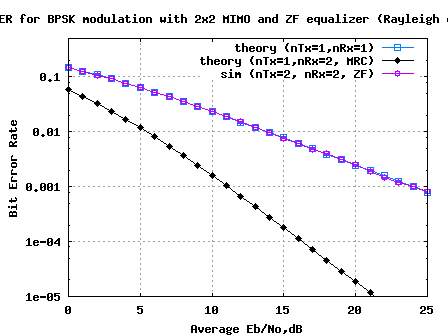
Figure: BER plot for 2×2 MIMO channel with ZF equalizer (BPSK modulation in Rayleigh channel)
Summary
1. As expected, the simulated results with a 2×2 MIMO system using BPSK modulation in Rayleigh channel is showing matching results as obtained in for a 1×1 system for BPSK modulation in Rayleigh channel.
2. As noted in Section 3.3 of [WIRELESS-TSE, VISWANATH]
3. We might not be able to achieve the two fold data rate improvement in all channel conditions. It can so happen that channels are correlated (the coefficients are almost the same). Hence we might not be able to solve for the two unknown transmitted symbols even if we have two received symbols.
4. It is claimed that there can be receiver structures which enables us to have both diversity gain and data rate gain. In future posts, the attempt will be to discuss receiver structures which hopefully enables us to find out approaches which will help us to keep the data rate gain, but still move from the 1×1 curve to 1×2 MRC curve. 🙂
References
[DIG-COMM-BARRY-LEE-MESSERSCHMITT] Digital Communication: Third Edition, by John R. Barry, Edward A. Lee, David G. Messerschmitt
[WIRELESS-TSE, VISWANATH]
Hi Krishna,
First of all I want to say thank you very much for writing this notes.
I have got a question about adding more antennas at the transmitting and receiving side, eg. 64*64 MIMO systems. I have tried to made modifications based on your programme but I don’t have a clue. Could you please give me some tips on possible modifications? Thank you so much!
@Raymond: a 64×64 system is huge. your would want to invert the 64×64 matrix for equalization
Dear krishna,
Have you done any coding for MU-MIMO uplink or downlink cases. thank you
@Raja: sorry, not yet
First of all thanks a lot for your information on matlab coding. I learnt matlab coding with the help of your codes. Thanks a lot. My question is ” I’m doing project on orthogonal space-time block codes under rayleigh channel. There is a code for this,but for a codeword of 4×4 matrix(rate=1) but i need it for8x4 matrix(rate of 0.5) and other rates of 0.75. I actually tried with QPSK modulation and demodulation, my BER vs SNR performance is of zigzag manner. Then i used your qam16 mod and demod and got 0.01 ber for an snr of 20(I hope this is not good performance)”
@sandeep: well, to rule out any obvious issue, first make sure that the ber is zero when there is no noise added. once that is done, the exact performance number will depend on your coding type which is employed. try to compare with the theoretically estimated ber curves.good luck.
i have a doubt about the code:
hCof(2,1,:) = -sum(h(:,2,:).*conj(h(:,1,:)),1); % c term
hCof(1,2,:) = -sum(h(:,1,:).*conj(h(:,2,:)),1); % b term
I think that there is something wrong,because i use inv() to do the computation , the result is not the same.
I think the ‘c term’ and ‘b term ‘ should be interchanged.
@michael: Is it the scaling by determinant which is missing?
Dear Krishna Sankar,
Does ‘ hMod = reshape(conj(h),nRx,N) ‘ do the Conjugate Transpose? I just see the conjugate work is done not the Transpose?
@Binh : The ‘ does conjugate transpose.
octave:3> h = [1+j 1+2j 1+3j]
h =
1 + 1i 1 + 2i 1 + 3i
octave:4> h’
ans =
1 – 1i
1 – 2i
1 – 3i
I also cannot find that it does the transpose operation.
In my code ,it really just do the conj operation !
thanks in advance
@michael: Hmm.. not sure how to debug. hope you found the answer
Sir,
could u please tel me why 4×4 is not better than 2×2……
@Neethu: Well, getting a sufficiently uncorrelated channel to support 4 spatial streams is more difficult than to support 2 spatial streams
why do we use channel taps in bpsk
@ash: The channel taps are not BPSK (i.e. modulation specific), rather to model the effect of reflections in wireless communication. Maybe the post on Rayleigh multipath channel model helps
https://dsplog.com/2008/07/14/rayleigh-multipath-channel/
Thanks for your great and helpful blog, I can’t have a good reuslts while Iam configure 4×4 mimo, I obtained that the 2×2 is better than 4×4
my program is:
clear
N = 10^4; % number of bits or symbols
Eb_N0_dB = [0:25]; % multiple Eb/N0 values
nTx = 2; nnTx=4;
nRx = 2; nnRx=4;
for ii = 1:length(Eb_N0_dB)
% Transmitter
ip = rand(1,N)>0.5; % generating 0,1 with equal probability
s = 2*ip-1; % BPSK modulation 0 -> -1; 1 -> 0
%2×2:
sMod = kron(s,ones(nRx,1));
sMod = reshape(sMod,[nRx,nTx,N/nTx]); % grouping in [nRx,nTx,N/NTx ] matrix
h = 1/sqrt(2)*[randn(nRx,nTx,N/nTx) + j*randn(nRx,nTx,N/nTx)]; % Rayleigh channel
n = 1/sqrt(2)*[randn(nRx,N/nTx) + j*randn(nRx,N/nTx)]; % white gaussian noise, 0dB variance
y = squeeze(sum(h.*sMod,2)) + 10^(-Eb_N0_dB(ii)/20)*n;
hCof = zeros(2,2,N/nTx);
hCof(1,1,:) = sum(h(:,2,:).*conj(h(:,2,:)),1); % d term
hCof(2,2,:) = sum(h(:,1,:).*conj(h(:,1,:)),1); % a term
hCof(2,1,:) = -sum(h(:,2,:).*conj(h(:,1,:)),1); % c term
hCof(1,2,:) = -sum(h(:,1,:).*conj(h(:,2,:)),1); % b term
hDen = ((hCof(1,1,:).*hCof(2,2,:)) – (hCof(1,2,:).*hCof(2,1,:))); % ad-bc term (det de matrix 2×2)
hDen = reshape(kron(reshape(hDen,1,N/nTx),ones(2,2)),2,2,N/nTx); % formatting for division
hInv = hCof./hDen; % inv(H^H*H)
hMod = reshape(conj(h),nRx,N); % H^H operation
yMod = kron(y,ones(1,2)); % formatting the received symbol for equalization
yMod = sum(hMod.*yMod,1); % H^H * y
yMod = kron(reshape(yMod,2,N/nTx),ones(1,2)); % formatting
yHat = sum(reshape(hInv,2,N).*yMod,1); % inv(H^H*H)*H^H*y
ipHat = real(yHat)>0;
nErr(ii) = size(find(ip- ipHat),2);
%4×4:
ssMod = kron(s,ones(nnRx,1));
ssMod = reshape(ssMod,[nnRx,nnTx,N/nnTx]);
hh= 1/sqrt(2)*[randn(nnRx,nnTx,N/nnTx) + j*randn(nnRx,nnTx,N/nnTx)]; %Rayleigh channel 4×4
nn = 1/sqrt(2)*[randn(nnRx,N/nnTx) + j*randn(nnRx,N/nnTx)]
yy = squeeze(sum(hh.*ssMod,2)) + 10^(-Eb_N0_dB(ii)/20)*nn;
hhCof = zeros(4,4,N/nnTx) ;
hhCof(1,1,:) = (sum(hh(:,2,:).*conj(hh(:,2,:)),1).* sum(hh(:,3,:).*conj(hh(:,3,:)),1) .* sum(hh(:,4,:).*conj(hh(:,4,:)),1))+ (sum(hh(:,2,:).*conj(hh(:,3,:)),1).* sum(hh(:,3,:).*conj(hh(:,4,:)),1) .* sum(hh(:,4,:).*conj(hh(:,2,:)),1))+ (sum(hh(:,2,:).*conj(hh(:,4,:)),1).* sum(hh(:,3,:).*conj(hh(:,2,:)),1) .* sum(hh(:,4,:).*conj(hh(:,3,:)),1))- (sum(hh(:,2,:).*conj(hh(:,2,:)),1).* sum(hh(:,3,:).*conj(hh(:,4,:)),1) .* sum(hh(:,4,:).*conj(hh(:,3,:)),1))- (sum(hh(:,2,:).*conj(hh(:,3,:)),1).* sum(hh(:,3,:).*conj(hh(:,2,:)),1) .* sum(hh(:,4,:).*conj(hh(:,4,:)),1))- (sum(hh(:,2,:).*conj(hh(:,4,:)),1).* sum(hh(:,3,:).*conj(hh(:,3,:)),1) .* sum(hh(:,4,:).*conj(hh(:,2,:)),1));
hhCof(1,2,:) = (sum(hh(:,1,:).*conj(hh(:,2,:)),1).* sum(hh(:,3,:).*conj(hh(:,4,:)),1) .* sum(hh(:,4,:).*conj(hh(:,3,:)),1))+ (sum(hh(:,1,:).*conj(hh(:,3,:)),1).* sum(hh(:,3,:).*conj(hh(:,2,:)),1) .* sum(hh(:,4,:).*conj(hh(:,4,:)),1))+ (sum(hh(:,1,:).*conj(hh(:,4,:)),1).* sum(hh(:,3,:).*conj(hh(:,3,:)),1) .* sum(hh(:,4,:).*conj(hh(:,2,:)),1))- (sum(hh(:,1,:).*conj(hh(:,2,:)),1).* sum(hh(:,3,:).*conj(hh(:,3,:)),1) .* sum(hh(:,4,:).*conj(hh(:,4,:)),1))- (sum(hh(:,1,:).*conj(hh(:,3,:)),1).* sum(hh(:,3,:).*conj(hh(:,4,:)),1) .* sum(hh(:,4,:).*conj(hh(:,2,:)),1))- (sum(hh(:,1,:).*conj(hh(:,4,:)),1).* sum(hh(:,3,:).*conj(hh(:,2,:)),1) .* sum(hh(:,4,:).*conj(hh(:,3,:)),1));
hhCof(1,3,:) = (sum(hh(:,1,:).*conj(hh(:,2,:)),1).* sum(hh(:,2,:).*conj(hh(:,3,:)),1) .* sum(hh(:,4,:).*conj(hh(:,4,:)),1))+ (sum(hh(:,1,:).*conj(hh(:,3,:)),1).* sum(hh(:,2,:).*conj(hh(:,4,:)),1) .* sum(hh(:,4,:).*conj(hh(:,2,:)),1))+ (sum(hh(:,1,:).*conj(hh(:,4,:)),1).* sum(hh(:,2,:).*conj(hh(:,2,:)),1) .* sum(hh(:,4,:).*conj(hh(:,3,:)),1))- (sum(hh(:,1,:).*conj(hh(:,2,:)),1).* sum(hh(:,2,:).*conj(hh(:,4,:)),1) .* sum(hh(:,4,:).*conj(hh(:,3,:)),1))- (sum(hh(:,1,:).*conj(hh(:,3,:)),1).* sum(hh(:,2,:).*conj(hh(:,2,:)),1) .* sum(hh(:,4,:).*conj(hh(:,4,:)),1))- (sum(hh(:,1,:).*conj(hh(:,4,:)),1).* sum(hh(:,2,:).*conj(hh(:,3,:)),1) .* sum(hh(:,4,:).*conj(hh(:,2,:)),1));
hhCof(1,4,:) = (sum(hh(:,1,:).*conj(hh(:,2,:)),1).* sum(hh(:,2,:).*conj(hh(:,4,:)),1) .* sum(hh(:,3,:).*conj(hh(:,3,:)),1))+ (sum(hh(:,1,:).*conj(hh(:,3,:)),1).* sum(hh(:,2,:).*conj(hh(:,2,:)),1) .* sum(hh(:,3,:).*conj(hh(:,4,:)),1))+ (sum(hh(:,1,:).*conj(hh(:,4,:)),1).* sum(hh(:,2,:).*conj(hh(:,3,:)),1) .* sum(hh(:,3,:).*conj(hh(:,2,:)),1))- (sum(hh(:,1,:).*conj(hh(:,2,:)),1).* sum(hh(:,2,:).*conj(hh(:,3,:)),1) .* sum(hh(:,3,:).*conj(hh(:,4,:)),1))- (sum(hh(:,1,:).*conj(hh(:,3,:)),1).* sum(hh(:,2,:).*conj(hh(:,4,:)),1) .* sum(hh(:,3,:).*conj(hh(:,2,:)),1))- (sum(hh(:,1,:).*conj(hh(:,4,:)),1).* sum(hh(:,2,:).*conj(hh(:,2,:)),1) .* sum(hh(:,3,:).*conj(hh(:,3,:)),1));
hhCof(2,1,:) = (sum(hh(:,2,:).*conj(hh(:,1,:)),1).* sum(hh(:,3,:).*conj(hh(:,4,:)),1) .* sum(hh(:,4,:).*conj(hh(:,3,:)),1))+ (sum(hh(:,2,:).*conj(hh(:,3,:)),1).* sum(hh(:,3,:).*conj(hh(:,1,:)),1) .* sum(hh(:,4,:).*conj(hh(:,4,:)),1))+ (sum(hh(:,2,:).*conj(hh(:,4,:)),1).* sum(hh(:,3,:).*conj(hh(:,3,:)),1) .* sum(hh(:,4,:).*conj(hh(:,1,:)),1))- (sum(hh(:,2,:).*conj(hh(:,1,:)),1).* sum(hh(:,3,:).*conj(hh(:,3,:)),1) .* sum(hh(:,4,:).*conj(hh(:,4,:)),1))- (sum(hh(:,2,:).*conj(hh(:,3,:)),1).* sum(hh(:,3,:).*conj(hh(:,4,:)),1) .* sum(hh(:,4,:).*conj(hh(:,1,:)),1))- (sum(hh(:,2,:).*conj(hh(:,4,:)),1).* sum(hh(:,3,:).*conj(hh(:,1,:)),1) .* sum(hh(:,4,:).*conj(hh(:,3,:)),1));
hhCof(2,2,:) = (sum(hh(:,1,:).*conj(hh(:,1,:)),1).* sum(hh(:,3,:).*conj(hh(:,3,:)),1) .* sum(hh(:,4,:).*conj(hh(:,4,:)),1))+ (sum(hh(:,1,:).*conj(hh(:,3,:)),1).* sum(hh(:,3,:).*conj(hh(:,4,:)),1) .* sum(hh(:,4,:).*conj(hh(:,1,:)),1))+ (sum(hh(:,1,:).*conj(hh(:,4,:)),1).* sum(hh(:,3,:).*conj(hh(:,1,:)),1) .* sum(hh(:,4,:).*conj(hh(:,3,:)),1))- (sum(hh(:,1,:).*conj(hh(:,1,:)),1).* sum(hh(:,3,:).*conj(hh(:,4,:)),1) .* sum(hh(:,4,:).*conj(hh(:,3,:)),1))- (sum(hh(:,1,:).*conj(hh(:,3,:)),1).* sum(hh(:,3,:).*conj(hh(:,1,:)),1) .* sum(hh(:,4,:).*conj(hh(:,4,:)),1))- (sum(hh(:,1,:).*conj(hh(:,4,:)),1).* sum(hh(:,3,:).*conj(hh(:,3,:)),1) .* sum(hh(:,4,:).*conj(hh(:,1,:)),1));
hhCof(2,3,:) = (sum(hh(:,1,:).*conj(hh(:,1,:)),1).* sum(hh(:,2,:).*conj(hh(:,4,:)),1) .* sum(hh(:,4,:).*conj(hh(:,3,:)),1))+ (sum(hh(:,1,:).*conj(hh(:,3,:)),1).* sum(hh(:,2,:).*conj(hh(:,1,:)),1) .* sum(hh(:,4,:).*conj(hh(:,4,:)),1))+ (sum(hh(:,1,:).*conj(hh(:,4,:)),1).* sum(hh(:,2,:).*conj(hh(:,3,:)),1) .* sum(hh(:,4,:).*conj(hh(:,1,:)),1))- (sum(hh(:,1,:).*conj(hh(:,1,:)),1).* sum(hh(:,2,:).*conj(hh(:,3,:)),1) .* sum(hh(:,4,:).*conj(hh(:,4,:)),1))- (sum(hh(:,1,:).*conj(hh(:,3,:)),1).* sum(hh(:,2,:).*conj(hh(:,4,:)),1) .* sum(hh(:,4,:).*conj(hh(:,1,:)),1))- (sum(hh(:,1,:).*conj(hh(:,4,:)),1).* sum(hh(:,2,:).*conj(hh(:,1,:)),1) .* sum(hh(:,4,:).*conj(hh(:,3,:)),1));
hhCof(2,4,:) = (sum(hh(:,1,:).*conj(hh(:,1,:)),1).* sum(hh(:,2,:).*conj(hh(:,3,:)),1) .* sum(hh(:,3,:).*conj(hh(:,4,:)),1))+ (sum(hh(:,1,:).*conj(hh(:,3,:)),1).* sum(hh(:,2,:).*conj(hh(:,4,:)),1) .* sum(hh(:,3,:).*conj(hh(:,1,:)),1))+ (sum(hh(:,1,:).*conj(hh(:,4,:)),1).* sum(hh(:,2,:).*conj(hh(:,1,:)),1) .* sum(hh(:,3,:).*conj(hh(:,3,:)),1))- (sum(hh(:,1,:).*conj(hh(:,1,:)),1).* sum(hh(:,2,:).*conj(hh(:,4,:)),1) .* sum(hh(:,3,:).*conj(hh(:,3,:)),1))- (sum(hh(:,1,:).*conj(hh(:,3,:)),1).* sum(hh(:,2,:).*conj(hh(:,1,:)),1) .* sum(hh(:,3,:).*conj(hh(:,4,:)),1))- (sum(hh(:,1,:).*conj(hh(:,4,:)),1).* sum(hh(:,2,:).*conj(hh(:,3,:)),1) .* sum(hh(:,3,:).*conj(hh(:,1,:)),1));
hhCof(3,1,:) = (sum(hh(:,2,:).*conj(hh(:,1,:)),1).* sum(hh(:,3,:).*conj(hh(:,2,:)),1) .* sum(hh(:,4,:).*conj(hh(:,4,:)),1))+ (sum(hh(:,2,:).*conj(hh(:,2,:)),1).* sum(hh(:,3,:).*conj(hh(:,4,:)),1) .* sum(hh(:,4,:).*conj(hh(:,1,:)),1))+ (sum(hh(:,2,:).*conj(hh(:,4,:)),1).* sum(hh(:,3,:).*conj(hh(:,1,:)),1) .* sum(hh(:,4,:).*conj(hh(:,2,:)),1))- (sum(hh(:,2,:).*conj(hh(:,1,:)),1).* sum(hh(:,3,:).*conj(hh(:,4,:)),1) .* sum(hh(:,4,:).*conj(hh(:,2,:)),1))- (sum(hh(:,2,:).*conj(hh(:,2,:)),1).* sum(hh(:,3,:).*conj(hh(:,1,:)),1) .* sum(hh(:,4,:).*conj(hh(:,4,:)),1))- (sum(hh(:,2,:).*conj(hh(:,4,:)),1).* sum(hh(:,3,:).*conj(hh(:,2,:)),1) .* sum(hh(:,4,:).*conj(hh(:,1,:)),1));
hhCof(3,2,:) = (sum(hh(:,1,:).*conj(hh(:,1,:)),1).* sum(hh(:,3,:).*conj(hh(:,4,:)),1) .* sum(hh(:,4,:).*conj(hh(:,2,:)),1))+ (sum(hh(:,1,:).*conj(hh(:,2,:)),1).* sum(hh(:,3,:).*conj(hh(:,1,:)),1) .* sum(hh(:,4,:).*conj(hh(:,4,:)),1))+ (sum(hh(:,1,:).*conj(hh(:,4,:)),1).* sum(hh(:,3,:).*conj(hh(:,2,:)),1) .* sum(hh(:,4,:).*conj(hh(:,1,:)),1))- (sum(hh(:,1,:).*conj(hh(:,1,:)),1).* sum(hh(:,3,:).*conj(hh(:,2,:)),1) .* sum(hh(:,4,:).*conj(hh(:,4,:)),1))- (sum(hh(:,1,:).*conj(hh(:,2,:)),1).* sum(hh(:,3,:).*conj(hh(:,4,:)),1) .* sum(hh(:,4,:).*conj(hh(:,1,:)),1))- (sum(hh(:,1,:).*conj(hh(:,4,:)),1).* sum(hh(:,3,:).*conj(hh(:,1,:)),1) .* sum(hh(:,4,:).*conj(hh(:,2,:)),1));
hhCof(3,3,:) = (sum(hh(:,1,:).*conj(hh(:,1,:)),1).* sum(hh(:,2,:).*conj(hh(:,2,:)),1) .* sum(hh(:,4,:).*conj(hh(:,4,:)),1))+ (sum(hh(:,1,:).*conj(hh(:,2,:)),1).* sum(hh(:,2,:).*conj(hh(:,4,:)),1) .* sum(hh(:,4,:).*conj(hh(:,1,:)),1))+ (sum(hh(:,1,:).*conj(hh(:,4,:)),1).* sum(hh(:,2,:).*conj(hh(:,1,:)),1) .* sum(hh(:,4,:).*conj(hh(:,2,:)),1))- (sum(hh(:,1,:).*conj(hh(:,1,:)),1).* sum(hh(:,2,:).*conj(hh(:,4,:)),1) .* sum(hh(:,4,:).*conj(hh(:,2,:)),1))- (sum(hh(:,1,:).*conj(hh(:,2,:)),1).* sum(hh(:,2,:).*conj(hh(:,1,:)),1) .* sum(hh(:,4,:).*conj(hh(:,4,:)),1))- (sum(hh(:,1,:).*conj(hh(:,4,:)),1).* sum(hh(:,2,:).*conj(hh(:,2,:)),1) .* sum(hh(:,4,:).*conj(hh(:,1,:)),1));
hhCof(3,4,:) = (sum(hh(:,1,:).*conj(hh(:,1,:)),1).* sum(hh(:,2,:).*conj(hh(:,4,:)),1) .* sum(hh(:,3,:).*conj(hh(:,2,:)),1))+ (sum(hh(:,1,:).*conj(hh(:,2,:)),1).* sum(hh(:,2,:).*conj(hh(:,1,:)),1) .* sum(hh(:,3,:).*conj(hh(:,4,:)),1))+ (sum(hh(:,1,:).*conj(hh(:,4,:)),1).* sum(hh(:,2,:).*conj(hh(:,2,:)),1) .* sum(hh(:,3,:).*conj(hh(:,1,:)),1))- (sum(hh(:,1,:).*conj(hh(:,1,:)),1).* sum(hh(:,2,:).*conj(hh(:,2,:)),1) .* sum(hh(:,3,:).*conj(hh(:,4,:)),1))- (sum(hh(:,1,:).*conj(hh(:,2,:)),1).* sum(hh(:,2,:).*conj(hh(:,4,:)),1) .* sum(hh(:,3,:).*conj(hh(:,1,:)),1))- (sum(hh(:,1,:).*conj(hh(:,4,:)),1).* sum(hh(:,2,:).*conj(hh(:,1,:)),1) .* sum(hh(:,3,:).*conj(hh(:,2,:)),1));
hhCof(4,1,:) = (sum(hh(:,2,:).*conj(hh(:,1,:)),1).* sum(hh(:,3,:).*conj(hh(:,3,:)),1) .* sum(hh(:,4,:).*conj(hh(:,2,:)),1))+ (sum(hh(:,2,:).*conj(hh(:,2,:)),1).* sum(hh(:,3,:).*conj(hh(:,1,:)),1) .* sum(hh(:,4,:).*conj(hh(:,3,:)),1))+ (sum(hh(:,2,:).*conj(hh(:,3,:)),1).* sum(hh(:,3,:).*conj(hh(:,2,:)),1) .* sum(hh(:,4,:).*conj(hh(:,1,:)),1))- (sum(hh(:,2,:).*conj(hh(:,1,:)),1).* sum(hh(:,3,:).*conj(hh(:,2,:)),1) .* sum(hh(:,4,:).*conj(hh(:,3,:)),1))- (sum(hh(:,2,:).*conj(hh(:,2,:)),1).* sum(hh(:,3,:).*conj(hh(:,3,:)),1) .* sum(hh(:,4,:).*conj(hh(:,1,:)),1))- (sum(hh(:,2,:).*conj(hh(:,3,:)),1).* sum(hh(:,3,:).*conj(hh(:,1,:)),1) .* sum(hh(:,4,:).*conj(hh(:,2,:)),1));
hhCof(4,2,:) = (sum(hh(:,1,:).*conj(hh(:,1,:)),1).* sum(hh(:,3,:).*conj(hh(:,2,:)),1) .* sum(hh(:,4,:).*conj(hh(:,3,:)),1))+ (sum(hh(:,1,:).*conj(hh(:,2,:)),1).* sum(hh(:,3,:).*conj(hh(:,3,:)),1) .* sum(hh(:,4,:).*conj(hh(:,1,:)),1))+ (sum(hh(:,1,:).*conj(hh(:,3,:)),1).* sum(hh(:,3,:).*conj(hh(:,1,:)),1) .* sum(hh(:,4,:).*conj(hh(:,2,:)),1))- (sum(hh(:,1,:).*conj(hh(:,1,:)),1).* sum(hh(:,3,:).*conj(hh(:,3,:)),1) .* sum(hh(:,4,:).*conj(hh(:,2,:)),1))- (sum(hh(:,1,:).*conj(hh(:,2,:)),1).* sum(hh(:,3,:).*conj(hh(:,1,:)),1) .* sum(hh(:,4,:).*conj(hh(:,3,:)),1))- (sum(hh(:,1,:).*conj(hh(:,3,:)),1).* sum(hh(:,3,:).*conj(hh(:,2,:)),1) .* sum(hh(:,4,:).*conj(hh(:,1,:)),1));
hhCof(4,3,:) = (sum(hh(:,1,:).*conj(hh(:,1,:)),1).* sum(hh(:,2,:).*conj(hh(:,3,:)),1) .* sum(hh(:,4,:).*conj(hh(:,2,:)),1))+ (sum(hh(:,1,:).*conj(hh(:,2,:)),1).* sum(hh(:,2,:).*conj(hh(:,1,:)),1) .* sum(hh(:,4,:).*conj(hh(:,3,:)),1))+ (sum(hh(:,1,:).*conj(hh(:,3,:)),1).* sum(hh(:,2,:).*conj(hh(:,2,:)),1) .* sum(hh(:,4,:).*conj(hh(:,1,:)),1))- (sum(hh(:,1,:).*conj(hh(:,1,:)),1).* sum(hh(:,2,:).*conj(hh(:,2,:)),1) .* sum(hh(:,4,:).*conj(hh(:,3,:)),1))- (sum(hh(:,1,:).*conj(hh(:,2,:)),1).* sum(hh(:,2,:).*conj(hh(:,3,:)),1) .* sum(hh(:,4,:).*conj(hh(:,1,:)),1))- (sum(hh(:,1,:).*conj(hh(:,3,:)),1).* sum(hh(:,2,:).*conj(hh(:,1,:)),1) .* sum(hh(:,4,:).*conj(hh(:,2,:)),1));
hhCof(4,4,:) = (sum(hh(:,1,:).*conj(hh(:,1,:)),1).* sum(hh(:,2,:).*conj(hh(:,2,:)),1) .* sum(hh(:,3,:).*conj(hh(:,3,:)),1))+ (sum(hh(:,1,:).*conj(hh(:,2,:)),1).* sum(hh(:,2,:).*conj(hh(:,3,:)),1) .* sum(hh(:,3,:).*conj(hh(:,1,:)),1))+ (sum(hh(:,1,:).*conj(hh(:,3,:)),1).* sum(hh(:,2,:).*conj(hh(:,1,:)),1) .* sum(hh(:,3,:).*conj(hh(:,2,:)),1))- (sum(hh(:,1,:).*conj(hh(:,1,:)),1).* sum(hh(:,2,:).*conj(hh(:,3,:)),1) .* sum(hh(:,3,:).*conj(hh(:,2,:)),1))- (sum(hh(:,1,:).*conj(hh(:,2,:)),1).* sum(hh(:,2,:).*conj(hh(:,1,:)),1) .* sum(hh(:,3,:).*conj(hh(:,3,:)),1))- (sum(hh(:,1,:).*conj(hh(:,3,:)),1).* sum(hh(:,2,:).*conj(hh(:,2,:)),1) .* sum(hh(:,3,:).*conj(hh(:,1,:)),1));
hhDen = (hhCof(1,1,:).*hhCof(2,2,:).*hhCof(3,3,:).*hhCof(4,4,:))+(hhCof(1,1,:).*hhCof(2,3,:).*hhCof(3,4,:).*hhCof(4,2,:))+(hhCof(1,1,:).*hhCof(2,4,:).*hhCof(3,2,:).*hhCof(4,3,:))+(hhCof(1,2,:).*hhCof(2,1,:).*hhCof(3,4,:).*hhCof(4,3,:))+(hhCof(1,2,:).*hhCof(2,3,:).*hhCof(3,1,:).*hhCof(4,4,:))+(hhCof(1,2,:).*hhCof(2,4,:).*hhCof(3,3,:).*hhCof(4,1,:))+(hhCof(1,3,:).*hhCof(2,1,:).*hhCof(3,2,:).*hhCof(4,4,:))+(hhCof(1,3,:).*hhCof(2,2,:).*hhCof(3,4,:).*hhCof(4,1,:))+(hhCof(1,3,:).*hhCof(2,4,:).*hhCof(3,1,:).*hhCof(4,2,:))+(hhCof(1,4,:).*hhCof(2,1,:).*hhCof(3,3,:).*hhCof(4,2,:))+(hhCof(1,4,:).*hhCof(2,2,:).*hhCof(3,1,:).*hhCof(4,3,:))+(hhCof(1,4,:).*hhCof(2,3,:).*hhCof(3,2,:).*hhCof(4,1,:))-(hhCof(1,1,:).*hhCof(2,2,:).*hhCof(3,4,:).*hhCof(4,3,:))-(hhCof(1,1,:).*hhCof(2,3,:).*hhCof(3,2,:).*hhCof(4,4,:))-(hhCof(1,1,:).*hhCof(2,4,:).*hhCof(3,3,:).*hhCof(4,2,:))-(hhCof(1,2,:).*hhCof(2,1,:).*hhCof(3,3,:).*hhCof(4,4,:))-(hhCof(1,2,:).*hhCof(2,3,:).*hhCof(3,4,:).*hhCof(4,1,:))-(hhCof(1,2,:).*hhCof(2,4,:).*hhCof(3,1,:).*hhCof(4,3,:))-(hhCof(1,3,:).*hhCof(2,1,:).*hhCof(3,4,:).*hhCof(4,2,:))-(hhCof(1,3,:).*hhCof(2,2,:).*hhCof(3,1,:).*hhCof(4,4,:))-(hhCof(1,3,:).*hhCof(2,4,:).*hhCof(3,2,:).*hhCof(4,1,:))-(hhCof(1,4,:).*hhCof(2,1,:).*hhCof(3,2,:).*hhCof(4,3,:))-(hhCof(1,4,:).*hhCof(2,2,:).*hhCof(3,3,:).*hhCof(4,1,:))-(hhCof(1,4,:).*hhCof(2,3,:).*hhCof(3,1,:).*hhCof(4,2,:));
hhDen = reshape(kron(reshape(hhDen,1,N/nnTx),ones(4,4)),4,4,N/nnTx);
hhInv = hhCof./hhDen;
hhMod = reshape(conj(hh),nnRx,N);
yyMod = kron(yy,ones(1,4)); % formatting the received symbol for equalization
yyMod = sum(hhMod.*yyMod,1); % H^H * y
yyMod = kron(reshape(yyMod,4,N/nnTx),ones(1,4)); % formatting
yyHat = sum(reshape(hhInv,4,N).*yyMod,1); % inv(H^H*H)*H^H*y
ippHat = real(yyHat)>0;
% counting the errors
nnErr(ii) = size(find(ip- ippHat),2);
end
simBer = nErr/N; % simulated ber
simBerr = nnErr/N;
EbN0Lin = 10.^(Eb_N0_dB/10);
theoryBer_nRx1 = 0.5.*(1-1*(1+1./EbN0Lin).^(-0.5));
p = 1/2 – 1/2*(1+1./EbN0Lin).^(-1/2);
theoryBerMRC_nRx2 = p.^2.*(1+2*(1-p));
close all
figure
semilogy(Eb_N0_dB,theoryBer_nRx1,’bp-‘);
hold on
semilogy(Eb_N0_dB,theoryBerMRC_nRx2,’kd-‘);
semilogy(Eb_N0_dB,simBer,’mo-‘);
semilogy(Eb_N0_dB,simBerr,’r-*’);
axis([0 25 10^-5 0.5])
grid on
legend(‘theory (nTx=1,nRx=1)’, ‘theory (nTx=1,nRx=2, MRC)’, ‘sim (nTx=2, nRx=2, ZF)’, ‘sim (nTx=4, nRx=4, ZF)’);
xlabel(‘Average Eb/No,dB’);
ylabel(‘Bit Error Rate’);
title(‘BER for BPSK modulation with 2×2 MIMO and ZF equalizer (Rayleigh channel)’);
@cherifi: Sorry, I could not look through the code. But, would not expect 4×4 to be better than 2×2.
Sir, am a research scholar from south India. i found your blog about 2*2 MIMO & zero forcing equalizer and is very interesting. am quite thankful to u if u suggest me some ideas to modify the code for various ocnfigurations 4*4 ,1*4 .. etc.
@Divya: Thanks. Well, scaling to higher antenna configurations require you to do the channel inversion appropriately.
please Mr. Krishna Sankar Iwant to build simple mimo ofdm system to simulate snr vs. ber but I want it the mimo system to be flexable not only 2×2 so ican change the number of transmitter and recievers please help me if you have the matlab code please send it to me
@eng_dina: In most of the articles which I have discussed I have used 2×2 MIMO case. And to increase the speed of the Matlab simulations, I have not used inv() operation in Matlab. You can try using inv() operation and increase the speed of the simulations
H^H I d’ont now how you calculate
@bouhafs: H^H is the hermitian operator i.e conjugate transpose.
Hello
Thanks for your great and helpful blog, I am wondering if i can extend your code to the case of multiuser MIMO, for two users rather than one? just want to know weather you think it is possible so i can start working on it. big thanks again
@Matt: Thanks. Yes, you can extend the code.
hello ,have you extended the code to multiuser ,i want to do it too.but i am new to mimo,thx!
help me please I d’ont know how you calculate the terms H^H in matlab
@bouhafs: H^H is the hermitian operator i.e conjugate transpose of a matrix
please help ma how you calculate the term H^H hrrmitien in matlab
@bouhafs: H^H is the Hermitian operator i.e conjugate and then transpose of a matrix
hallo ,help me please i d’ont know to calculate the terms of H^H in matlab
@bouhafs: H^H is the hermitian operation i.e conjugate and then transpose of a matrix
help me i d’ont know how you calculate H^H IN MATLAB
@bouhafs: H^H is the hermitian operation ie conjugate and then transpose.
help me please Id’ont understand how you calculate the term :H^H in MAtlab
@bouhafs: hmm… you are referring to conjugate transpose i reckon – it is by doing H’
help me please i D’ont understand how you calculate the term :H^H in Matlab
@mouhamed: hmm… you are referring to conjugate transpose i reckon – it is by doing H’
please help me I d’ont know this ,hMod = reshape(conj(h),nRx,N);
Hello,
I have a question about plotting BER vs SNR in MIMO systems. Lets say i have a 2×2 MIMO system, and i perform an SVD on the channel, so i can encode and decode the signal with V and U, respectively, such that i am left with 2 uncoupled SISO channels. now each channel has its own singular value, and let us assume for now that the noise power is the same in both channels. So we have SNR1 in the first channel, and SNR2 in the second channel, and they are different.
Q1: How would you define the SNR of this system? is it the average SNR of both channels?
Now we now that according to the Water Filling algorithm, we can transmit more power (and thus, more bits) in channels with higher SNR. so if come to conclusion that the first channel can carry QPSK, and the second channel can only carry BPSK, i have different contelations in both channels… So the SNR which were calculated earlier for each channel, should now be modified in order to reflect the number of bits which are transmitted via those channels, by: SNR_bit=SNR_sym/k, where k=log_2(M).
Q2: How should plot 1 graph which describes the BER vs. SNR_bit of this system? Should i calculate SNR_bit for each SISO channel, and BER for each SISO channels separately, and the average the results?
Thanks
@ben: My replies
1.a) As I recall, when we are multiplying by V, we are not introducing any gain in the transmitter. In that case, signal power at the transmitter remains the same irrespective of multiplication by V. Agree?
Having said that reporting SNR information from both the streams and average SNR is useful. I believe most MIMO test instruments report both
1.b) The signal to noise ratio is independent of the constellation used. If you want to compare using Eb/N0, then yes, need to factor in the constellation
2) Hmm…. you can defined Es/N0 = ratio of total power at tx / total noise power at rx. Then depending on the number of bits which are pumpre through, Es/N0_dB = Eb/N0_dB + 10*log10(number of bits per symbol across all tx chains)
Agree? Your thoughts please.
1.a I agree. I want to have a single number which describes the SNR of the system. In that case, i will take the average. The only question left is which average? mean, or geometrical average?In page 12 of http://www.stanford.edu/group/cioffi/publications.html, Cioffi takes the geometric one.
1.b. Since in order to compare two transmission schemes, which uses different constellations, i need to compare the BER (SER is almost meaningless, e.g., if scheme 1 uses 64QAM and scheme 2 uses BPSK….), so the x axis should read SNR_bit (=Eb/No) rather than SNR_sym (=Es/N0).
2. Inside the log is the average bits per symbol over all Tx chaise? so if i Tx QPSK in stream 1, and BPSK in stream 2, than it will be qual to 1.5?
SNR_bit=SNR_sym-10log10(1.5)?
@ben:
1.a Well, I do not know… I need to do more reading to find out.
1.b Well I do not think Es/N0 is meaning less… I
2. Why 1.5? It should be 3 bits per symbol. Agree?
2. No. QPSK is 2 bits per symbol. BPSK is 1 bit per symbol. the average is 1.5 bits.
@ben: Well, we do not need to take average. The three bits go simultaneously in air… Agree?
That’s a matter of definition, whether to take the sum or the average. I would take the average but i am not saying that’s the answer.
@ben: Hmm… true.
Wow. Your blog is very useful for me. I’ll come here and try to catch up what you did before. Great!!
@ysn: Glad
Hi there,
good day. Can you please check these two lines of your code again?
hCof(2,1,:) = -sum(h(:,2,:).*conj(h(:,1,:)),1); % c term
hCof(1,2,:) = -sum(h(:,1,:).*conj(h(:,2,:)),1); % b term
I have done the calculation and my calculation says it should be
hCof(2,1,:) = -sum(h(:,1,:).*conj(h(:,2,:)),1); % c term
hCof(1,2,:) = -sum(h(:,2,:).*conj(h(:,1,:)),1); % b term
Thanks in advance.
@Jamil: Hmm… why do you say its wrong. Recall, its co-factor
hey Krishna, congratulations for the blog.
Could you recommend me some info about correlation between fast and slow fading ??
Rayleigh for fast fading.
Log-normal for shadowing.
Thank you!
@Joseba: With fast fading, the channel varies quickly over time.
With slow fading, the channel varies slowly over time
can you help me getting mat lab code for rake receiver
@ pravindra kumar: I have not made any posts on rake receiver.
Interesting article.
Can you help me in getting MATLAB code for MIMO frame synchronization?
@Pushpa: You may ask queries
hey karishna your codes and articls help alooooooooot
thank you sooo very much 🙂
How can I make sure that E[||H|| * ||H||] =1 ?
ie Expectation of square of Mod of the Channel matrix is equal to one.
This is the first condition that has to be met before I start to simulate.
Is the term [||H|| * ||H||] relating to the a single channel realization or an ensemble of them. In anycase how do I generate H satisfying the above condition and verify this the same. H is a Rayleigh fading channel initially and later on (not related to the first one) I will have to look into the cascaded rayleigh fading channel.
Thanks and Regards
have u considered the 4×4 case. how could thisbe extended to it
help me please :my question is I need the matlab program calculates the’binary ‘error rate ”BER”of systems (SISO, Simo, miso mimo) COMPARISON
I need the matlab program calculates the”error rate”of binary systems (SISO, Simo, miso mimo) COMPARISON
@bouhafs: Please have a look at
https://dsplog.com/tag/diversity/
https://dsplog.com/tag/mimo
Hi Krishna thanks for this post,
I had a few doubt about channel EVM as I am working on 802.11n
lets say I have 2 streams of Data which are coupled using a Q matrix and are transmitted. Then,
Y=H[]*Q[]*S[]
by solving for S[] I am able to calculate the stream EVM
-but how do I calculate channel EVM ?
-is the Q[] matrix known at the receiver
-is it possible to extract Q[] matrix at the receiver
@Vineet Singh: My replies:
a) Whats your definition of channel EVM? Average EVN across streams?
b) Typically no. Q matrix forms part of the channel estimate at the receiver.
c) see above
have you thought of CDMA instead of QAM for your MIMO work
@greg: Well, I do not understand how CDMA can be substituted for QAM. CDMA is a multiuser technique where users are separated by codes, whereas QAM is a amplitude+phase modulation technique.
have you tried adapting this bpsk signal to a multi-user cdma signal
@greg: Sorry, no.
Hi everybody;
my question is: If we use the same technique (e.g spatial multiplexing with the ZF receiver, or Alamouti scheme ) in the conventional MIMO performing over the flat fading channel and in MIMO-OFDM performing over the frequency selective channel, should be the results same?
I mean,… MIMO is designed for flat fading channels and OFDM transform frequency selective channel into several flat fading channel so the performance should be same, but I am not sure…
Can you please share comments on that aspect?
@peet: Yes. The usage of OFDM need not change the underlying BER.
Please check the post on
a) BER for BPSK in AWGN (with OFDM)
https://dsplog.com/2008/06/10/ofdm-bpsk-bit-error/
b) BER for BPSK in multipath channel with OFDM (same as flat fading Rayleigh channel)
https://dsplog.com/2008/08/26/ofdm-rayleigh-channel-ber-bpsk/
thanks!!!….
why you used the signe negatif (-) in 10^(-Eb_N0_dB(ii)/20)
@boukhari: To make the noise power to be lower than the signal power
pourqoui vous etuliser le signe moin (-) dans 10^(-Eb_N0_dB(ii)/20)
@bopuhafs: To make the noise power to be lower than the signal power
Hi krishna
Nice blog sir…i have only one doubt..
you are using
Inverse of a [2×2] matrix [a b; c d] = 1/(ad-bc)[d -b;-c a]
method to calculate inverse of (H^H*H)..
My question is since we are finding invers of 2X2 Matrix.. why cant we use
Inverse of a [2×2] matrix [a b; c d] = 1/(ad-bc)[d -b;-c a]
method directly to calculate inverse..
why are we going through
(H^H*H)^-1 *H^H route to calculate inverse..
i am sure there is some reason for that
Thanks
@jhon: 1/H is same as H^H/(H^H*H) i.e multiplying by H^H in numerator and denominator. This makes the matrix general for any non square matrix.
Just a quick matlab code snippet:
h = rand(2,2)+j*rand(2,2)
w1 = inv(h’*h)*h’
w2 = inv(h)
can see w1 and w2 are same.
hi Krishna Sankar, you do all the simulations in flat-fading environment, how about frequency selective channels which are more realistic than the former? In fact, I use ITU channel models in my simulation but it’s difficult to me to apply your codes with more taps. Would you please help me with that problem. Thank you in advance
Well, i think there is no formula for uncoded BER at multi-tap Rayleigh fading channels 😉
what will change is that if you perform equalization in time domain then you would have to do filtering (convolution) which is of course more complex than simple multiplication for one-tap fading, but if you use systems like LTE, WiMAX (OFDM, SC-FDMA based) where you have cyclic prefix and freq.domain pilots for channel estimation then there is no problem for simple frequency domain equalization.
Another thing, ITU channel were originally for SISO systems, they have no information about spatial correlation between antennas (antenna spacing, polarization, angular spread, AoA etc.). But this model can be extended to MIMO channel models with the definition of a per-tap spatial correlation.
@aydar: Ok
@minh: Adding simulations with frequency selective channel is my next step
Tow questions about your code:
Q1, I think the channel need to be normalized which means h*conj(h’)=1, but it seems you did not do that, how do you think about the channel matrix normalization as I described.
Q2, To calculate the inverse matrix, in your code, why do not you directly use the matlab ‘inv()’ method but implement your self with a block of code?
@chen: My replies:
1/ The E{h*h’} over all channel realization (and not per realization) is unity.
2/ As I recall, the inv() operator works only a for two dimensional matrix, and I would have to put a for loop to perform the equalization for all symbols. To speeden things up, I used my own inv() and performed the whole story using matrix algebra.
If I consider the SIMO case (1 Tx * 2 Rx), then what would be the Zero Forcing equalization matrix W?
And also for SIMO case with correlated fading which receiver structure would be better, i.e. Zero forcing/ MMSE or other kind?
@Street hawk: If you have 1 transmit and 2 receive antennas and the channel is flat fading, then the ZF equalization structure reduces to Maximal Ratio Combining receiver.
https://dsplog.com/2008/09/28/maximal-ratio-combining/
Note: If you have only one transmit antenna, then there is no interference to suppress.
Hi, Krishna.
That what was bothering me for some long time – difference between ZF and MRC. So, you mean there is no MRC for MIMO?
@Street hawk: well, if you have correlated fading then probably ML-based receivers would be a good choice. Or you could use correlation in order to perform beamforming to suppress inter-cell interference (like IRC receiver based on e.g. MMSE or MLD).
Cheers
@aydar: If there are multiple copies of the same information coming even in a MIMO link, we need to use MRC. For eg, a three receive, 2 transmit case.
I agree with you
your answer seems to be right
thank u Mr krishna
It is honor to me to know such a vast experience man like you ….
Thanks for all special efforts you have done ….
Hi Mr krishna
I have an question about pseudo inverse matrix;
We know that we want to get an identity matrix from the equation WH=I.
So we can get the same result by using another equation which is
W=inv(H) , because [ inv(H)*H=I ]
(I consider this equation[W= inv(H)*H ] in my work and it gave me the same result.)
Can u pls explain why we can not use such equation??
@sam2: The inv(H) is not defined for a non-square matrix. Hence the pseudo inverse is a more general definition which works for non-square matrix, and scales down to inverse operation for a square matrix.
Agree?
Yep. You can use inv(H) only when the number of Tx and Rx antennas are equal.
@aydar: agree. we use pseudo inverse for non-square channels
Hi krishna…
Can you please tell me Why you are using
y = squeeze(sum(h.*sMod,2)) + 10^(-Eb_N0_dB(ii)/20)*n;
instead of :-
y = squeeze(sum(h.*sMod,1)) + 10^(-Eb_N0_dB(ii)/20)*n;
becauase the using of sum(s,2) will sum the raws of information bits
like this:-
ip =[0 0 1 1];
s=[-1 -1 1 1];
x=sum(s,2)
will result in x=0 and that will not make any sense to me?
@mohanad: The way the matrix multiplication is organized for each time slot is as follows:
h = [h11 h12 ; h21; h22] and s = [s1 s2;s1 s2]
We know that y = [h11*s1 + h12s2; h21*s1 + h22*s2]
So, how do we achieve that?
We do a dot product of h and s, and the sum in the column dimension. To the sum in the column dimension, we have the parameter sum(,2).
Hope this helps.
Hi Krishna,
Thanks very much for the reply. The case that am considering is that
y1=x1+x2+n1
y2=x1+x2+n2
the channel is AWGN channel and I want to apply the ZF or MMSE equilizer to de-multiplex the channels. I this case, I assume that h11, h12, h21 and h22 are equal to 1. Therefore, the inverse of the channel matrix will be INF?
If you could help me to understand how to apply the MIMO detectors for AWGN channel?
for the two parallel AWGN channel
y1=x1+n1
y2+x2+n2
Thanks very much for the reply
waiting for your kind answer
@SARA: If you have
y1=x1+x2+n1
y2=x1+x2+n2
the you wont be able to solve for x1 and x2, given that you know y1 and y2. Think of your linear algebra classes. To solve for two unknowns (x1, x2), we need two equations (y1, y2). If the two equations carry ‘same/similar’ information, then there is no way that we can use them for resolving y1, y2. In MIMO communication parlance, having such a channel is called rank deficient channel.
The problem you have is that you assume your both MIMO users (if it spatial MIMO case for example) have identical channel. That means both MIMO users are completely correlated. Your channel matrix is [1 1 ; 1 1] => you cant perform pseudoinverse inv(H^H*H). what you could do is set a phase difference between Rx antennas for one user, let’s say its ‘pi’, so your channel would be H=[1 1; 1 -1] => fully uncorrelated. It is a common problem for MMSE/ZF receivers when channels are correlated. Whereas, MLD could still exploit symbol constellation and outperform MMSE/ZF.
@aydar: In general, I agree with the intent of the comment. However, just to add that I have not assumed that the channel matrix is identical. I assume that the channel matrix takes tap from Rayleigh distributed channel.
oopps sorry, i think H=[1 1; 1 -1] IS still correlated, but anyway we can perform inverse (you can think of it as MMSE performs spatial separation or beamforming).
Hi Krishna,
Thanks very much for the intersting topics. Could I ask what will be the case if we have AWGN channel. In this case h11, h12, h21 and h22 will be 1. and the inverse of H will Inf.
Could you explain in more details how this could be solved for AWGN channel
Regards
@SARA: If we assume that the AWGN channel is formed by connecting via cable, then we can assume that h11=1, h22=1, h12=0, h21=0.
i.e. formation of two parallel AWGN channels. Agree?
hello
my name is hamidreza
i am communication student
i work on mimo channel and i need mimo-ofdm matlab code
i would appreciate your help
@hamidreza: Glad to hear from you. Though I have not discussed posts on MIMO + OFDM, I have posts discussing OFDM and MIMO independently @
https://dsplog.com/tag/ofdm
https://dsplog.com/tag/mimo
Hope this helps
Hi, you always consider
n = 1/sqrt(2)*[randn(nRx,N/nTx) + j*randn(nRx,N/nTx)]; % white gaussian noise, 0dB variance
AWGN=10^(-Eb_N0_dB(ii)/20)*n;
WHY ?
why not , AWGN=sqrt(10^(-Eb_N0_dB(ii)/10))*n?
Thanx
@amrali: The noise signal n is a voltage signal. So when we convert the dB ratio to be applied to a voltage signal, the conversion happens by 10^(dB/20). Hope this helps.
ok thanks
Thanks Krishna i got a lot of help from your blog and i am realy very immpressed of you. Can you tell me how to modfiy your code in case I want to use it for 4×4 and 4×3 MIMO system.
@Khattak: Thanks. Well, I have not written posts on the 4×3 or 4×4 MIMO systems. Anyhow, I hope that you will be able to adapt the existing code to the above configurations. Good luck for you algorithm explorations.
Dear Mr. Krishna, you are really helping students a lot. Please, I would like to know, why you used the operation sum(h(:,2,:).*conj(h(:,2,:)),1);to calculate each of the cofficents, because c*conj(c) will result in (abs(C)).^2 or in other worlds the magintude squared of each of the column elements. also, why taking summation?. Thank you again and best wishes.
@Saria: If you see the equation, the term (H^H*H) has |h_{1,2}|^2 + |h_{2,2}|^2. Hence the need for the sum.
Hi,
Can you tell me how to modfiy your code in cas I want to use it for a general Nt x Nr case and with 16 QAM Modulation..
Both for ZF and MMSE Equalizer
Sir Plz help in modifying the codes for sIC for 16 QAM and hence to comare the performance.
2.Plz guide me in getting the codes for With and With out Equalizer performance.
NSk
@NSK: Modifying for 16QAM should be reasonably easy.
The following posts should be a good reference.
https://dsplog.com/2008/06/05/16qam-bit-error-gray-mapping/
https://dsplog.com/2007/12/09/symbol-error-rate-for-16-qam/
hi , please, could give me address of books or litrature ,which talk about mimo matrix.
I want to understand the matrix operation on MIMO.
Thanx
@amrali: The book
Fundamentals of Wireless Communication, David Tse, Pramod Viswanath has a very good discussion on MIMO matrices. Hope this helps.
Hi
in the case of 2×2 MIMO with ZF equalization what the changes in the case of 8×8 or 12×12 MIMO,i.e how i can find inv(H^H*H)*H.
@yazeed: Well in the case of 8×8 or 12×12 MIMO, the equation still holds good. However, now you need to find the inverse of that 8×8 or 12×12 matrix.
Hi. Can you tell me how you got this equation
W = (H^H*H)^-1 H^H
and what is means. Especially what is H^H
Its the only part that I can’t understand. How would I write if I only considered one path?
@communications_engineer: The term H^H is Hermitian operator – in simple terms its the conjugate transpose of a matrix.
If there is only one path, then the equation reduces to H*/|H|^2, where H* is the conjuagate of H. Agree?
Umm… I’ll try to get some references to understand more….
Krishna, as I have written before I’m working on CDMA MUD, so I want to use ZF equalization (I now its not good, but only for the sake of it), so I’ll use ZF before the de-correlation (I’m using eq y1 = A1*r2 + A2*r2*sgma+noise, verdu’s book), so ZF before decision making.
r = conv(ytx,chan); % received signal
eq=ifft(fft(ytx) ./ fft(chan));
r_eq = conv(r, eq); % equalizer output
Would this be the right Matlab code to use? Where ytx is the spread signal of two users. If I use AWGN then I’ll just add wgn.
I’m kinda confused as you can probably see, so any suggestions?
@communications_engineer: I did not quite understand your way of doing equalization. In equalization, we want to make the channel response close to an impulse, agree?
How come the performance of ZF is the same as SISO? Since in the case of ZF, there is an interference between the transmitted symbols at each recive antenna.
Thanks alot
@John: Note that we receive two copies of the transmit symbol at the receiver (one on each receive antenna). The presence of two copies helps to achieve the ZF performance eventhough there is interference.
Do you agree?
Yep, but since the matrix W is also applied to the noise, so there should be some noise enhancement. I think that would decrease the performance of ZF?
@John: Yes, there is noise enhancement. But I would think that is case for 1×1 too. Hence 1×1 ZF can compare with 2×2 ZF.
As an additional thought:
If I see 1×1 with ZF equalization and MMSE equalization, I find that the equalized constellaion has a lower EVM/MER in the presence of MMSE. However, the raw BER is the same. I fail to understand that behaviour. Can you please share comments on that aspect?
Hello Krishna,
I am researching in MIMO wideband and ISI. Could you help me and tell me some algortihm for decode.
thanks you.
Hi Krishna
Thanks a lot for the helpful comment. Really appreciate it!
thanx dude
Dear Krishna,
In fully correlated channel, i.e. correlation coefficient nearing 1 (0.9999) at both Tx and Rx, do you think ZF will outperform MMSE in this case?
@Dwade: I do not have results to share. However, from a quick googling found the following article:
Advanced receiver design boosts performance
http://www.eetimes.com/news/design/showArticle.jhtml?articleID=206104566
In the article, author is saying that both MMSE and ZF suffers when the channel is correlated. He is suggesting that Maximum Likelihood Decoder (MLD) performs the best in that scenario.
thanx for your articles…
hope it can help me….;-)
Sorry, I mean the ZF equalizer you did in this post, is it should be ZF receiver?
@Sky Stradlin: I think ZF equalizer and ZF receiver are used interchangably. 🙂
Zero Forcing and MMSE equalizer, is it a receiver structure? Coz i know there is ZF/MMSE receiver, so I’m confusing. Thanks
@ Sky Stradlin: Yes, Zero Forcing and MMSE classifies two different types of receiver structure (with MMSE performing better than Zero Forcing in MIMO case). Can you please point me to the literature which discuss ZF/MMSE receiver.
Krishna, why you don’t halved total transmit power for each transmit antenna like the case of alamouti matlab code and you still can compare with the 1×1 case?.
thanks.
@karl: Well, recall that in the MIMO case we require only half the time to transmit the symbols.
Assuming P is the transmit power from a single antenna in a 1×1 case and we require time T to send N symbols. The energy
consumed in E_{1×1| = PT
For the 2×2 MIMO, the time taken is only T/2 and we assume that we transmit from both the antennas at power P each. The energy consumed is E_{2×2} = 2P*T/2 = PT
Since the total energy consumed is the same, I think it is fair to compare with the SISO 1×1 case.
Do you agree to my perspective? Kindly share your thoughts
@Jarrod: As is the case with MIMO, if there is ISI, then Zero Forcing equaliser does not be the optimal way to equalize. Conceptually ISI can be thought of as interference in the time domain where as MIMO can be thought of as interference in the spatial domain.
Hello Krishna,
thanks for this blog, I am researching signal processing for MIMO. I have utilized vblast, qostbc, with mmse but I don’t know that algorithm can I utilized for wideband. Could you help me? Do you have some example code for ISI?
Thank you.
@mimo: Sorry, I have not studied the case where there is ISI plus MIMO. Most of my MIMO analysis was assuming flat fading. Kindly do share your results when they are available. Good luck
Thanks a lot for this blog. I am curious how your model of the Zero Forcing equilizer would differ if the channel was ISI instead of the MIMO?
@lvs: Thanks :). This blog is my humble way of sharing what I know and hopefully learn more during the process.
I started off some time last year by writing posts on SER/BER computation of different modulation schemes in AWGN
https://dsplog.com/tag/awgn/
Later moved on to Rayleigh multipath channel model
https://dsplog.com/tag/Rayleigh/
Then started on receive diversity (EGC, MRC, selection combining) and transmit diversity (alamouti STBC)
https://dsplog.com/category/diversity/
And recently to MIMO
https://dsplog.com/tag/mimo/
Once in a while tries to discuss topics on negative frequency etc
https://dsplog.com/category/miscellaneous/
I sure do hope to make the contents more readable/friendly by putting some real world examples. Need to think of a way to fit in.
Btw, you have a really good blog out there. Nice long articles. I have bookmarked for future read.
Thanks.
A DSP blog 🙂 Amazing, the internet does have it all!
A long time ago I used to work in DSP and communications. Since then this world has completely changed. I am looking forward to catching up by reading your blog.
You seem to have put a lot of effort, even have equations in here.
I have started out with this article so I dont know if I have missed some things…but you could make it more easier and interesting for readers like me through real life examples and putting more of your own insights into the equations.