Mr. Lealem Tamirat, in a comment on BER for BPSK in Rayleigh channel, wondered about the performance of an OFDM modulated system in a frequency selective Rayeligh fading channel. My response was that,
Though the total channel is a frequency selective channel, the channel experienced by each subcarrier in an OFDM system is a flat fading channel with each subcarrier experiencing independent Rayleigh fading.
So, assuming that the number of taps in the channel is lower than the cyclic prefix duration (which ensures that there is no inter symbol interference), the BER for BPSK with OFDM in a Rayleigh fading channel should be same as the result obtained for BER for BPSK in Rayleigh fading channel.
Let us try to define a quick simulation to confirm the claim.
OFDM system
Let us use an OFDM system loosely based on IEEE 802.11a specifications.
| Parameter | Value |
| FFT size. nFFT | 64 |
| Number of used subcarriers. nDSC | 52 |
| FFT Sampling frequency | 20MHz |
| Subcarrier spacing | 312.5kHz |
| Used subcarrier index | {-26 to -1, +1 to +26} |
| Cylcic prefix duration, Tcp | 0.8us |
| Data symbol duration, Td | 3.2us |
| Total Symbol duration, Ts | 4us |
You may refer to post Understanding an OFDM Transmission and the post BPSK BER with OFDM modulation for getting a better understanding of the above mentioned parameters.
Eb/No and Es/No in OFDM
The relation between symbol energy and the bit energy is as follows:
.
Expressing in decibels,
.
Rayleigh multipath channel model
As defined in the post on Rayleigh multipath channel model, the channel was modelled as n-tap channel with each the real and imaginary part of each tap being an independent Gaussian random variable. The impulse response is,
,
where
is the channel coefficient of the 1st tap,
is the channel coefficient of the 2nd tap and so on.
The real and imaginary part of each tap is an independent Gaussian random variable with mean 0 and variance 1/2.
The term is for normalizing the average channel power over multiple channel realizations to 1.
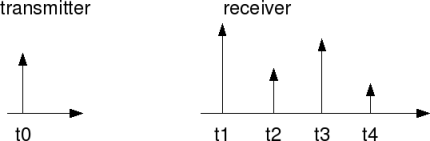
Figure: Impulse response of a multipath channel
Cyclic prefix
In the post on Cyclic Prefix in OFDM, we discussed the need for cyclic prefix and how it plays the role of a buffer region where delayed information from the previous symbols can get stored. Further, since addition of sinusoidal with a delayed version of the sinusoidal does not change the frequency of the sinusoidal (affects only the amplitude and phase), the orthogonality across subcarriers is not lost even in presence of multipath.
Since the defined cyclic prefix duration is 0.8us duration (16 samples at 20MHz), the Rayleigh channel is chosen to be of duration 0.5us (10 taps).
Expected Bit Error Rate
From the post on BER for BPSK in Rayleigh channel, the BER for BPSK in a Rayleigh fading channel is defined as
.
I recall reading that Fourier transform of a Gaussian random variable is still has a Gaussian distribution. So, I am expecting that the frequency response of a complex Gaussian random variable (a.k.a Rayleigh fading channel) will be still be independent complex Gaussian random variable over all the frequencies.
Note: I will update the post, once I am able to locate the proof for “frequency response of a complex Gaussian random variable is also complex Gaussian (and is independent with frequency)“.Given so, the bit error error probability which we have derived for BER for BPSK in Rayleigh channel holds good even in the case of OFDM.
Simulation model
Click here to download: Matlab/Octave script for BER simulation of BPSK in a 10-tap Rayleigh fading channel
The attached Matlab/Octave simulation script performs the following:
(a) Generation of random binary sequence
(b) BPSK modulation i.e bit 0 represented as -1 and bit 1 represented as +1
(c) Assigning to multiple OFDM symbols where data subcarriers from -26 to -1 and +1 to +26 are used, adding cyclic prefix,
(d) Convolving each OFDM symbol with a 10-tap Rayleigh fading channel. The fading on each symbol is independent. The frequency response of fading channel on each symbol is computed and stored.
(e) Concatenation of multiple symbols to form a long transmit sequence
(f) Adding White Gaussian Noise
(g) Grouping the received vector into multiple symbols, removing cyclic prefix
(h) Converting the time domain received symbol into frequency domain
(i) Dividing the received symbol with the known frequency response of the channel
(j) Taking the desired subcarriers
(k) Demodulation and conversion to bits
(l) Counting the number of bit errors
(m) Repeating for multiple values of Eb/No
The simulation results are as shown in the plot below.
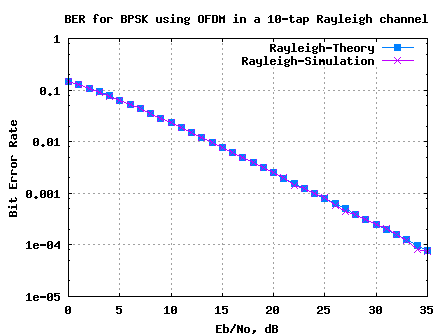
Figure: BER plot for BPSK with OFDM modulation in a 10-tap Rayleigh fading channel
Summary
1. The simulated BER results are in good agreement with the theoretical BER results.
2. Need to find the proof for frequency response of a complex Gaussian random variable is also complex Gaussian (and is independent with frequency).
Hope this helps. Happy learning.
Hello
when we simulate standard like IEEE802.11a what we mean for NCBPS(number of coded bit per symbol) and what is:
1- relation between the Number of data subcarier and NCBPS ?.
2- and the relation between code rate and NCBPS?
@bilo: Number of coded bits per symbol is the product of number of coded bits per subcarrier times the number of data subcarriers.
Code rate and Number data subcarriers are an independent choice.
Dear Mr.Krishna,
Im correcting.
*I mean, i have tried changing that part of code but theoretical plot and simulated plots are not similar.
@suvash: How much is the delta?
Mr.Krishna,
Im working on MIMO OFDM.
what will be the changes for ofdm on the matlab code without guard period insertion.
cylic_add_data = [IFFT_data(:,[49:64]) IFFT_data].’;
P/S conversion
ser_data = reshape(cylic_add_data,80*nsym,1);
and other respective codes.
waiting for your help.
Thanks
Suvash.
@suvash: Guess, changing the lines
cylic_add_data = [IFFT_data(:,[49:64]) IFFT_data].’;
to
cylic_add_data = [IFFT_data].’;
will suffice
could you please give me a derivation of ber of qam with ofdm modulation in both awgn and Rayleih channels. and if we use mimo system.
thank you very much.
@Yassir: The following post discuss the derivation of symbol error rate of 16-QAM in AWGN
https://dsplog.com/2007/12/09/symbol-error-rate-for-16-qam/
Dear Krishna
In the above code of yours, I did some modification by introducing a Convolutional encoder (K=7, Code_Gen [171,133]) and Viterbi decoder. I was expecting the BER to improve but that did not happen. Would you know why the BER din improve?
I have checked my code for Viterbi decoder and it works fine in AWGN channel with and without OFDM modulation. It also works well in Rayleigh Fading Channel without OFDM.
Looking forward to hear from you soon.
Ravinder
@Ravinder: OFDM modulation should not have changed the underlying BER vs Eb/N0 curve.
With the Viterbi decoder, are you getting curves similar to the ones in the following posts?
https://dsplog.com/2009/01/04/viterbi/
https://dsplog.com/2009/01/14/soft-viterbi/
As far as the “BER for BPSK in OFDM with Rayleigh Multipath Channel” is concerned, I think I have no doubt on it, since as the result shows BPSK using OFDM with Rayleigh Multipath channel has the same performance as the BPSK(Single carrier) with a Rayleigh flat channel thanks to the charactistic of OFDM using CP.
I just simply modify a little bit from BPSK in OFDM to QPSK in OFDM.There is a mismatch between theoretical and simulation results.
For the theoretical result of QPSK in Rayleigh fading channel, I use the command : BER_fading = berfading(EbN0dB,’psk’,4,1); I don’t understand why there is a gap between. I expect to have two coincided curves. Could you please explain it a little bit?
Thank you in advance
Best Regards
@Augusto: How much is the delta – is it due to the 3dB in the Es/N0 vs Eb/N0 of QPSK?
yes, it’s due to the 3dB gap from the BPSK. Now they coincide! Thanks a lot!Krishna
One more question, since we treat the rayleigh multipath channel model as a FIR filter, each tap is a flat fading rayleigh process. suppose nSym=1e4, len_ofdm=64+16=80. so the length of each tap is 80*1e4=8e5 which is a rayleigh process changing with time variable.cuz there are 8e5 symbols passing through the FIR filter,namely 8e5 time instance. When I wanna to get the hF, ht would be a metric with 8e5 x 64, consequently hF will 8e5 x 64. but when we do zero-forcing equalization, yF is 1e4 x 64 that is different from the size of hF, Can I interpret like this: I take one time instance as my hF of that ofdm frame (80 instances) to get a 1e4 x 64 metric? I try it, but the curve stay bad. what’s the reason inside? Thank you for the answer!
Best regards
@Augusto: I think the simulations assumed independent channel realization for each symbol.
Dear Krishna Sankar,
I’m really approciate for your code which gave me a great reference for my ofdm link. Thanks a lot in advance. I have several questions on the ofdm link over rayleigh multipath channel.
I am simulating a COST 207 bad urban channel with the channel info:
ChannelType: ‘Rayleigh’
InputSamplePeriod: 2.6001e-007
DopplerSpectrum: [1×1 doppler.jakes]
MaxDopplerShift: 16.6667
PathDelays: [0 4.0000e-007 1.0000e-006 1.6000e-006 5.0000e-006 6.6000e-006]
AvgPathGaindB: [-3 0 -3 -5 -2 -4]
NormalizePathGains: 1
StoreHistory: 1
StorePathGains: 0
PathGains: [1×6 double]
ChannelFilterDelay: 4
ResetBeforeFiltering: 0
NumSamplesProcessed: 0
I would like to know how to introduce the doppler power spectrum in the code? Since people use Clarke’s Fading model to specify one Rayleigh fading simulator for a flat fading channel, if it’s selective fading channel, there will be several fading simulators with different time delays and Gains. but how can we realize it by merely modifing your code a little bit somehow, since I see, you have developped a 10-tap channel with each gain of unity. If the gains of 6 taps should satisfy like:
AvgPathGaindB: [-3 0 -3 -5 -2 -4]
How could I do?
Moreover,
I see you build the 10 tapped delay channel like;
ht = 1/sqrt(2)*1/sqrt(nTap)*(randn(nSym,nTap) + j*randn(nSym,nTap));
I don’t understand what’s the ‘PathDelays’ of that?If I were not wrong, you have 10 taps, each one you have a time delay spacing equal to a symbol duration (Ts). Is that true? So it’s Ts; 2Ts; 3Ts; 4Ts; 5Ts…;10Ts;
if we have taps with non-uniform spaced tapped delay, the delays tau_k are not integer multiples of the simulation sampling time Ts, or some of the differential delays tau_k-tau_i may be equal to a small fraction of the simulation sampling time Ts. like the real bad urban channel. How can we build this kind of channel?
It’s really a interesting topic for me to know. I hope you can give me a hand. Indeed thank you very much
Augusto Zhao
please explain
% BPSK demodulation
% +ve value –> 1, -ve value –> -1
ipModHat = 2*floor(real(yMod/2)) + 1;
what if ipmodhat becomes 0 some wgere
@vinayak:That case will happen only if yMod is exactly 0. Even if it is slightly perturbed above/below zero, the result will be +1/-1 respectively
Hi Krishna,
If we need to replace Rayleigh channel with some other channel model. How should we do the convolution the channel with ofdm symbols.
Lets say: OFDM matrix [N M] %N rows columns, M columns
channel model =ones (1,X) %arbitrary channel model data in serial form
Now how can we convolve both of them
@Horis: What does the OFDM matrix contain, multiple symbols on each row – one can form a long vector of the OFDM symbols and convolve with the channel vector.
Dear Krishna Sankar
I am working on VLC(visible light communication)system would you like to help me which matlab simulation model is helpful to develop a basic VLC model if we want to use develop a basic VLC model then start working on it to develop any higher order modulation technique for indoor communication. if I want to built adaptive higher order modulation for near and far receiver in the room is these model we hav’nt any example of near channel and far channel response your advice willl be so helpfull for me reply on aghayasirali@hotmail.com
thanks
@Agha: I have not tried simulating visible light communication, but would expect that the underlying concepts to to be the same.
I want Matlab code for BER of OFDM MSK & DQPSK systems.. pls help me through asap..
@Prakash: I have not tried OFDM MSK. For DQPSK, check out
https://dsplog.com/2010/04/12/non-coherent-demodulation-of-pi4-dqpsk-tetra/
Dear Sir,
I have introduced convolutional coding in the above code but the result i am getting is a straight line for simulated BER.
The script is given below
% Script for computing the BER for BPSK in OFDM modulation in the
% presence of Rayeligh fading channel with convolutional coding
clc;
clear all;
close all;
nFFT = 64; % fft size
nDSC = 52; % number of data subcarriers
nBitPerSym = 52; % number of bits per OFDM symbol (same as the number of subcarriers for BPSK)
iBitPerSym = 26; % number of bits initially generated before coding rate 1/2
nSym = 10^2; % number of symbols
EbN0dB = [0:35]; % bit to noise ratio
EsN0dB = EbN0dB + 10*log10(nDSC/nFFT) + 10*log10(64/80); % converting to symbol to noise ratio
for ii = 1:length(EbN0dB)
% Transmitter
ipBit = rand(1,iBitPerSym*nSym) > 0.5; % random 1’s and 0’s
% convolutional coding
constlen =7;
codegen = [133 171];
trellis = poly2trellis(constlen,codegen);
coded = convenc(ipBit,trellis);
% BPSK modulation 0 –> -1, 1 –> +1
ipMod = 2*coded-1;
ipMod = reshape(ipMod,nBitPerSym,nSym).’; % grouping into multiple symbols
% Assigning modulated symbols to subcarriers from [-26 to -1, +1 to +26]
xF = [zeros(nSym,6) ipMod(:,[1:nBitPerSym/2]) zeros(nSym,1) ipMod(:,[nBitPerSym/2+1:nBitPerSym]) zeros(nSym,5)] ;
% Taking FFT, the term (nFFT/sqrt(nDSC)) is for normalizing the power of transmit symbol to 1
xt = (nFFT/sqrt(nDSC))*ifft(fftshift(xF.’)).’;
% Appending cylic prefix
xt = [xt(:,[49:64]) xt];
% multipath channel
nTap = 10;
ht = 1/sqrt(2)*1/sqrt(nTap)*(randn(nSym,nTap) + j*randn(nSym,nTap));
% computing and storing the frequency response of the channel, for use at recevier
hF = fftshift(fft(ht,64,2));
% convolution of each symbol with the random channel
for jj = 1:nSym
xht(jj,:) = conv(ht(jj,:),xt(jj,:));
end
xt = xht;
% Concatenating multiple symbols to form a long vector
xt = reshape(xt.’,1,nSym*(80+nTap-1));
% Gaussian noise of unit variance, 0 mean
nt = 1/sqrt(2)*[randn(1,nSym*(80+nTap-1)) + j*randn(1,nSym*(80+nTap-1))];
% Adding noise, the term sqrt(80/64) is to account for the wasted energy due to cyclic prefix
yt = sqrt(80/64)*xt + 10^(-EsN0dB(ii)/20)*nt;
% Receiver
yt = reshape(yt.’,80+nTap-1,nSym).’; % formatting the received vector into symbols
yt = yt(:,[17:80]); % removing cyclic prefix
% converting to frequency domain
yF = (sqrt(nDSC)/nFFT)*fftshift(fft(yt.’)).’;
% equalization by the known channel frequency response
yF = yF./hF;
% extracting the required data subcarriers
yMod = yF(:,[6+[1:nBitPerSym/2] 7+[nBitPerSym/2+1:nBitPerSym] ]);
% BPSK demodulation
% +ve value –> 1, -ve value –> -1
ipModHat = 2*floor(real(yMod/2)) + 1;
ipModHat(find(ipModHat>1)) = +1;
ipModHat(find(ipModHat<-1)) = -1;
% converting modulated values into bits
ipBitHat = (ipModHat+1)/2;
ipBitHat = reshape(ipBitHat.',nBitPerSym*nSym,1).';
% Decoding
decoded = vitdec(ipBitHat,trellis,5,'trunc','unquant');
% counting the errors
nErr(ii) = size(find(decoded – ipBit),2);
end
simBer = nErr/(nSym*iBitPerSym);
EbN0Lin = 10.^(EbN0dB/10);
theoryBer = 0.5.*(1-sqrt(EbN0Lin./(EbN0Lin+1)));
close all; figure
semilogy(EbN0dB,theoryBer,'bs-','LineWidth',2);
hold on
semilogy(EbN0dB,simBer,'mx-','LineWidth',2);
axis([0 35 10^-5 1])
grid on
legend('Rayleigh-Theory', 'Rayleigh-Simulation');
xlabel('Eb/No, dB')
ylabel('Bit Error Rate')
title('BER for BPSK using OFDM in a 10-tap Rayleigh channel')
Kindly help me for this.
Vineet
@Vineet: Are you getting zero BER with zero noise?
Could you solve the problem Vineet?
plz do explain mimo ofdm mat lab simulation program for inverse fast fourier transform.
Dear Kirishna, please help me withOFDM amplify and forward in relay schem mathlab codes mine is there but not ok.
%////////////////////////////////////////////////////
% MIMO OFDM BPSK MMSE/ZF Function Multipath – Simplificado
%////////////////////////////////////////////////////
clear,clc
%===================================================
% OFDM Parameters Settings
%===================================================
antennas=1; % Antenas
bit=2048;%4;%2048; % Bit
symbol=bit; % Symbol
carrier=64;%2;%64; % Channels
gil=16;%2;%16; % Guard Interval
delay=1; % Delay
path=16; % Number of Paths
dur=0; % dB Rate
min_err=2000; % Minimum error
min_pckt = 800; % Minimum Packet
sym=symbol/carrier*(carrier+gil);
error=0;
skip=2.5;
%———————–SN Loop———————
for sn=0:skip:30;
%===================================================
% AWGN Setting
%===================================================
snr=10^(sn/10);
sd=sqrt(antennas*0.5/(snr*1*(carrier/(carrier+gil))));
error=0;
pckt=0;
snrtheorical1=(erfc(sqrt(snr)))/2; %BPSK AWGN Theoretical BER
snrtheorical2=0.5.*(1-sqrt(snr/(snr+1)))/(carrier/(carrier+gil)); %BPSK AWGN Multipath Theoretical BER
%—————————-
% packet loop
%—————————-
while(error<=min_err && pckt=0)
% recSD(ch,sk)=1;
% else
% recSD(ch,sk)=-1;
% end
% sk=sk+1;
% end
% end
%************************************************
%************************************************ %************************************************ %************************************************ %************************************************
%************************************************
%%************************************************
%%%************************************************
%%************************************************
%%%************************************************
%%%%************************************************
% Source-Relay LINK
%===================================================
% Multipath Settings
%===================================================
for ch=1:antennas*antennas
gsum(ch)=0;
for k=1:path
pr(ch,k) = (1.0)*sqrt(-log(rand));
prc(ch,k)=pr(ch,k)*exp((2*pi*rand*j));
ga(ch,k)=10^(-dur*(k-1)/20.0);
gsum(ch) = gsum(ch) + abs(ga(ch,k))^2;
end
for k=1:path
ga(ch,k) = ga(ch,k)/sqrt(gsum(ch))*prc(ch,k);
end
end
%===================================================
% Channel Loop
%===================================================
r1=1/sqrt(2);
fsle=0;
for ch=1:antennas*antennas
eqa(ch,1:carrier) = 1;
eqaT=ifft(eqa(ch,:),carrier);
eqaf=eqaT(1);
for k=1:path
eqaT((k-1)*delay+1) = ga(ch,k) * eqaf;
end
eqaF(ch,1:carrier)=fft(eqaT,carrier);
end
hsr=eqaF;
%===================================================
% ZF, MMSE Settings
%===================================================
H1=zeros(antennas,antennas);
sig=1e-6;
for k=1:carrier
for l=1:antennas
H1(l,1:antennas)=eqaF(1+antennas*(l-1):antennas+antennas*(l-1),k);
end
H1T=H1′;
%ZF criteria
%G1=H1T/(H1*H1T+eye(antennas)*sig);
%MMSE criteria
G1=H1T/(H1*H1T+antennas*sd^2*eye(antennas));
for l=1:antennas
for m=1:antennas
G(antennas*(l-1)+m,k)=G1(l,m);
end
end
end
%—————————-
% Transmitter
%—————————-
%*************************
% IFFT – Guard interval
%*************************
% for ch=1:antennas
% for k=1:symbol/carrier
%
% fftmp=map(ch,(k-1)*carrier+1:(k-1)*carrier+carrier);
%
% fftmpT=ifft(fftmp,carrier)*sqrt(carrier);
%
% ggi=fftmpT(:,carrier-gil+1:carrier);
%
% mc=[ggi,fftmpT];
%
% map2(ch,1+(k-1)*(carrier+gil):carrier+gil+(k-1)*(carrier+gil))= mc;
% end
% end
%**************************
%—————————–
%—————————-
% Channel
%—————————-
%**************************
% Multipath
%**************************
smp=zeros(antennas,sym);
for k=1:path
for m=1:antennas
HH(m,1:antennas)=ga(1+antennas*(m-1):antennas+antennas*(m-1),k);
end
for l=1: sym-(k-1)*delay
smp(1:antennas,(k-1)*delay+l)=smp(1:antennas,(k-1)*delay+l)+HH*map2(:,l);
end
end
%***************************
%**************************
% AWGN
%**************************
for ch=1:antennas
for k=1:sym
smp(ch,k)=smp(ch,k)+sd*(randn+j*randn);
end
end
recSR=smp;
%***************************
%—————————–
%——————————
% Receiver
%——————————
%*************************
% FFT – Guard interval
%*************************
%for ch=1:antennas
%for k=1:symbol/carrier
% fftmp=smp(ch,(k-1)*(carrier+gil)+(gil+1):(k-1)*(carrier+gil)+carrier+gil);
% fftmpF=fft(fftmp,carrier)/(sqrt(carrier));
%map3(ch,1+(k-1)*(carrier):k*(carrier))=fftmpF;
%end
%end
%***************************
%*************************
% FDE
%*************************
%map6=zeros(antennas,symbol);
%for k=1:symbol/carrier
% for l=1:carrier
% for m=1:antennas
% GG(m,1:antennas)=G(1+antennas*(m-1):antennas+antennas*(m-1),l);
%end
% map6(1:antennas,(k-1)*carrier+l)=GG*map3(:,(k-1)*carrier+l);
%end
%end
%***************************
%*************************
% BPSK demodulation
%*************************
% for ch=1:antennas
% sk=1;
% for k=1:bit
% if(real(map6(ch,k))>=0)
% recSR(ch,sk)=1;
% else
% recSR(ch,sk)=-1;
% end
% sk=sk+1;
% end
% end
%************************************************
%************************************************
%%************************************************
%%%************************************************
%%%%************************************************
%%%%%************************************************
%%%%%%************************************************
%%%%%%%************************************************
%%%%%%%%************************************************
% Relay-Destination LINK
%===================================================
% Multipath Settings
%===================================================
for ch=1:antennas*antennas
gsum(ch)=0;
for k=1:path
pr(ch,k) = (1.0)*sqrt(-log(rand));
prc(ch,k)=pr(ch,k)*exp((2*pi*rand*j));
ga(ch,k)=10^(-dur*(k-1)/20.0);
gsum(ch) = gsum(ch) + abs(ga(ch,k))^2;
end
for k=1:path
ga(ch,k) = ga(ch,k)/sqrt(gsum(ch))*prc(ch,k);
end
end
%===================================================
% Channel Loop
%===================================================
r1=1/sqrt(2);
fsle=0;
for ch=1:antennas*antennas
eqa(ch,1:carrier) = 1;
eqaT=ifft(eqa(ch,:),carrier);
eqaf=eqaT(1);
for k=1:path
eqaT((k-1)*delay+1) = ga(ch,k) * eqaf;
end
eqaF(ch,1:carrier)=fft(eqaT,carrier);
end
hrd=eqaF;
%===================================================
% ZF, MMSE Settings
%===================================================
H1=zeros(antennas,antennas);
sig=1e-6;
for k=1:carrier
for l=1:antennas
H1(l,1:antennas)=eqaF(1+antennas*(l-1):antennas+antennas*(l-1),k);
end
H1T=H1′;
%ZF criteria
%G1=H1T/(H1*H1T+eye(antennas)*sig);
%MMSE criteria
G1=H1T/(H1*H1T+antennas*sd^2*eye(antennas));
for l=1:antennas
for m=1:antennas
G(antennas*(l-1)+m,k)=G1(l,m);
end
end
end
%—————————-
% Transmitter
%—————————-
map=recSR;
for ch=1:antennas*antennas
beta(ch) = sqrt(1./sum((abs(hsr(ch,1:subcarrier)).^2) +N0));
map2(ch)=beta(ch)*map(ch);
end
%*************************
%*************************
% IFFT – Guard interval
%*************************
%for ch=1:antennas
%for k=1:symbol/carrier
% fftmp=map(ch,(k-1)*carrier+1:(k-1)*carrier+carrier);
% fftmpT=ifft(fftmp,carrier)*sqrt(carrier);
% ggi=fftmpT(:,carrier-gil+1:carrier);
% mc=[ggi,fftmpT];
% map2(ch,1+(k-1)*(carrier+gil):carrier+gil+(k-1)*(carrier+gil))= mc;
%end
%end
%**************************
%—————————–
%—————————-
% Channel
%—————————-
%**************************
% Multipath
%**************************
smp=zeros(antennas,sym);
for k=1:path
for m=1:antennas
HH(m,1:antennas)=ga(1+antennas*(m-1):antennas+antennas*(m-1),k);
end
for l=1: sym-(k-1)*delay
smp(1:antennas,(k-1)*delay+l)=smp(1:antennas,(k-1)*delay+l)+HH*map2(:,l);
end
end
%***************************
%**************************
% AWGN
%**************************
for ch=1:antennas
for k=1:sym
smp(ch,k)=smp(ch,k)+sd*(randn+j*randn);
end
end
%***************************
%—————————–
%——————————
% Receiver
%——————————
%*************************
% FFT – Guard interval
%*************************
for ch=1:antennas
for k=1:symbol/carrier
fftmp=smp(ch,(k-1)*(carrier+gil)+(gil+1):(k-1)*(carrier+gil)+carrier+gil);
fftmpF=fft(fftmp,carrier)/(sqrt(carrier));
map3(ch,1+(k-1)*(carrier):k*(carrier))=fftmpF;
end
end
%***************************
%*************************
% FDE
%*************************
map6=zeros(antennas,symbol);
for k=1:symbol/carrier
for l=1:carrier
for m=1:antennas
GG(m,1:antennas)=G(1+antennas*(m-1):antennas+antennas*(m-1),l);
end
map6(1:antennas,(k-1)*carrier+l)=GG*map3(:,(k-1)*carrier+l);
end
end
recRD=map6;
combRD=recSD+recRD;
%***************************
%*************************
% BPSK demodulation
%*************************
% for ch=1:antennas
% sk=1;
% for k=1:bit
% if(real(map6(ch,k))>=0)
% recRD(ch,sk)=1;
% else
% recRD(ch,sk)=-1;
% end
% sk=sk+1;
% end
% end
%************************************************
%************************************************
%%************************************************
%%%************************************************
%%%%************************************************
%%%%%************************************************
%%%%%%************************************************
%%%%%%%************************************************
%%%%%%%%************************************************
%*************************
% Combining demodulation
%*************************
for ch=1:antennas
sk=1;
for k=1:bit
if(real(combRD(ch,k)+combSD(ch,k))>=0)
final(ch,sk)=1;
else
final(ch,sk)=-1;
end
sk=sk+1;
end
end
%************************************************
%=====================================================================
% ERROR COUNT
%=====================================================================
for ch=1:antennas
for k=1:bit
if(final(ch,k)~=tx(ch,k))
error=error+1;
end
end
end
end
%—————————–End packet loop
%=====================================================================
% BER
%=====================================================================
BER(sn/skip+1,1)=error/(antennas*bit*pckt);
sn,BER
%error,pckt
sn1(sn/skip+1)=sn;
sn2(sn/skip+1)=snrtheorical2;
if(BER(sn/skip+1,1)<=1.e-6)
break;
end
end
%=====================================================================
% Graphic
%=====================================================================
semilogy(sn1,BER,'*b-',sn1,sn2,'r-'); title('OFDM BPSK Multipath'); xlabel('Eb/N0 (dB)'); ylabel('BER'); grid;
AXIS([0 30 1e-6 1]);legend('Simulated Result','Theoretical Result',1);
%
%
@Fayeqa: Sorry, was unable to look deep into the code.
can u pls tel me the equation for taps representation in ofdm…
is dis d correct eqn
h=(1/sqrt(2^taps))*(randn+i*randn)???
or
h=(1/sqrt(2*taps))*(randn+i*randn)???
@vasanth: What was your intent – to normalize the variance to unity?
Hi,
Why OFDM RAYLEIGH is equal to the BPSK RAYLEIGH , should not it be better?
please help me
Thanks
@MIKA: The BPSK in Rayleigh simulation does not have multipath. And in OFDM case though it has multipath, as long as it’s contained within cyclic prefix, there is no performance impact
Hello,
I am implementing the same example by in frequency… it would be:
y = H.*x +n;
where H is the frequency response, x is the ofdm symbol after of the ifft and n the noise.
I multiply H1*x1, H2*x2….Hp*xp… because I consider p transmissions narrow band…
Is it well?
@mimo: Looks fine.
Hello,
I’m interested in MIMO-OFDM but working in frequency domain and not work with convolution, can you help me??
thank you.
@mimo: Not sure I fully understand your query. Both time and frequency domain are correlated.
so following this article a have 2 questions?
1. “OFDM system in a multipath environment is similar to its performance in an AWGN channel” why in our case is different??
2. “However, the performance of a single carrier transmission will degrade rapidly in the presence of multipath.” Its true comparing BER for AWGN and Ray channel for BPSK but why the same happen with ofdm signal??? I thought that one of the main benefit of OFDM is correctness of the first statement????
@Libre:
1. OFDM performance with multipath is comparable to flat fading Rayleigh channel performance
2. See above
dear krishna
pls help me out!!!
i habe to do my project on evaluation of ber of ofdm using bpsk,qpsk & dqpsk.Kindly send the coding or the same.
@charu: You may find code for
a) BPSK in AWGN : https://dsplog.com/2007/08/05/bit-error-probability-for-bpsk-modulation/
b) BPSK with OFDM in AWGN : https://dsplog.com/2008/06/10/ofdm-bpsk-bit-error/
c) QPSK in AWGN : https://dsplog.com/2007/11/06/symbol-error-rate-for-4-qam/
d) DBPSK in AWGN : https://dsplog.com/2007/09/30/coherent-demodulation-of-dbpsk/
Hope this helps
As i already posted you some doubt regarding the convolutional code in the ofdm rayleigh fading channel .I guess you didnt receive the post .So this time i am sending the code .
%%%%%%%%%%%%%%%%%%%%%%%%%%%%%%%%
close all;
clear all;
clc;
nFFT = 64; % fft size
nDSC = 64; % number of data subcarriers
nBitPerSym = 64; % number of bits per OFDM symbol (same as the number of subcarriers for BPSK)
nSym = 10^4; % number of symbols
EbN0dB = 0:2:20; % bit to noise ratio
EsN0dB = EbN0dB + 10*log10(nDSC/nFFT) + 10*log10(64/80); % converting to symbol to noise ratio
EsN0dBc = EbN0dB + 10*log10(nDSC/nFFT) + 10*log10((64)/(2*80)); % converting to symbol to noise ratio
for ii = 1:length(EbN0dB)
%% Transmitter
ipBit = randint(1,nBitPerSym*nSym); % random 1’s and 0’s
trellis=poly2trellis(7,[133 171]);
ipc=convenc(ipBit,trellis,[1 1]);
% ipc=ConvEncoder(ipBit,1/2);
ipMod = 2*ipBit-1; % BPSK modulation 0 –> -1, 1 –> +1
ipModc=2*ipc-1;
ipMod = reshape(ipMod,nBitPerSym,nSym).’; % grouping into multiple symbolsa
ipModc= reshape(ipModc,2*nBitPerSym,nSym).’;
%% Assigning modulated symbols to subcarriers from [-26 to -1, +1 to +26]
xF =ipMod;
xFc =ipModc;
%% Taking FFT, the term (nFFT/sqrt(nDSC)) is for normalizing the power of transmit symbol to 1
xt = (nFFT/sqrt(nDSC))*ifft(fftshift(xF.’)).’;
xtc = (2*nFFT/sqrt(2*nDSC))*ifft(fftshift(xFc.’)).’;
%% Appending cylic prefix
xt = [xt(:,[49:64]) xt];
xtc = [xtc(:,[97:128]) xtc];
%% multipath channel
nTap = 1;
ht = 1/sqrt(2)*1/sqrt(nTap)*(randn(nSym,nTap) + j*randn(nSym,nTap));
%% computing and storing the frequency response of the channel, for use at recevier
hF = fftshift(fft(ht,64,2));
hFc = fftshift(fft(ht,64*2,2));
%% convolution of each symbol with the random channel
for jj = 1:nSym
xht(jj,:) = conv(ht(jj,:),xt(jj,:));
xhtc(jj,:) = conv(ht(jj,:),xtc(jj,:));
end
xt = xht;
xtc = xhtc;
%% Concatenating multiple symbols to form a long vector
xt = reshape(xt.’,1,nSym*(80+nTap-1));
xtc = reshape(xtc.’,1,nSym*(2*80+nTap-1));
%% Gaussian noise of unit variance, 0 mean
nt = 1/sqrt(2)*[randn(1,nSym*(80+nTap-1)) + j*randn(1,nSym*(80+nTap-1))];
ntc = 1/sqrt(2)*[randn(1,nSym*(2*80+nTap-1)) + j*randn(1,nSym*(2*80+nTap-1))];
%% Adding noise, the term sqrt(80/64) is to account for the wasted energy due to cyclic prefix
yt = sqrt(80/64)*xt + 10^(-EsN0dB(ii)/20)*nt;
ytc = sqrt(2*80/128)*xtc + 10^(-EsN0dBc(ii)/20)*ntc;
%% Receiver
yt = reshape(yt.’,80+nTap-1,nSym).’; % formatting the received vector into symbols
ytc = reshape(ytc.’,2*80+nTap-1,nSym).’;
yt = yt(:,[17:80]); % removing cyclic prefix
ytc = ytc(:,[33:160]);
%% converting to frequency domain
yF = (sqrt(nDSC)/nFFT)*fftshift(fft(yt.’)).’;
yFc = (sqrt(2*nDSC)/(2*nFFT))*fftshift(fft(ytc.’)).’;
%% equalization by the known channel frequency response
yF = yF./hF;
yFc = yFc./hFc;
%% extracting the required data subcarriers
%yMod = yF(:,[6+[1:nBitPerSym/2] 7+[nBitPerSym/2+1:nBitPerSym] ]);
yMod = yF;
yModc = yFc;
%% BPSK demodulation
% +ve value –> 1, -ve value –> -1
ipModHat = sign(real(yMod/2));
ipModcHat =sign(real(yModc/2)) ;
%% converting modulated values into bits
ipBitHat = (ipModHat+1)/2;
ipBitHat = reshape(ipBitHat.’,nBitPerSym*nSym,1).’;
ipBitcHat = (ipModcHat+1)/2;
ipBitcHat = reshape(ipBitcHat.’,2*nBitPerSym*nSym,1).’;
% ipbc= ConvDecoder(ipBitcHat,1/2);
ipbc=vitdec(ipBitcHat,trellis,436,’trunc’,’hard’,[1 1]);
%% counting the errors
nErr(ii) = size(find(ipBitHat – ipBit),2);
nErrc(ii) = size(find(ipbc – ipBit),2);
end
simBer = nErr/(nSym*nBitPerSym);
simBerc = nErrc/(nSym*nBitPerSym);
close all; figure
semilogy(EbN0dB,simBer,’bs-‘,’LineWidth’,2);
hold on
semilogy(EbN0dB,simBerc,’ro-‘,’LineWidth’,2);
axis([0 20 10^-5 1])
grid on
legend(‘Ofdm’, ‘ofdm-coded’);
xlabel(‘Eb/No, dB’)
ylabel(‘Bit Error Rate’)
title(‘BER for BPSK using OFDM in Rayleigh channel’)
%%%%%%%%%%%%%%%%%%%%%%
In this code i am implementing convolutional code parallely with normal ofdm (which is just the simple modified version of your code ) and i am not getting the coding gain in if i am plotting it . Please help me
@Manoj Kumar: Have you factored the coding ratio, when you computed the Eb/N0?
Hello Krishna,
Thanks for responding ,i didn’t what do you mean by factoring the coding ratio while computing Eb/No.But what i mean by coding gain is that to have a shift of the original ofdm BER vs SNR curve towards left(but for me the coded curve moves to the right ) when convolution code is used.I am using convolution code with code rate 1/2,that means after the convolutional encoding there will be twice the number of bits when compared with the source i.e., 10000*128 and i have took the Symbol to noise ratio as
“EsN0dBc = EbN0dB + 10*log10(nDSC/nFFT) + 10*log10((64)/(160)); “,it is 160 in the expression because of 128 bits and the cyclic prefix 32.Is it that what you mean by factoring of coding ratio while computing Eb/No?.If no could you please what is it actually.
One more thing could you please explain me channel equalization in MIMO case for some example diversity schemes like cyclic delay diversity or Phase delay diversity Once again thanks for responding.
Hello krishna,
I have got the coding gain for ofdm with convolutional coding ,but now i have the problem with channel equalisation in MIMO-OFDM case with cyclic delay diversity scheme .Please enlighten me regarding the channel equalisation in MIMO-OFDM case in cyclic delay diversity scheme.
@Manoj Kumar:
a) Oh, good.
b) Typically, the cyclic delay diversity (CDD) is seen as a multipath like effect in the receiver. The phase/amplitude distortions due to CDD get captured in channel estimation too.
@manoj
how did u corrected your code ? i am also working on convolutional coding using ofdm….please help….
@Manoj Kumar: With coding rate 1/2, since 2 coded bits carry one bit of information
Ec_N0_dB = Eb_N0_dB – 10*log10(2);
how to factorize the coding ratio, sir ? . i m working on the above scenario. how to correct above code
@Manish Kumar: Factorize the coding ratio?
Hi, Krishna Sankar.
This is definitely wonderful post, but there are two questions confused me.
Q1, when you take FFT to channel to calculate the channel frequency response, why you did not take transpose to ht? Each of row of ht represent the channel impulse of each OFDM symbol, and FFT is operated to each column of matrix by matlab.
Q2, Is Rayleigh-theory equation for single tap Rayleigh channel or multiple Rayleigh channel? or vaild for both of them?
Waiting for your reply. Thank you.
@Xudong Wu: Thanks, my replies
1/ In the post, am assuming random Rayliegh faded multipath taps for each symbol and to compensate it, the channel frequency response is found for each symbol.
2/ Single tap is the special case of multipath case.
Hope this helps.
Dear Krishna,
Thank you for your enthusiastic reply, but my first question is still there.
In your source code, you generated a nSym(10^4)-by-nTap(10) matrxi to represent 10-Tap Rayleigh Channel.
% nTap = 10;
% ht = 1/sqrt(2)*1/sqrt(nTap)*(randn(nSym,nTap) + j*randn(nSym,nTap));
From your source code, I can see that each row of ht represent a channel impulse response of each OFDM symbol, in this case, you totally generate 10^4 test OFDM symbol.
And then, you take FFT directly in order to calculate the channel frequency response, and at the receiver, you divide yF by hF in order to realise equation.
% hF = fftshift(fft(ht,64,2));
% converting to frequency domain
% yF = (sqrt(nDSC)/nFFT)*fftshift(fft(yt.’)).’;
% equalization by the known channel frequency response
% yF = yF./hF;
Obviously, in your yF, each row of yF still represent each OFDM symbol.
However, I notice that For matrices, the FFT operation is applied to each column. So, I think that if you want to calculate the channel, the source code
should be
% hF=fftshift(fft(ht.’,64,2)).’ and this make each row of hF corresponse to each OFDM symbol in yF.
So, what is your opinion? and what is more, could you kindly explain me why you use another parameter 2 in your FFT command?
Finally, may I have your E-mail address? Because I found that your posts are quite useful for me, and if I have any question regarding to digital signal processing, I can turn to you. 🙂
Thank you.
@Xudong Wu: The parameter 2 in fft is to do fft in the row dimension i.e take fft for each row in the nSym x nTap matrix. Operation fftshift(fft(ht.’,64)).’ will do the same thing.
You may continue to post queries in the comments section as it will help a wider audience.
Oh, finally, I got it. So, thank you for your answer and your post.
% Receiver
yt = reshape(yt.’,80+nTap-1,nSym).’; % formatting the received vector into symbols
yt = yt(:,[17:80]); % removing cyclic prefix
can u explain yt = yt(:,[17:80]);. if u want remove CP, u should remove data 1:16 and why u remove data 81:89????
so i think the correct code is yt(:,[17:89]);
@Key Ei: Recall, the vector is of length 80 samples, whose indices can be visualized as [1 … 16, 17… 80]. Hence taking [17:80]. How did you get [17:89]?
Hi Krishna,
This post is for 802.11. I could not find any thing about LTE. viz 5 mhz, qpsk, rayleigh with turbo coding. in forward direction.
@sarkar: This post for the general OFDM case… with some minor resemblance to 802.11
hi krishna
i want to know how to apply sub-carrier spacing(HZ) in ofdm systems.
if have any code please insert your site.
best regards
@mohamadali: Well, subcarrier spacing is controlled by the sampling clock and the number of points in the FFT. For examples, if the sampling clock is 20MHz and the FFT size is 64, the subcarrier spacing is 20MHz/64 = 312.5kHz.
hi sir,
plz can u give me matlab code for generating stream cipher system
thanks,
@abady: Sorry, I do not have any posts discussing stream cipher systems
Dear Krishna
I have a question about OFDM with Nyquist pulse shaping.
When we employment a Nyquist pulse shaping at the transmitter, we cyclically extend the OFDM symbol interval by alpha*T (from T to (1+alpha)T ), then we multiply the extended OFDM symbol by the Nyquist pulse shape with roll-off factor alpha, and transmit it over the channel.
How we can get N samples (at the receiver side) as input to FFT from (1+alpha)T interval?
note: The T interval has N samples (the output of IFFT in the transmitter)
Thanks in advance
@Sami: Well, the cyclic extension (also known as cyclic prefix insertion) is independent of pulse shaping. At the receiver, we can ignore the samples corresponding to the cyclic prefix.
Please see the post https://dsplog.com/2008/02/17/cylcic-prefix-in-orthogonal-frequency-division-multiplexing/ for a brief intro into cyclic prefix and its use in OFDM
Sorry I have a stupid my question, because i’m newbie
In frequency selective fading, each of subcarrier or each of OFDM symbol experience flat fading??. And how about Single Carrier in frequency selective fading. it’s each symbols (ex.BPSK) experience Frequency selective fading??? Please Help Me
Regards
@Newbie: Yes, in OFDM each subcarrier typically experience flat fading.
In single carrier, each symbol experience the effect of multipath (inter symbol interference) caused by frequency selective fading
Hi, Mr Krishna,
I am doing a matlab simulation about BER for BPSK in OFDM with Rayleigh multipath channel which is same to you.^^
However, the way I used is very different from yours. ( Am I wrong?) In additon, I have quite a lot of questions about your Matlab codes. Hope you can help me. I am really confused now.
i. I use cosine as the subcarriers, i.e., cos(2*pi*f*t), while I cannot see any sinusoidal in your codes.
ii. Due to the project process, I am now modeling the simulation without FFT and IFFT. The stream is as follows:
%%%%%%%%%%%%START%%%%%%%%%%%%%%%
clear;
T=200;
Tg=T/4; %period of cyclic prefix
f=1/T; %carrier freq.
s=cos(2*pi*f*(1:1:T)’); %carrier
snr_db=0:1:12;
P_error=[];
N=10; %no. of bit generated per loop
N1=1000;
for i=1:length(snr_db)
error=0;
for ii=1:N1;
a=round(rand(N,1));
y=[];
for k=1:N
y=[y;(2*a(k)-1)*s]; % BPSK modulation 0 -> -1; 1 -> 0
end;
%addition of cyclic prefix
zcyc=[];
for u=1:N
zcyc=[zcyc;y((u*T-Tg+1):(u*T))];
zcyc=[zcyc;y(((u-1)*T+1):(u*T))];
end;
h=sqrt(1/2)*(randn(1,N)+j*randn(1,N));
c=conv(h,zcyc);
sgma=1/sqrt(2*(10^(snr_db(i)/10)));
z=c+12*sgma*randn(length(c),1);
%removal of cyclic prefix
for m=1:N
z(((m-1)*(T+Tg)+1):((m-1)*(T+Tg)+Tg))=0;
end;
zre=[];
for w=1:size(z,1)
if z(w)==0
continue;
else
zre=[zre;z(w)];
end
end
zRe=real(zre);
outcome=[];
z0=[];
%correlation
for n=1:N
z0=zRe(((n-1)*T+1):(n*T));
outcome=[outcome;s’*z0/(sqrt(s’*s)*sqrt(z0’*z0))];
if outcome(n)>=0
outcome(n)=1;
end;
if outcome(n)<0
outcome(n)=0;
end;
if outcome(n)~=a(n)
error=error+1;
end;
end;
a=[];
end;
P_error=[P_error;(error/(N*N1))];
end;
semilogy(snr_db,P_error);
%%%%%%%%%%%%END%%%%%%%%%%%%%%%
I cannot generate the correct BER graph using the above simulation. What mistakes do I make? Thanks a lot!
@kyle: My replies
1/ Am using complex sinusoidal – which has both cosine and sine term.
2/ Due to time constraints, I did not look too deeply into the code. For debug, you can try to make the simulation up with one subcarrier case.
Hi, Mr Krishna,
Can you do a matlab simulation about BER for QAM in OFDM system? What I mean is that can you do this in time domain? Thanks.
Cheers,
Kyle
@kyle:
a) Ofcourse, QAM in OFDM system is possible. All most all wireless standards use that.
b) The demod is done after taking the FFT of the received time domain samples.
Hi Krishna,
I ran your script ” BER simulation of BPSK in OFDM with Rayleigh fading channel” . I observed that even when i set the number of taps(nTap parameter in the script) to 1, it results in the same curve.Should we not see a improvement in the BER as the channel is changed from a 10-tap multipath fading channel to 1-tap flat fading channel? Please provide your comments on this observation.
Thanks
Ishwinder
@Ishwinder: If you observe the code carefully, you can see that am normalizing the channel power to unity. So, as long as there is no inter symbol interference, the BER performance should hold good.
Dear Mr.Krishna
plz i need to calculate BER in QPSK -OFDM With multi path rayleigh fading
can you help me
and if you want how can use PN sequence in QPSK
thanks alot
@Rayed: What is the help which you are looking for? I have discussed about symbol error rate for QPSK at https://dsplog.com/2007/11/06/symbol-error-rate-for-4-qam/
hello mr. krishna,
i would ask you a question regarding the rayleigh channel. how can i generate Rayleigh channel impulse response as ready numbers to be used in a program without using the rand()+j*randn() commands. in other words, i don’t want to have a loop or large number of symbols to get the plot of the prob. of error. I want to have a table of values for channel impulse response to be used for simulating a MIMO system. some papers do list down in a table the channel as complex values between each transmit and receive antenna to get a MIMO channel matrix, how did they get such values? this is exactly my question
@samalqudah: Common sense backed up data collection from the lab?
Dear Krishna
Thanks for assistance. I was just looking the your code. The following line of code:
xt = (nFFT/sqrt(nDSC))*ifft(fftshift(xF.’)).’;
I understand the multiplication of nFFT to cancel the inherent 1/nFFT in the ifft() function. But why is division by sqrt(nDSC) – is this sqrt() to normalize expected transmit power to 1?
Kind Regards
A Mehboob
@A Mehboob: Yes.
im new in matlab.
Hello Krishna, thanks for ur nice work on OFDM.
i want to design an OFDM simulator using matlab GUI so that we can easily to find out the BER vs SNR when i change any parameter on the modulation..
can u give me some idea which part i need to change mybe on the sampling freq or mybe on the no of sample..
and lastly from ur code which part i must to do so…please teach me…-shah-
@shah: Well, the concept of sampling is notional in Matlab
Hallo,
your code had helped me a lot. Thank you very much.
Please can you help me if the channel became Nakagami-m multipath fading channel.
I do not know how to simulate Nakagami-m channel, please help me
@Ahmwd: Sorry, I have not tried Nakagami models
Idon’t try to simulte cfo for mimo system only but for mimo ofdm I propose a new scheme that targets MMIO OFDM systems which have unsynchronized oscillators such that CFO of individual paths have to be estimated separately. This scheme may also apply to OFDM systems with multi-user access. The new method, which is similar to Moose’s method, estimates the CFO by measuring the carrier phase difference between 2 identical successive training sequences embedded in the preambles. In order to make CFO estimates be more time efficient,I allow 2 transmitter antennas transmit their training sequence concurrently in every time period, except the first and the last period. I use Frank-Zadoff code with different phase shifts in the training sequences in different antennas. Due to the good correlation property of Frank-Zadoff code, it helps reduce the interference caused by the concurrent transmissions from other antennas.
please helpppppppppppppppppppppppp
please reply me it’s urgent Ineed the code it’s really important and thanks alot
@eng_dina: Good luck with you are algorithm investigation. Hope you have made the simulations and obtained satisfactory results.
sir,
how i will generate allocation of adaptive subcarrier for users in ofdma in matlab.
@surjeet: There is no one perfect approach, it depends on the channel and the error correction capabilities.
Idon’t try to simulte cfo for mimo system only but for mimo ofdm I propose a new scheme that targets MMIO OFDM systems which have unsynchronized oscillators such that CFO of individual paths have to be estimated separately. This scheme may also apply to OFDM systems with multi-user access. The new method, which is similar to Moose’s method, estimates the CFO by measuring the carrier phase difference between 2 identical successive training sequences embedded in the preambles. In order to make CFO estimates be more time efficient,I allow 2 transmitter antennas transmit their training sequence concurrently in every time period, except the first and the last period. I use Frank-Zadoff code with different phase shifts in the training sequences in different antennas. Due to the good correlation property of Frank-Zadoff code, it helps reduce the interference caused by the concurrent transmissions from other antennas.
please helpppppppppppppppppppppppp
thanks for your your graet work
please I study for my master in frequency synchronization in mimo ofdm system but i have problem with the matlab code to simulate to find out if estimation of the CFO on one path is affected by the CFO values of the adjacent paths and examine the estimator accuracy in term of its mean and variance
please help me it’s urgent and necessary
f_max = f_Tofdm/(M_sub*T_s); % f_max =maximal Doppler frequency (Hz),M_sub*T_s = OFDM Symbol period (sec),
%f_ndopp = f_max*M_sub*T_s % Normalized Maximum Doppler Spread Freq.
% Area parameter
% ra Rural Area
% tu Typical Urban
% bu Bad Urban
% ht Hilly Terrain
% no no fading
AREA = ‘no’ ;
% start simulation loops
for ee = 1 : length(EcNo)
ee
[theo_fo_var, rfo_var, rfo] = FOE_mimo_fading(EcNo(ee), tfo_array, NTX, NRX, M_sub, N, f_max, AREA, T_s, model, L);
plot_theo_fo_var(:,:,ee)=theo_fo_var;
plot_rfo_var(:,:,ee)=rfo_var;
plot_theo_rfo(:,:,ee)=tfo_array;
plot_rfo(:,:,ee)=rfo;
end
% plot results
for ii_tx = 1 : NTX
for ii_rx = 1 : NRX
% rearrange array order for easier plotting
vect_plot_theo_rfo = permute(plot_theo_rfo(ii_tx,ii_rx, , [2 3 1]);
vect_plot_rfo= permute(plot_rfo(ii_tx,ii_rx, , [2 3 1] ) ;
vect_plot_theo_fo_var= permute(plot_theo_fo_var(ii_tx,ii_rx,:),[2 3 1]);
vect_plot_rfo_var= permute(plot_rfo_var(ii_tx,ii_rx, , [2 3 1]);
%plot mean
figure;
plot(EcNo, vect_plot_theo_rfo, ‘:’ , ‘Linewidth’,2) ;
hold;
plot(EcNo, vect_plot_rfo,’o-’,’MarkerSize’ , 6,’Linewidth’, 1) ;
grid on;
t_str=sprintf(’New_ Theo and Est Freq Offset %s M=%d N=%d %dx%d path:tx%d-rx%d fo=%1.3f’,AREA,M_sub,N,NTX,NRX,ii_tx,ii_rx,tfo_array(ii_tx,ii_rx));
title(t_str);
xlabel(’EcNo SNR range and step (in dB)’);
ylabel(’Norm Freq Offset’) ;
legend(’Theo’,’Est’,’Location’,’Northeast’);
% save graph
fstr=sprintf(’new_m%d_%dx%dp%d%d_%s’,M_sub,NTX,NRX,ii_tx,ii_rx,AREA);
hgsave(fstr);
% plot variance
figure;
semilogy(EcNo, vect_plot_theo_fo_var,’:’,’Linewidth’,2);
hold;
semilogy(EcNo, vect_plot_rfo_var,’o-’,’MarkerSize’,6,’Linewidth’,1);
grid on;
grid minor;
t_str=sprintf(’New_ Est Var and CRLB %s M=%d N=%d %dx%d path:tx%d-rx%d fo=%1.3f’,AREA,M_sub,N,NTX,NRX,ii_tx,ii_rx,tfo_array(ii_tx,ii_rx));
title(t_str);
xlabel(’EcNo (in dB)’);
ylabel(’Variance’);
legend(’CRLB’,’Est’,’Location’,’Northeast’);
% save graph
fstr=sprintf(’new_y%d_%dx%dp%d%d_%s’,M_sub,NTX,NRX,ii_tx,ii_rx, AREA) ;
hgsave(fstr);
end
end
% rename variables for export
new_plot_theo_fo_var=plot_theo_fo_var;
new_plot_rfo_var=plot_rfo_var ;
new_plot_theo_rfo=plot_theo_rfo;
new_plot_rfo=plot_rfo;
% save all variables
fstr=sprintf(’new_f%d_%dx%d_%s.mat’,M_sub,NTX,NRX,AREA);
save(fstr);
% save variables for plotting
fstr=sprintf(’new_p%d_%dx%d_%s.mat’,M_sub,NTX,NRX,AREA);
save(fstr,’new_plot_theo_fo_var’,’new_plot_rfo_var’,’new_plot_theo_rfo’,’new_plot_theo_rfo’);
% end of file
@eng_dina: How are you modeling the CFO for MIMO systems?
If all the chains have a common RF clock, then all the chains will have similar CFO and the estimate from all the chains can be combined to improve the accuracy of the CFO estimation.
If the chains have independent RF clock, then we need to estimate CFO on each chain independently.
Dear Krishna
What would be the performance of above code it the channel taps are not independent Gaussian random variables with mean 0 and variance 1/2.
I am asking because I am doing a simulation on a 10-taps channel. The taps’ amplitudes are generated through a procedure and taps’ phases are chosen to be uniformly distributed. Cyclic Prefix is 16 which is greater than number of channel taps (10). Following lines of code have been used to generate the complex taps and convolution.
ht1c=ht1.*exp(j*2*pi*rand(size(ht1))); %complex taps ht [10-by- 1]
ht1c = ht1c./max(abs(ht1c)); %normalizing channel taps’ magnitude to 1
xh=conv(ht1c,x); %convolving with the input with channel
But this gives me a curve approx. 5 dB better than the theoretical Rayleigh flat fading curve.
Any clue! Why is it happening? Your help is really appreciated
Regards
Anser
@Mehboob: Can you please tell how you are generating ht1
is it by ht1 = 1/sqrt(2)*1/sqrt(nTap)*(rand(nSym,nTap) + j*rand(nSym,nTap))
Quite likely, the variance of the ht1 is reason for seeing better performance.
Hi Krishna
Thank for your response. Actually, the amplitude of my ht1 isn’t following Rayleigh distribution – its just decaying exponentially with a miximum and minimum values pre fixed using following lines of code.
Th=1e-6; %Th=Impulse response delay
Np=10; % Np= Number of Paths
i=0:Np-1; % ith path from 0 to Np-1
ti=(Th/(Np-1))*i;
b0=0.01;
b1=0.002;
ht1=(b0*(b1/b0).^(ti/Th)); %this generates an exponential decaying
%function with maximum amplitude=
%bo=0.01 and minimum amplitude=
%b1=0.002;
And in the following code I am just multiplying taps’ amplitudes (ht1) with a random phases terms. I dont think here I would need to normalize the exp(j*2*pi*rand(size(ht1))); term with 1/sqrt(2)*1/sqrt(nTap) because amplitude of exp(j*2*pi*rand(size(ht1))) is already 1 – I am only interested in its phase which can only be affected by (j*2*pi*rand(size(ht1))) term.
Thanks
Anser
ht1c=ht1.*exp(j*2*pi*rand(size(ht1))); %complex taps ht [10-by- 1]
ht1c = ht1c./max(abs(ht1c)); %normalizing channel taps’
%magnitude to 1
xh=conv(ht1c,x); %convolving with the input with channel
@A Mehboob: Hope you solved the problem?
Hello Krishna,I have a problem in simulating OFDM rayleigh fading multipath using 16QAM.More precisely,I am simulating a flat fading channel
along with the 4 ITU-R channel Models Pedestrian A and B,Vehicular A and
B.I am expecting the ber curves for the 5 models to coincide since I am using
Cyclic Prefix duration longer than the largest delay spread.Isn’t that so??Instead I get only the pedestrian A and flat fading curves almost the same,whereas the others not.Have you any idea what could be wrong in these case??Here is my code:
close all
clear all
clc
M = 16; % range of data symbols
k = log2(M); % number of bits per data symbol
N_OFDM_Symbols = 10;
N_FFT = 128; % number of subcarriers used in an OFDM symbol
EbNo = 0:1:20;
CP = 40; % number of subcarriers used for the Cyclic Prefix
Tsymbol = 1/10e6;
W = 10e6; % bandwidth
Df = W/N_FFT; % distance in the frequency domain between subcarriers
fc =2.5*10^9 ; % main frequency
data_modulator=modem.qammod(M); % M-QAM modulator
data_demodulator=modem.qamdemod(M); % M-QAM demodulator
f=(fc-W/2)+((1:N_FFT)-1/2)*Df ; % value of frequency for each of the N_FFT subcarriers
H=zeros(1,N_FFT);
channelModelName = { ‘Flat’, ‘PedA’, ‘PedB’, ‘VehA’, ‘VehB’ } ;
NumOfErrors=zeros(length(channelModelName),length(EbNo)); % Array of Errors in transmitted symbols for each value of EbNo
channelModel_cnt=0;
for channelModelNames=channelModelName
channelModel_cnt=channelModel_cnt + 1;
channelModel = defineChannelModel(channelModelNames{1});
a = channelModel.PathPower_dB ; % vector with path channel gains in dB
t = channelModel.PathDelays_usec*1e-6 ; % vector with path delays
L = length(t);
%Calculation of Channel Impulse Response
for l=1:L
H =H +(randn+1i*randn).*(10^(a(l)/10))*exp(-1i*2*pi*f*t(l)); % channel impulse response
end;
H_Chan=H’;
for ebno_cnt=1:length(EbNo)
ebno=EbNo(ebno_cnt);
snr=ebno+10*log10(k) + 10*log10(N_FFT/(N_FFT+CP));
for N_OFDM_Symbols_cnt=1:N_OFDM_Symbols
% Transmitter
% Frequency Domain
data_symbols=randi([0 M-1], [N_FFT, 1]); % unmodulated symbols
mod_data_symbols=modulate(data_modulator,data_symbols); % modulated symbols
% Time Domain
mod_data_samples = sqrt(N_FFT)*ifft(mod_data_symbols,N_FFT); % Inverse Fast Fourier Transform
mod_data_samples_w_CP=[mod_data_samples(N_FFT-CP+1:N_FFT, :); mod_data_samples]; % Addition of cyclic prefix
% Frequency Domain transition through FFT
% Data through Rayleigh channel
mod_data_symbols_w_CP=1/sqrt(N_FFT+CP)*fft(mod_data_samples_w_CP,N_FFT+CP);
H_chan=[H_Chan(N_FFT-CP+1:N_FFT, 🙂 ; H_Chan ];
mod_data_symbols_w_CP_chan =H_chan.*mod_data_symbols_w_CP ;
% IFFT
mod_data_samples_w_CP_chan=sqrt(N_FFT+CP)*ifft(mod_data_symbols_w_CP_chan,N_FFT+CP) ;
% AWGN channel
received_mod_data_samples_w_CP=awgn(mod_data_samples_w_CP_chan,snr,’measured’); % addition of awgn
% Receiver
received_mod_data_samples=received_mod_data_samples_w_CP(CP+1:N_FFT+CP,:); % Removal of Cyclic Prefix
%Fast Fourier Transform – Frequency Domain
received_mod_data_symbols=1/sqrt(N_FFT)*fft(received_mod_data_samples,N_FFT);
% Channel compensation
received_mod_data_symbols= (conj(H_Chan)./(conj(H_Chan).*H_Chan)).*received_mod_data_symbols;
received_data_symbols=demodulate(data_demodulator, received_mod_data_symbols); % demodulated symbols
% Calculation of error symbols
[tNumOfErrors,~] = biterr(data_symbols, received_data_symbols);
NumOfErrors(channelModel_cnt,ebno_cnt) = NumOfErrors(channelModel_cnt,ebno_cnt)+tNumOfErrors;
end;
end;
end;
semilogy(EbNo,NumOfErrors/(N_OFDM_Symbols*N_FFT));
hold on;
xlabel(‘EbNo’);
ylabel(‘ber’);
title(‘plot of BER vs EbNo’);
legend(channelModelName);
I am also using the following function defineChannelModel in another m-file:
function RValue=defineChannelModel(ChannelModelName)
Flat = struct(‘Name’,’Flat’,’PathPower_dB’,0, ‘PathDelays_usec’,0 );
PedA = struct(‘Name’,’PedA’,’PathPower_dB’,[0 -9.7 -19.2 -22.8], ‘PathDelays_usec’,[0 110 190 410]*1e-3 );
VehA = struct(‘Name’,’VehA’,’PathPower_dB’,[0 -1 -9 -10 -15 -20], ‘PathDelays_usec’,[0 300 700 1100 1700 2500]*1e-3 );
PedB = struct(‘Name’,’PedB’,’PathPower_dB’,[0 -0.9 -4.9 -8 -7.8 -23.9], ‘PathDelays_usec’,[0 200 800 1200 2300 3700]*1e-3 );
VehB = struct(‘Name’,’VehB’,’PathPower_dB’,[-2.5 0 -12.8 -10.0 -25.2 -16.0], ‘PathDelays_usec’,[0 300 8900 12900 17100 20000]*1e-3);
switch ChannelModelName
case ‘Flat’,
RValue = Flat;
case ‘PedA’,
RValue = PedA;
case ‘VehA’,
RValue = VehA;
case ‘PedB’,
RValue = PedB;
case ‘VehB’,
RValue = VehB;
otherwise,
throw(MException(‘VerifyOutput:OutOfBounds’, ‘Unknown Channel Model’));
end;
Hi Krishna,
If i do k/n rate Convolution encoding, how does it change the theoretical BER equation for BPSK, QPSK, 16QAM and 64 QAM? Do you have some visibility on this?…
Thanks
Ishwinder
Hi Krishna,
I was looking at your BER curves for BPSK in OFDM with and without Rayleigh multipath fading channel.BER curves shown by you in both cases are similar but isn’t OFDM suppose to provide resilience to degradation in the signal strength due to multipaths and frequency selective fading? Please clarify the advantages of using OFDM in multipath fading scenarios…
Thanks
Ishwinder
sir i am getting no answer regarding previous queries. i am requesing u to reply them asap
sir i have one more doubt. actually i want to compare ofdm performance with and without equalizer in frequency selective channels.
in above script i changed nTap to 20 for getting frequency selective channel. then i run the code with and without equalizer.
with equalizer it seems ok but without equalizer it showing straight line BER curve plz help.
sir plz answer my previous query.
i got bit confused in frequency selective channels. should i always need channel estimation before equalization in frequency selective channels in OFDM systems.
Hi Krishna,
I tried to change tap number ,but I couldn’t see a difference in BER.Isn’t it suppossed to be change?
Thanks from now.
Hi Khrisna,
If i use QPSK, what should i use for x-axis, Eb/N0 or Es/N0?
Thank you
* genearte large no of bits using randint
* modulate the data once with bpsk & then 16-QAM
* bpsk mod is 2*data-1
* after modulation u should loop on the data with step of 64’s
each time calculating their ifft
* add the noise to each 64
* if u remeber how to add noise then do it as u know,
else use awgn
sigandnoise=awgn(signal, SNR in dB , ‘measured’ )
* do fft with steps of 64’s , the same groups of symbols that were ifft’ed
* demodulate the data ( if bpsk then bits= recdata > 0)
*calculate ber using
ber=sum(xor( transmitted bits , received bits ) )
* the whole program should be done in a large loop that loops over
SNR -5 -> 15
* in case of fading
multiply with channel before ifft then divide after ifft
* multiplication is done using (.*) not just (*)
hi, how are you?
is there any way to convert this BPSK mod to QPSK mod?
Will it have the same result with this?
@Matlab’s: Please have a look @
https://dsplog.com/2007/11/06/symbol-error-rate-for-4-qam/
Hello Krishna,
no, i am not using BPSK, but the 64QAM. Sorry, i forgot to tell you this…
if i change the HF from fftshif(fft(ht,64,2)) to fftshif(fft(ht,64,2))/sqrt(64), then the symbol error rate becomes 1(100%). Without this scaling factor , the SER curve matches the theoretical curve of 64 QAM SER under Rayleigh channel, which is(M=64):
alpha =4;
beta = 3/(M-1);
theorySer= alpha/2*(1-sqrt(0.5*beta*(10.^(EsN0dB/10))./(1+0.5*beta*(10.^(EsN0dB/10)))));
thank you very much.
@xero: Well, if you add the scaling factor in the transmitter, make sure that you inverse the effect of scaling when performing demapping of the bits from constellation points. For 64-QAM, we set our constellation thresholds assuming constellation at {+/-7,+/-5,+/-3, +/-1}. If you have the scaling by 1/sqrt(64), you can either multiply by sqrt(64) in the rx or adjust the thresholds for making the decision
hi krishna
ur script is really appreciable. actually i am workeing on a problem when the number of taps are greater than cyclic prefix. in your code i made nTap=20 becoz cp=16 and rest everything same. then i run your codes. by doing this it gives wrong results. what should i do plz help
@Bhasker: Well, can you please tell bit more why you consider the results to be wrong? What is your expected result?
Actually i want to analyze BER performance under frequency selective fading.
so for this i increased tap length from 10 to 20 i.e higher than CP. i run your code just after changing nTap from 10 to 20. it showing some error. plz help
can you plz tell me what sort of equalization i shoud employ for the above scnerio.
Krishna,
Thanks for uploading such good codes and continuous updates. They are extremely helpful.
I have couple of queries regarding OFDM in rayleigh fading cahnnel.
1)Is there any difference between no. of paths and no. of taps for multipath channels?
2)You have mentioned about using a FFT sampling frequency of 20Mhz.
Would you please explain how this value is used in the simulation since (if I am not mistaken) I couldn’t find any reference to this value in the code.
3)In one of your replies you mentioned about applying zero-forcing equalization.
The code line
yF=yF/.hF
is its implementation. Is it a correct understanding?
4) As per my understanding , in OFDM the receiver as well as the (transmitter) is assumed to work in frequency domain, thus if we consider applying receiver diversity for OFDM system, can you suggest the fundamentals modifications that are needed (if any) in your codes regarding receiver diversity (mrc, ecg, selection) which I feel is written in the essence of time domain.
Thanks in advance
Regards
Ahmed
@Ahmed: My replies
1) No, they mean the same
2) The concept of sampling frequency is notional in Matlab. For eg, in a vector x = [1 2 3 4 5], the duration between 1 and 2 can be 1s or 1 us or any other number. In our simulation the gap between each sample at the output of the ifft is assumed to be 50ns (and hence the fft sampling frequency is 20MHz).
3) Yes
4) You need to have one more receive chain (i.e one more fft). The receive chain gets information from an independent channel. The output of the fft from multiple receive chains can be processed in any of the diversity combining ways.
Good luck in your explorations
Hallo,
your code had helped me a lot. Thank you very much.
I have a question to your code. The frequency response of the channel
in your code didn’t use the FFT scaling factor. why ?
i think , it schould be : HF=fftshift(fft(ht,64,2))/sqrt(nFFT)
i have tried with this scaling factor, but then the result became wrong
Can you explain me that? Thank you very much
@xero: I think since am using BPSK, any normalization error at the receiver should not really matter. Were you using BPSK?
When you said – “results became wrong”, was it 100% errors?
I am waleed from Palestianian
I was in need the lms beamforming for pre and post-fft processing ofdma communiation system.
thank you for all
@waleed salos: Sorry, I have not discussed LMS beamforming.
Hi Krishna:
Your blog is very good.
Can you explain equation for Es/No in details? Also I am confused about
sqrt(80/64) term used in code to account for wasted energy of CP. Would you please delve more into it?
yt = sqrt(80/64)*xt + 10^(-EsN0dB(ii)/20)*nt;
Are we multiplying ‘nt’ with its sqrt(variance) corresponding to Symbol to NR? I mean, is 10^(-EsN0dB(ii)/20) = sqrt(sigma_n^2) here? Please, explain. I am getting confused with scaling factors.
Thanks.
@Toufiq: My replies
1) The 16 samples out of 80 received samples are ignored by the receiver. This means that the noise added onto those samples does not corrupt the demodulation. To make the simulation model accurate, so we scale the transmit power by sqrt(80/64)
2) Yes. The noise term nt is multiplied by square root of variance.
I think that removing the 16 samples is not just removing the noise associated with them, it also removes the corresponding transmitted symbols. That means there are loss on both the total power of noise and the total power of transmitted symbols. Therefore, I think the scaled factor sqrt(80/64) should be removed, and then the effect of CP on the BER performance can be shown. Do you agree with me? Looking forward to your reply. Thanks!
(an extreme exmple is that the length of CP is very very long, and then what will happen?)
@Zhongliang: Though at the receiver, we remove the 16 samples, the transmitter still needs to send those samples (and hence these contribute to the total power). Agree?
of course i agree, thank you mr. krishna
Dear Krishna,
Thanks for your excellent works. However, I am littlle bit confused how the term (nFFT/sqrt(nDSC)) is normalizing the power of transmit symbol to 1. Would you please help me in this regards?
Thanking you
Anwar
@Anwar: The term 1/sqrt(nDSC) is used because we are using only nDSC subcarriers. The term nFFT is used to remove the effect of normalization by 1/nFFT, which is present in ifft() function.
Thank you for your post. I have read it and also all the comments. I have a question about multipath fading. In your simulation, all of the paths have the same gain, and you use the normalization that makes the same result with flat-fading channel. Therefore, if the paths that have different gains will result in worse quality, is it right and is it true in reality? Thank you
@minh: I normalize the channel taps such that the channel gain is unity. Such a channel in single carrier case would have given poorer performance compared to OFDM case. Thanks to cyclic prefix in OFDM, the multipath channel performance is comparable to flat fading.
Thank you for your reply. However, I still want to ask you about the result in reality, when paths have different gains and the normalization will make the path gains worse. Thank you.
@minh: Well even if the paths have different gain, but if you still make the total channel gain to unity, I expect you should get similar performance. Did you try? Can you please share your results.
Thanks alot to u for providing such core details regarding ofdm n frequency selective channel . i hav got very gud marks in my masters project only bcoz of dsplog
keep continuing gud work.ur work is very helpful around the world
God bless u
@mak_m : Glad to hear. Thanks 🙂
Thank you for your post. I have read it and also all the comments. I have a question about multipath fading. In your simulation, all of the paths have the same gain, and you use the normalization that makes the same result with flat-fading channel. Therefore, if the paths that have different gains will result in worse quality, is it right and is it true in reality? Thank you
@minh: Well, I do not agree with the first part of your comment.
The fact that all paths have the same gain and the normalization does not make the channel as flat fading. Its the cyclic prefix in OFDM transmissions which make the channel equivalent to a flat fading channel.
In reality, each path may have an exponential distribution (for eg, see Naftali channel model)
http://www.commsdesign.com/article/printableArticle.jhtml?articleID=16505977
Hello Mr. Krishna,
if i have the channel taps as a complex row vector in the z-transform representation, how can i get the channel impulse response in time, and how then to apply the frequency response of the CIR? if i want to use the invfreq command [a b]=invfreqz(h,w,n,m), so how can i know the w vector in the command(i don’t have any knowledge of w, from where should i get it?i just have h), and if the h i have is a complex row vector of order z^(-11) then n=11? and m=0?
Thank you
@samalqudah: Well, the channel can be modeled as an FIR filter. Lets assume that the
H(z) = 1 + 2z^-1 + 0.1z^-2
Then h[n] = [1 2 0.1]
H(f) = fft(h[n])
Agree?
hello Mr. Krishna,
i am a wireless communications master student, and i’m working on the simulation of the SDMA-OFDM system for 2 by 2 and 4 by 4 channels. I tried to combine your separate codes of OFDM, MIMO to build my system but i didn’t get anything correct, and i got a very lengthy and difficult code. Actually, i need your help regarding this, and i have some questions regarding your OFDM code.
1. why didn’t you use the same number of subcarriers as the size of the fft.
2. why did you use the subcarrier index for the subchannels?
i tried using the same as this code for 2 by 2 channel and i defined four random channel matrices to represent the four paths between the two transmit antennas and the two receive antennas. and then i applied the MMSE equation at the receiver after the fft operation, i used this equation on a per tone basis, and then at the end i compared the estimated and the actual bit streams, but, unfortunately, i got a straight line as a BER plot vs. the SNR. So, i would appreciate if you help me or give me some hints in this regard…Thanks
@samalqudah
1/ The subcarriers at edge are not used to avoid interference with other channels. The DC subcarrier is not used as zero IF receivers will have DC in the RF
2/ Subcarrier index is just a way of identifying the used subcarriers
nice site 😀
hi krishna,
i would like to know the difference between BER and PER.
and can you guide me in my project work.
title”Efficient spatial covariance estimation for Asynchronous co channel interference in MIMO OFDM systems”
pls i will looking forward for ur help
thanking you,
Sk Khaja rasool
pls : reply to this mail ID khajarasool_17@yahoo.com
@khajarasool:
BER – bit error rate
PER – packet error rate.
A packet will consist of multiple bits and even if one bit in the packet is in error, the packet is flagged to be in error.
Hi Krishna,
just wondering what ia the number 80 stands for?
64 is the nFFT size but 80 ???
EsN0dB = EbN0dB + 10*log10(nDSC/nFFT) + 10*log10(64/80);
@Marwan: For constructing the OFDM symbol, we have a 64 samples of data plus 16 samples of cyclic prefix, resulting in a 80 samples in an OFDM symbol. Cyclic prefix does not carry any extra information, rather just serves as a buffer zone for avoiding inter symbol interference (ISI) in multipath channel. Makes sense?
Dear Kreshna:
please reply me please .
Can you help me in writing program for BER of psk modulation in frequency selective fading channel .My problem in how modeling the frequency selective and I want the references for the equations of your program.
Thank you
Dear Kreshna
Can you help me in writing program for BER of psk modulation in frequency selective fading channel .My problem in how modeling the frequency selective and I want the references for the equations of your program.
Thank you
@Ahmad: I have discussed only frequency selective channel in OFDM case.
hi
i knew that OFDM technique improve BER performance in frequency selective fading channel
you can help me in
writing program for BER for binary phase keying modulation in frequency selective fading
and comparison with BER for OFDM technique also using BPK
@najat: I have not written post on BPSK single carrier in a multipath channel. Will do so in future.
I am working over for the thesis work in channel estimation.pl can i be helped for matlab codes for the same??
@manoj sharma: Channel estimation in typical wireless communication happens by using known preamble sequence. For eg,
y = hx + n, where
y – is the received symbol
h – is the channel
x – is the known preamble,
n – is the noise
Simplest estimate of channel is
h estimate = y/x
Good luck.
plz tell me is that 1o-tap rayleigh channel is a frequency selective chnnel, which is later converted to flat fading channel..ie each subcarrier will suffer flat fading
tel me am i right or wrong?
quick response is appreciable
thanks very much
keep up the gud work
plz tell me is that 1o-tap rayleigh channel is a frequency selective chnnel, which is later converted to flat fading channel..ie each subcarrier will suffer flat fading
tel me am i right or wrong?
quick response is appreciable
thanks very much
keep up the gud work
@mak_m: You are right. For each subcarrier, the channel is flat fading.
HI Krishna
I have read the proof that you have given for BPSK in flat rayleigh fading. It is brilliant presentation.
What I would like to know is that how can I derive an upper bound for frequency selective maultipath channel (Time invariant case, lets say Proakis Channel B) for MMSE linear equalizer. I am getting the BER plot that he has given in the book but I am interested in the upper bound.
It will be really great if you can suggest some papers or anything that can be useful.
Thanks
Chintan Shah
@Chintan: You have to thank Mr. Jose Antonio Urigüen for providing the proof. Sorry, I do not have references for the topic which you have suggested.
and, if the distance btw two consecutive tap is 50 ns, then the taps should be equidistant….kindly explain.
@ali: Need not be. We can have situations where some of the tap values are zero. In that case, the distance between tap values are not the same always.
HELLO SIR,
THANK YOU FOR REPLY.
Sir, How to caculate SNR of WiMAX?
@SUBHA: From the receiver bandwidth, we know the noise floor. Then we might also know the received signal power. Using both the above information, we can find the signal to noise ratio.
Sir,
I want to know about the relation between SNR & PAPR?
@SUBHA: Hmm… no relation. PAPR is the measure of peak signal power by average signal power.
SNR is the measure of average signal power by average noise power.
Hi krishna
BER for Rayleigh fading channel with or without using OFDM is same. Plz can u comment on this?
@Neetu: Infact, BER for flat fading Rayleigh channel is same as BER for frequency selective Rayleigh channel with OFDM. This is because, thanks to OFDM, even though the channel is frequency selective, the channel experienced by each subcarrier is still flat fading. Also note that, since channel duration is lower than the cyclic prefix, there is no inter symbol interference. Hence the performance is the same.
Hi Krishna,
Regarding the taps coefficients; if I wnat to make them spaced by 2 or 3 samples for example; how can we modify your code?! can I simply upsampling the channel taps vector (adding zeros)?
Thanks,
@Khalid: Yes, add zeros inbetween channel taps.
Thanks krishna:)
sir:
Thank you for your advice!I want to know how to write the matlab code
about the multi-user MIMO-OFDM Rayleigh channel,I have modified your code ,I don’t know it is right? My code:
k=2; %user numbers
Nc=128;%subcarrier number
cp=32;
sym_per_carrier=6;
signal=rand(k,Nc*signum_per_carrier);
%through Rayleigh channel
H=sqrt(1/2)*(randn(nr,nt,addcp*signum_per_carrier,k)+i*randn(nr,nt,addcp*signum_per_carrier,k));
In order to give you less trouble, I have cut the part of the code. for every user,use for language to change the 1th and 2th row to Nc row,ifft and add cp ,then through the Rayleigh channel and add noise.
At receiver,I use ZF Algorithm to detect each user.
my code:
for i=addcp*signum_per_carrier
for user=1:k
G=pinv(H(:,:,i,user))
r=G*y
end
end
I don’t know my thout is right? can you give me some advice? thank you very much!
@Wyl: Sorry, I still could not understand. Some questions:
1/ Does each transmitting user has a multiple transmit antennas?
2/ How many antennas at the receiver?
Krishna, while studying your simulation code I noticed that you are adding a cyclic prefix before the P-2-S converter at the transmitter. Shouldn’t it be after the P-2-S converter?
Waiting for your reply
@Communications Engineer: The cyclic prefix is added in the time domain. It happens after the serial-to-parallel conversion (which happens at the ifft) in the transmitter.
sir
plz help me out for matlab programs of MCCDMA (transmitter & receiver)
racien fading any programs of matlab regarding MCCDMA
thank u,
pragya
@pragya: Though I have not discussed MC-CDMA explicitly, I would guess that problems in equalization can be treated similar to OFDM case and the Matlab code in this post gives an example for equalization in Rayleigh multipath channel model. Agree?
hi:sir
I try to write the matlab code about multiuser detection for STBC
coded OFDM system,but it is not easy.,for example ZF MMSE etc.
can you give me some advice about it. thanks!
@Wyl: The multi-user detection problem can be considered to be equivalent to decoding of a V-BLAST transmission. In the multi-user case, transmission from another user is the interference; in the V-BLAST case, transmission from other spatial dimension is the interference. There are some posts on equalizers in V-BLAST
a) MIMO with Zero Forcing equalizer
https://dsplog.com/2008/10/24/mimo-zero-forcing/
b) MIMO with MMSE equalizer
https://dsplog.com/2008/11/02/mimo-mmse-equalizer/
c) Six equalizers for V-BLAST
https://dsplog.com/2009/04/21/six-equalizers-for-v-blast/
Hope this helps.
im stuck with frequency selective fading aspect of my project
its not with OFDM, but with single carrier frequency domain equalization..
today i went to see my supervisor
to show her the codes i had and the results(which are a bit off target in terms of Eb/No)
supervisor gave me hell
asking me why i had not implemented frequency selective fading
now she wants me to do this
IMPLEMENT A CHANNEL THAT EXHIBITS FREQUENCY SELECTIVE FADING!!!
now consider the code below!
% ——————————————————————- %
% Parameters Declaration %
% ——————————————————————- %
% Initialize the parameters
FrameNum = input(‘number of frames transmitted is(default=5000) =’);
if isempty(FrameNum)
FrameNum = 5;
end
FrameSize = input(‘size of each frame is(default=256) =’);
if isempty(FrameSize)
FrameSize = 256;
end
Chan =input(‘channel IR is(default=[0.227 0.46 0.688 0.46 0.227]) =’);
if isempty(Chan)
Chan = [0.227 0.46 0.688 0.46 0.227]; !!!!!!!!!!!!!!===============
end
CPLen = FrameSize/8;
% ——————————————————————- %
% Generate Transmit Signal & BPSK Modulation %
% ——————————————————————- %
% generate the random binary stream for transmitting
BitsTranstmp = randint(1,FrameNum*FrameSize);
% modulate ,generate the BPSK symbols
Table=[-1 1];
% After the step upon,Table = [-1.0000-0.0000i 1.000]
BitsTrans = Table(BitsTranstmp+1);
% ——————————————————————- %
% Add CP %
% ——————————————————————- %
% the function RESHAPE is to rearrange the BitsTrans to add cp for con-
% venience
AddCPtmp = reshape(BitsTrans,FrameSize,FrameNum);
AddCP = zeros(FrameSize+CPLen,FrameNum);
AddPrefix = FrameSize-CPLen+1:FrameSize;
% the matrix below is as the same function of add cp to each frame one
% by one
AddCP = [AddCPtmp(AddPrefix,:);AddCPtmp];
% ——————————————————————- %
% Go Through The Channel %
% ——————————————————————- %
RecChantmp =filter(Chan,1,AddCP);!!!!!!!!!!!!!!!!!==============
notice the two lines with the marks of exclamation followed by ========= sign
first one
there is some declaration of CIR parameters which are applied to our bits to be sent in the second HILIGHTED command
now
what exactly is the function of doing this??
and how this affects our data??
at present, just help me with the frequency selective part!
howto implement a channel that exhibits frequency fading……..
HELPPPPPPPPPPPPPPPPPPPPPPPPPPPPPPPPPPPPPPPPPPPPP!!!!!!!!!!!!!!????????????
Hi krishna,
can u plz tell me how to calculate the delay(in terms of time) between the two multipaths….and how to change the delay because i am studying the effect of changing delay between the two multipaths…
Thanks.
Hi krishna,
can u plz tell me how to calculate the delay(in terms of time) between the two multipaths….and how to change the delay because i am studying the effect of changing delay between the two multipaths…
Thanks.
@Ali: Well, did you mean that you wish to find the delay between two taps where the multipath coefficients are defined digitally? If you know the sampling period used for defining multipath, that should be reasonably easy, agree?
sorry,I can’t understand how to calculate the delay between the two multipaths in the matlab code provided by you…can u guide me specificallly how to calculate the time delay btw the two multipaths(if the number of taps is set to 2)???
@Ali: Whats your sampling frequency?
Lets say, the sampling frequency is 1MHz, then if the taps are defined as
h = [ coeff1 0 0 coeff2]; then the time delay between the taps is 3us.
Makes sense?
I am doing it in digital….not converting frm digital to analog and then back frm analog to digital….nd also i m doing baseband…. i have used this code of your’s to simulate…if i use nTap=2 in your code,then can u tell me how to calculate the delay?
@Ali: Whats your sampling frequency?
i have assumed the same 20 MHZ as u have…kindly give the procedure of calculating the delay….also,are all the multipaths equidistant from each other?
@Ali: If the sampling frequency is 20MHz, the delay between the two consecutive taps are 50ns. No, its not guaranteed that all multipath taps are equidistant from each other.
can u plz tell me how u calculated that.?
@ali: The inverse of sampling frequency i.e 1/20MHz = 50nano seconds
But should we at least sample at Nyquist’s criterion and select sampling frequency of 40 MHz to recover the 20 MHz bandwidth?
Or is this kind assumption is fine i.e. fs = 20 MHz
@communications engineer: For recovering an OFDM signal with bandwidth 20MHz, we need only a sampling of 20MHz. We use aliasing to our advantage here. For more details, please refer to the post on negative frequency
https://dsplog.com/2008/08/08/negative-frequency/
Hi Krishna,
What’s the purpose of shifting the frequency sub carriers before performing the ifft?
xt = (nFFT/sqrt(nDSC))*ifft(fftshift(xF.’)).’;
Cheers,
Minh
@Minh: In the code, I have defined the subcarriers in the range from [-N/2 to N/2-1]. However, the ifft() function expects inputs to be in the range from [0 to N-1]. So the subcarriers from [-N/2 to -1] were shifted to [N/2 to N-1]. The post https://dsplog.com/2007/06/17/interpreting-the-output-of-fft-operation-in-matlab/ discuss this in bit more detail.
hello Mr. pillai i am currently pursuing my masters and working on secure communication using ofdm actually i am stuck up at a place…….were we have to estimate the mutual channel between two user….the channel model is assumed to be simple block fading model frequency band is split into D coherence bands, with Nc = N=D OFDM tones per coherence band.We are considering a MMSE channel estimator for which the channel estimate generally takes the form hi = hi + ¢hi.¢hi is the error in estimate….i will be highly obliged if u can guide me on this matter….
@tahir: You might be able to formulate it as a classical MMSE problem, where you try to find a set of cofficients W which minimizes the mean of the square of the error between observed (noisy) and ideal channel coefficients. Typically MMSE solution reduces to
W = R{xy} R{yy}^-1 where
R{yy} – is the auto-correlation of the noisy channel estimate
Rx{xy} – is the cross-correlation between noisy channel estimate and ideal channel estimate
Khrisna,
Thank you for your reply for my email. I admit that i used bit energy instead of symbol energy. I am fixing my program now. May i know the reference you used for this article, especially about relation between bit energy and symbol energy in OFDM?
@Filbert: Well, I did not use any article as a reference. I just played with the variables and selected the one which was mathematically valid:)
Dear Krishna,
I would like to ask you about the current IEEE 802.11 a/g/n for wireless LAN.
From what I read, OFDM is used with several choice of modulation and coding.
How the modulation and coding are varied in the OFDM transmission.
Do they implement adaptive modulation and coding yet?
Thank you very much
@hanne: In typical PHY specifications, there will be multiple data rates which are created using a combination of modulation scheme and coding rate. For eg, in 802.11a we have 6Mbps (using BPSK) and 54Mbps (using 64-QAM). Plz check Table 78 in the 802.11a specification You may use the link to http://standards.ieee.org/getieee802/download/802.11a-1999.pdf to download.
Which data rate to use is decided by the higher layer (MAC) based on packet error rate statistics.
Dear Krishna,
Thank you for your reply.
I will refer to that document.
By the way, i just want to ask you whether the modulation and coding in OFDM is varied by subcarrier or by the whole carrier.
For example can different subcarrier use different modulation and coding in one transmission?
TQVM
@hanne: Well, theoretically each subcarrier in an OFDM system can have a different modulation scheme. Having a different coding scheme on each subcarrier might be difficult as it might require per subcarrier coding. In typical specifications like 802.11a/n all the subcarriers in a stream uses the same modulation scheme.
Thank you for your answer.
Now I understand the current practice.
hello krishna,I fully respect your work! now i have a question about OFDM,’Though the total channel is a frequency selective channel, the channel experienced by each subcarrier in an OFDM system is a flat fading channel with each subcarrier experiencing independent Rayleigh fading’you said,Now i have got the results of BER performance in SISO OFDM with 16Path of Rayleigh multipath channel. But the BER perforance of MMSE,ZF and MLD is same to flat Rayleigh case, can you give me the theory poof of it or give me some reference information?
@Risou: Even if we have 16path rayleigh multipath channel, if the cyclic prefix is of duration more than the channel, each subcarrier will be experiencing flat fading. If there is no Inter Symbol Interference, i think that the ZF is optimal. That might explain why you are getting identical curves for MMSE and MLD cases.
Hope this explanation helps?
hi Krishna,
I workinig on simulink model – BER for DQPSK with AWGN, Rayleigh and LMS equalizer, and I dont know how can I get BER wich congruent with teoretical BER.
Do you have any example for this?
@nany: Sorry, I have not tried modeling LMS equalizer.
Mr Krishna
Thanks for ur support I want to know that how can i use this command
hF=fft(ht,64,2); in place of
hF = fftshift(fft(ht,64,2)); if there is no alternative then pls explain me about these commands
hF = fftshift(fft(ht,64,2));
xt=(nFFT/sqrt(nDSC))*ifft(fftshift(xF.’)).’;
Mr Krishna
Thanks for ur support I want to know that how can i use
hF=fft(ht,64,2); command in place of
hF = fftshift(fft(ht,64,2)); if there is no alternative then pls explain me about these commands
hF = fftshift(fft(ht,64,2));
xt=(nFFT/sqrt(nDSC))*ifft(fftshift(xF.’)).’;
Dear Krishna,
can u explain how do we have in general to scale the energy (power ?) of a time signal in order to get the mean power of 1 after ifft (or fft). What are the scaling factors that the ifft (or fft) introduce ?
Thank You !
Regards
@joel: My replies
1/ Well, we typically scale the transmit power to 1 such that we can have precise definition of SNR when we compute BER or when we compare different modulation schemes
2/ Scaling factor introduced by FFT/IFFT depends on the implementation. In Matlab, fft() has scaling of 1, whereas ifft() has a scaling of 1/N
Plz refer to the link for more details.
Mr Krishna,
I want just to know if you have an idea on Performance of an OFDM Communication System under a Frequency and Time Dependent Channel, I will appreciate your comment on that.
@chris: Most of the OFDM systems are expected to work in channel which is varying in frequency. However, for each subcarrier the channel experienced will be of flat fading and will be equalized by a single tap equalizer.
If the channel is time varying, quite likely the system should have mechanisms to track the channel. This can be achieved by having periodic preambles and/or hard decision decoding based channel tracking.
Dear,
can you explain why are you coverting from dB once with factor 10 and another one with factor 20 ?
I mean those lines:
EbN0Lin = 10.^(EbN0dB/10);
yt = sqrt(80/64)*xt + 10^(-EsN0dB(ii)/20)*nt;
Thank you !
@joel: The noise is a voltage term and hence scaled by 20.
The other one is converting power in dB to power in linear, hence used the factor 10.
Agree?
Of course, you are right.
Thank you !
please, can you help me?
how i can explain the gain of diversity between ZF and MMSE by therory?
for exemple in my simulation of ZF and MMSE BER=f(RSB), for 0.001 error rate, i have RSB=2 db of gain .
but i dont understand this result virtually.
@med: Sorry, I have not tried to evalue the theoretical difference between the ZF and MMSE. What is RSB?
hi kirshina
on the above post you calculated BER with out the erfc functions can you explaine why it is written that way.i have seen the same formula in some books for it said if only for one tap.
thanks
@kebede: You may refert to the posts on Derivation of BER for BPSK in Rayleigh channel
https://dsplog.com/2009/01/22/derivation-ber-rayleigh-channel/
hello krishna,
could you please explain the significance of using .’ in the code
xt = (nFFT/sqrt(nDSC))*ifft(fftshift(xF.’)).’;
why does it not work when i use
1) xt = (nFFT/sqrt(nDSC))*ifft(fftshift(xF(:,1:52)));
or do seperately as
2) xt = fftshift(xF(1:52));
xt = (nFFT/sqrt(nDSC))*ifft(xt(1:52));
Thanks
@kishore: I recall xF is a vector of 64 elements. And the 52 modulated subcarriers are not the first 52. Leaving guard subcarriers and not using DC subcarrier, we use subcarriers [-26:-1 1:26]. Agree?
Dear Dr krishna:
Please reply me as soon as please.You do ot reply to my questio . Please it is an urgent case for my proposal to master degree please .
With best regards
@najat: Sorry for the delayed response. We had internet outage at our place. Good luck in your studies.
hi krishna:
please aswer me
After viewig your program with title “Script for computing the BER for BPSK in OFDM modulation in the
of Rayeligh fading channel” I have some quieries about the code in program .In this code “
Taking FFT, the term (nFFT/sqrt(nDSC)) is for normalizing the power of transmit symbol to 1
xt = (nFFT/sqrt(nDSC))*ifft(fftshift(xF.’)).’;
converting to frequency domain
yF = (sqrt(nDSC)/nFFT)*fftshift(fft(yt.’)).’;
you said that you multiply with factor to make normalization 1 .please can you prove me that.
With best regard.
in this programme , i don’t understand some codes
please , prove these codes
% Taking FFT, the term (nFFT/sqrt(nDSC)) is for normalizing the power of transmit symbol to 1
xt = (nFFT/sqrt(nDSC))*ifft(fftshift(xF.’)).’;
how, the power of transmitt sympol
normalize to 1
sum(abs(xt(1,:).^2)) do not equal to 1 ??????
sum(abs(xt(:,1).^2)) do not equal to 1 ???????
@najat: We are trying to make E{|x(t)|^2) = 1. So try mean(abs(xt(1,:).^2)). This should be equal to 1. Agree?
xF is of 64 elements…. but i don’t know because you divede by sqrt(52) and not by sqrt(64).
thank you.
Sorry! please, ignore my questions, i found answers.
hi Krishna,
thanks for your code.
but how can i add the transmission loss(path loss) to the channel and plot the BER after that.
thanks in advance
Hello Krishna:
I have a doubt, I hope you can help me, what happend if I need to use V-blast and the taps are uncorrelated and obey an exponential power delay profile, E{|hk|2} = Cexp(-a k) and it is assumed that the channel does not vary over two OFDM symbols. How can I simulate this in Matlab
@Rajuelo: Well, for the 802.11a systems, we typically characterise the performance using the Naftali channel model. You may find more details about it in the following link:
Modeling Multpath in 802.11 Systems
http://www.commsdesign.com/article/printableArticle.jhtml?articleID=16505977
Hope this helps.
hullow..
krishna can u help me to understand more about the performance of BER in BPSK….
Why the performance of BER are degrades while the SNR are increased? there is another reason????
@nyna: You may refer to the post on BER for BPSK in AWGN
https://dsplog.com/2007/08/05/bit-error-probability-for-bpsk-modulation/
Please, could you help me to derive the BER equation of OFDM with Walsh-Hadamrd spreading in Rayleigh fading channel.
@Ahmed: Well, if there is a corresponding de-spreading algorithm at receiver, then the BER performance should be similiar to what we have obtained here in this plot. Agree?
hi krishna
do you codes for the effect of change in cyclic prefix length on BER,POWER,etc…PLz help me
@Ravi: Well, you can play with the code provided in the post, try for different values of cyclic prefix etc.
Hi Krishna,
Is multipath channel = ISI channel?
@Allyson: In general, yes.
Note that for modulation types like OFDM, the multipath channel causes interference from the previous symbol to the cylic prefix of the current symbol (and since cyclic prefix is ignored, the channel can be treated as flat fading for individual subcarriers).
hello sir..
i am working on designing a complete adaptive modulation system..can you guide me?
@pulkit: I have not worked much on adaptive modulation. What is the level of guidance which you are expecting?
Hello Krishna, thanks for ur nice work on OFDM.
I have run ur simulation of ofdm in rayleigh multipath channel with and without cyclic prefix. But I dont get any difference in the result.why? where actually this thing work?
How can I use the doppler shift in the rayleigh simulation?
is there any problem if we use the Matlab build-in function chan = rayleighchan(ts,fd) as channel estimation?
@Masum: My replies:
1. Its surprising that you were able to obtain similiar performance with and without cyclic prefix in a multipath channel. How many taps were your channel. And what was your cyclic prefix duration?
2. Sorry, I have not tried modeling doppler.
3. I have not used rayleighchan() function. Hence unable to comment.
@Krishna
In the Frequency domain, each sub carrier will still see a complex gaussian random variable, but they wont be independent..
for OFDM since we take the Fourier transform of the channel, , in the freq domain, the random variables will have a covariance matrix of FAF^H
where F is the Fourier transform matrix and A is the diagonal matrix that contains the powers of the taps in the time doamin
and F^H denotes the Hermitian of the matrix
@Arun: Were you suggesting that the channel response in frequency domain will be correlated?
For the time domain channel, I have assumed 10 tap Rayleigh channel with each tap having an idependent random variable. In that case, what will be the covariance matrix A for that channel? Kindly clarify.
hello guys…..im doing my final year project of bachelors Regarding OFDM on simulink…uptill now i have done with IEEE802.11a OFDM with AWGN channels…now i have to extend it for MULTIPATH RAYLEIGH CHANNEL and EQUALIZERS…but im unable to proceed because when i insert rayleigh channel in place of AWGN in the model of 54Mbps…it gives an error of memory…and when i insert equaliser than it gives an error that input must be a complex vector at its input port….i dont know how to convert my input binary signal which is already in the form of double to Complex in order to make it compatible with Equaliser:(
PLZ SOMEBODY HELP ME…IS THERE ANY SIMULINK EXPERT HERE WHO HIMSELF OR HERSELF HAS WORKED ON MULTIPATH AND EQUALIZERS IN SIMULINK….IM RUNNING SHORT OF TIME…PLZZ MAIL ME IF U GUYS HAVE SIMULINK MODEL OF IEEE802.11a REGARDING MULTIPATH and EQUALIZER TO CORPORATE ISI….IT WILL BE OF GREAT HELP 4 ME…
MY EMAIL ADDRESS IS
zain.87@hotmail.com
will wait for response….plzzzzzzzzz HELP ME OUT
REGARDS
ZAIN
@zain: I do not have simulink with me, but I can point you to a post on BER for BPSK with OFDM modulation in Rayliegh channel.
https://dsplog.com/2008/08/26/ofdm-rayleigh-channel-ber-bpsk/
Further, in Mathworks website, there is 802.11a model (i think for AWGN only) in Simulink
http://www.mathworks.com/matlabcentral/fileexchange/3540
Hope this helps.
In your channel model the spacing between taps is constant (equally spaced taps), I guess the spacing between taps explains the delay arrival of each path on the multipath channel.
Is it always equally spaced taps which describes the multipath effect?
What would be a justification for using equally spaced taps on the simulation?
@Joe: Equally spaced taps need not be the case always. Atleast, for this simulations, the objective was to show that in OFDM, even with a multipath channel, the BER is same as in flat fading rayleigh channel.
In practise, the channel power delay profile maybe exponentially decaying (like Naftali model)
http://www.commsdesign.com/article/printableArticle.jhtml?articleID=16505977
Then there are channel models (like JTC), which specify channel taps without having equally spaced delay.
Hope this helps.
Yes but what happesns when we use flat Rayleigh fading with OFDM? plz reply
@nature boy: In this simulation, even though the channel is multi tap (and frequency selective), thanks to OFDM, each subcarrier experience flat fading
Hi krishna,
I’d appreciate very much your patience! my question is:
in OFDM model, BER curve should coincide with theoretical ones at all times?. and by the way are you going to equalize in OFDM model using MMSE? I could not succeed in equalization using mmse method.
@Marwan: As the OFDM makes a multipath channel effectively a flat fading channel on each subcarrier, the BER performance with OFDM should be comparable to flat fading Rayleigh channel performance.
In the code, am equalizing by zero forcing. You need not use MMSE here. As I see, since there is no interference, the ZF equalization is optimal from BER perspective.
Hope this helps.
Sorry! please, ignore my questions, i found answers.
Hi Krishna,I think you can ignore my previous question,
I alresdfy convoluted my measured channel impulse response with the appended signal xt in time domaine:
but how the cyclic prefix is chosen on line 38 from[49:64], I know that 64 is the fft size, but why 49?
also in line 64, yt = yt(:,[17:80]);
after convolution the length of the signal become 89, the 89-(nTap-1)=80, but what is the 17 stands for?
Good evening Mr. Krishna Pillal,
I fully respect your work!
I have carried wideband measurement campaign to measure the frequency response of a channel, it s length is 10,000 points. I need to investigate OFDM transmission using your OFDM code. my question to you is:
instead of using the rayleigh fading model in the code, is it correct to transform my measured frequency response to impulse response (IFFT(FR)=IR) then convolute this IR with the symbols then add noise and so on? note that the IR is almost 40 multipath components.
or is it possible to slice the FR and use it without converting it to IR.
I would be very greatful if you kindly provide me with some hints and the steps to follow.
my regards o you!
@Marwan: In the physical medium, the signal is getting convoluted with impulse response of the channel. In OFDM, if the cyclic prefix is more than the channel duration, you can alternatively model the effect of channel my multplication in frequency domain.
Hope this helps.
Krishna, you stated before that using a 10-tap channel, which is lower than the CP duration, BER for BPSK and BER for BPSK-OFDM will be the same, my question is what results are to expect for a channel with more number of taps e.g. 20 taps??
What would be the interpretation of that kind of channel and those results?
@Jose: I would think that the performance will be poorer due to the ISI caused by channel.
No. No equalizer used
I wasn’t surprised. Look for BPSK we need have coherent demodulation. In AWGN that may be easy to have. However, in Rayleigh fading, the channel phase response changes dramatically. Now have a coherent demodulation will always produce bad results as phase is no longer preserved (I’m talking about fast and not slow fading). So with DBPSK (I’ve tested it on DBPSK and DQPSK) we can local, ‘differential’ synchronization. So even if channel phase response varies in what ever form it can, the performance does not get too worse. But you would already know that, right?
I also have an observation about convolutional encoder, but I’ll ask it on its page. You can contact me on my email address
@Communication: Good, so are in agreement. Since your receiver did not have equalization the DBPSK provided better performance. In typical systems, we do expect to have the equalizer in the receiver.
Hello Krishna
If I use an equalizer than the performance of DBPSK will also improve. Its not like BPSK improving 10 times and DBPSK 1 time.
But now I have found an answer to my question, why DBPSK is not commonly used in mobile communication
It would be good if you can simulate some of these topics in Simulink
@Communications: Can you please share your observation on “why DBPSK is not commonly used in mobile communication” in some more detail.
Well even though DPSK for M=2 or 4 are spectrally efficient, we STILL have those transition of phases through the center which makes the need for highly linear amplifiers, making the device based on this technique expensive. Thats the whole reason for using pi/4-QPSK, O-QPSK and GMSK, right? The so-called CPM
Acha Krishna have you considered Matlab/Simulink simulations for CDMA and IDMA. I would be interested in those. Especially in Simulink environment. I’m sure other people would too. May be allow other people to contribute as well, turn this into something like dsprelated.com
@communication: Yes, you are right that the continuous phase modulation schemes have a cleaner spectrum – relaxing the constraints on filter, PA’s etc.
I do not have Simulink available for me for the simulations for the blog. Yes, I am fine with having guest posts running on the blog. We recently had a blog on the derivation of BPSK BER in Rayleigh channel by Jose Antonio Urigüen
https://dsplog.com/2009/01/22/derivation-ber-rayleigh-channel/
Mr Krishna
Regarding your matlab code for OFDM using BPSK over Rayleigh Fading Channels. I tried but i failed to understand how u calculated these parameters.
nFFT = 64; % fft size
nDSC = 52; % number of data subcarriers
nBitPerSym = 52; % number of bits per OFDM symbol (same as the number of subcarriers for BPSK)
nSym = 10^4; % number of symbols
As according to my coding BPSK in OFDM. i have used 256 bits to transmit over 256 symbols i.e. 1 bit/symbol. Using 256 point fft and IFFT. So pls advice me how can i setup my parameters.
Acc to my knowledge in BPSK one bit is transmitted in one symbol and then it is furthur transmitted on the subcarrier.Pls correct me if i am wrong.
@raj: “Acc to my knowledge in BPSK one bit is transmitted in one symbol and then it is furthur transmitted on the subcarrier.Pls correct me if i am wrong.”
This is wrong. In OFDM, depending on the FFT size, there will be more than 1 subcarrier which is used. For eg, in 802.11a systems, we use 64pt FFT and use 52 subcarriers. If each subcarrier is BPSK modulated, then each symbol can carry 52 bits. Hope this helps.
Please refer to posts @ https://dsplog.com/tag/ofdm
Krishna, I created an m-file to find the level crossing rate and the average fade time duration. First I found the BER for QPSK and for the same same of channel conditions I found for DQPSK.
Now the error rate under Rayleigh conditions (ts = 1e-3, fd=25) I received about 55% bits in error. However when I used DQPSK I had a BER of 25% which is significant difference. Also I later put an interleaver of depth 10 (depth suggested by AFTD) so in QPSK my BER reduced to 30% while for DQPSK my error was 3% Huge difference, right?
Your post finds the BER under AWGN where phase fluctuations are not severe unlike Rayleigh fading, try it using scatterplot in Matlab. So, I again repeat my question, DQPSK gives better results than QPSK under fading conditions so why is it not used in standards? Why is QPSK still prefered? Also with DQPSK we wont need a complex phase detector, right?
@communication: So your observation is that DQPSK gives better performance than QPSK in Rayleigh channel. Intetresting! May I ask one question: Do you have an equalizer in the receiver in your simulations?
Hello Krishna, I was going through simulation of BER for coherent Psk schemes with non-coherent PSk i.e. Differential PSK so DPSK of any modulation level was behaving much better than a coherent PSK. So my question is that why haven’t we seen more implementation of DPSK as compared to say GMSK, pi/4-QPSK or O-QPSK
Is there some problem of implementation, if so what is it?
I hope you’ll reply soon!
TC
@communications_engineer: Well, I do not quite understand why you are saying the Differential PSK was behaving much better than coherent PSK. Typically if we do non-coherent demodulation of DBPSK, then BER is expected to be around 3dB worse. Even if we do coherent demodulation of DBPSK, then the BER is double. I have written a post on coherent demodulation with DBPSK at
https://dsplog.com/2007/09/30/coherent-demodulation-of-dbpsk/
Hope that provides you some clues. Kindly do share your findings.
hi Krishna
I would a BER of pi/4-qpsk ,GMSK please help me
and I/Q of GMSK
@Radio: Hope the post on MSK will help you
https://dsplog.com/2009/06/16/msk-transmitter-receiver/
Hi ! I am a student of B.Sc. (Honors) Computer Science & Engineering in STAMFORD UNIVERSITY BANGLADESH . For my thesis i choose topics OFDDM( my work make OFDM CODE which use BPSK,QPSK and 16 QAM as OFDM modulation technique than code find which technique can efficient , fast, and low bit error etc)
Here any body help me about this,, plz mail me at: solimanhossain@yahoo.com.
I need the matlab OFDM script in different channel.
@karim: which channel?
@mohamadali: I just checked. The scaling by sqrt(nFFT/NDSC) ensures that mean power for each row becomes one i.e E{|xt|^2} = 1. Infact, I should have said mean power.
Does that help?
Dear Krishna
I am bit confused here. You said “The scaling by sqrt(nFFT/NDSC) ensures that mean power …” is it scaling by sqrt(nFFT/NDSC) or nFFT/sqrt(NDSC).
Kind Regards
A Mehboob
@A Mehboob: I believe the code is performing the right scaling
hi mr pillai
in your code
xt = (nFFT/sqrt(nDSC))*ifft(fftshift(xF.’)).’;
the power of each row becomes 64 and the norm of it becomes 8
should not we multiply ifft(fftshift(xF.’)).’ by
sqrt(nFFT/nDSC) instead (nFFT/sqrt(nDSC)) and in this condition the norm of each row will become 1 and so the power of each row will become 1 too.
Hi Krishna..
[[[[[Comment by Krishna Pillai on November 26, 2008 @ 6:03 am
@GRS: On your first question on pilots
As I understand from you, you have pilots subcarriers embedded in your data subcarriers in the OFDM symbol. How are you planning to use the pilots?
As I can recall, typically for systems like 802.11a, the pilots are used to track the residual carrier frequency offset error, sampling clock offset error etc. There we find the phase of the received pilots given that we know what was transmitted, and uses the phase information from multiple pilot values to form the estimate.
I do not understand the expectation from your side when you say – “you do autocorrelation of the pilot sequence”.
Can you please point me to the paper which you are refering to for the algorithm.
]]]]]
sorry for late in replaying.
http://ieeexplore.ieee.org/stamp/stamp.jsp?arnumber=1556874&isnumber=33117
((In this paper : only the magnitude of received signal is
used to obtain the time position of the pilot symbols))
We also need to estimate the magnitude of the received signal as well as pilots but for another issue than timing as mentioned earlier in my 2nd post.
Thanx.
for the second part i will point u 2 a paper.
@sahil : Sorry, I have not written any post on modeling Rician channel.
Sir if you can provide me code for calculating BER in rician fading that would also help me a lot
Thanks
sahil
Sir if you can provide me code for rician fading that would also help me a lot
Thanks
sahil
Sorry sir this link doesnt help me lot.Can u provide me any information from where else i can get material to simulate nakagami-m fading channel.
thanking you
sahil chaudhary
@karl: Yeah, I would also expect to get coding gain with OFDM in AWGN channel. Did you try with simple AWGN channel alone (no OFDM)?
OR is it due to some scaling error in bit to noise ratio (Eb/No) vs code bit to noise ratio (Ec/No) vs SNR?
Please do report your findings. All the best.
@sahil: I have not done modeling of Nakagami fading channel, hence do not have code/results on the same. Hope the following
link is helpful.
http://wireless.per.nl/reference/chaptr03/ricenaka/nakagami.htm
dear Krishna,
I took several of your simulations and add channel coding (poly2trellis(3,[5 7])). I got the coding gains expected. Similar I get coding gain in your BPSK in OFDM with Rayleigh multipath channel simulation with ntap=10. But when I use channel coding in OFDM flat fading channel (ntap=1) I don’t get any coding gain. Curve is the same as OFDM uncoded. do you have any insights why this? I know i will get more coding gain in a frequency-selective channel but I will also expect some coding gain in a flat-fading channel, correct?.
keep with the good work.
respected sir,
I m btech final year student can u help me by giving me advice how to calculate “BER of OFDM on frequency selective nakagami-m fading channel”.Or if possible can u provide me matlab code for simulation.Any help in this regards will be benifical for me.
Thanking you
sahil chaudhary
@GRS: As I understand from Rayleigh multipath channel model
( https://dsplog.com/2008/07/14/rayleigh-multipath-channel/ ), each tap corresponds to a path having delay of tau(n) and amplitude of alpha(n).
I do not quite follow the term ray. Can you please point me to a paper please.
Hi Mr.Krishna..
regarding ur post above,,u mentioned that:
((I recall reading that Fourier transform of a Gaussian random variable is still has a Gaussian distribution. So, I am expecting that the frequency response of a complex Gaussian random variable (a.k.a Rayleigh fading channel) will be still be independent complex Gaussian random variable over all the frequencies.))
so hope u get that prove..I may strongly need it..hpoe u point me to the exact reference aloso..
thanx in advance.
@GRS: On your first question on pilots
As I understand from you, you have pilots subcarriers embedded in your data subcarriers in the OFDM symbol. How are you planning to use the pilots?
As I can recall, typically for systems like 802.11a, the pilots are used to track the residual carrier frequency offset error, sampling clock offset error etc. There we find the phase of the received pilots given that we know what was transmitted, and uses the phase information from multiple pilot values to form the estimate.
I do not understand the expectation from your side when you say – “you do autocorrelation of the pilot sequence”.
Can you please point me to the paper which you are refering to for the algorithm.
Hi again after long time Mr.krishna..
1) Well,forget about the pilot for now.
2) Am focusing only on the time-doman signal..before the fft.
3) Simply , by using the auto-correlation (of the received signal with it self) i manage to estimate the received average power..without any delay this corresponds to the zero-lag peak..with the AWGN this can work,but for the RAYLEIGH the problem takes place.
The question again is like this:
How could I estimate the channel (in order to componsate for it) in the case of time-domain..not in the frequency-domain???
@GRS: My replies
1/ ok
2/ ok
3/ ok, i understood how you are estimating the power.
I can think of one way of estimating the channel in time domain. Let us say you have a known preamble in time domain, p(t).
Also, let the preamble has
a) good cross-correlation properties i.e p(t) * p(-t) = impulse, d(t)
b) and does not correlate with noise i.e n(t) * p(t) = 0
where * is the convolve operator
The received signal is
y(t) = c(t) * h(t) + n(t)
Convolve the received signal with the time-reversed complex conjugate of the known channel i.e
m(t) = y(t) * p(-t) = c(t) * h(t) * p(-t) + n(t) * p(-t)
Since c(t) * p(-t) = d(t) and n(t) * p(-t) ~= 0, we have
m(t) = h(t)
Does this help?
Yaa Thanx..but:
1) Whats the difference between p(-t) here,when u said:”Also, let the preamble has
a) good cross-correlation properties i.e p(t) * p(-t) = impulse, d(t)” and when u said:”Convolve the received signal with the time-reversed complex conjugate of the known channel i.e
m(t) = y(t) * p(-t)”????
2)”Since c(t) * p(-t) = d(t) and n(t) * p(-t) ~= 0, we have
m(t) = h(t)” … I think u mean: m(t) = h(t)d(t).. right?
3)After estimating this h(t), how could I compensate for it? Is it just multiplying of the received signal by the inverse of the estimated channel..[1/h(t)]??as the frequency domain equalization???
Thanx again.
cos in 1) above..I understood that in both cases we just do a cross-correlation..here:
((((a) good cross-correlation properties i.e p(t) * p(-t) )))) for the known channel with it self(auto-correlation)..
whereas here (((Convolve the received signal with the time-reversed complex conjugate of the known channel i.e
m(t) = y(t) * p(-t)))) cross-correlating the known channel with the received signal..
So my question in other words : Why did u say:
“Convolve the received signal with the time-reversed complex conjugate of the known channel i.e
m(t) = y(t) * p(-t)”
instead of just:
“cross-correlate the received signal with known channel”..whats the difference????
@GRS: “cross-correlate the received signal with known channel” – we do not know the channel, do we?
@GRS: My replies:
1/ Did not get your question. Difference between p(-t) and ?
2/ Yes, i mean m(t) = h(t) delta(t). Since delta(t) is impulse, I did not mention this explicitly.
3/ If the channel is not flat fading, then we need to find a new filter c(t), which undoes the effect of the channel, i.e h(t) * c(t) = delta(t)
Hi again Mr.Krishna..
Another basic question Sir..What is the difference between the number of channel Taps and the number of Rays?? What i get from somewhere that ONE Tap is consist of a GROUP of RAYS..is it correct?? If so,How can I determine that number of Rays for each (ONE) Tap?? Depending one what I mean..Time delay profile??((This is in case of multipath channels..As Rayleigh))As U know!!
Thanx for replying Mr.Krishna..
In fact it isn’t a pure preamble,i mean,not a separate sequence transmitted periodically,but,instead,it’s a kind of PSAM system..Pilot Symbol Assisted Modulation..That is:
* The pilots are inserted along with the data sequence periodically,means after every certain amount of data-subcarriers there will be a pilot subcarrier..e.g.every ten,the eleventh is a pilot.
* We’ve 100 pilots per a symbol,say..means,1100 data subcarriers..1200 subcarriers (samples) per symbol.with a duration of 120us..say.
* The cyclic prefix is 1/4..30us.
* we locally regenerate the pilot in the Rx with duration and POWER LEVEL (AMPLITUDE) as same in the Tx side but before the transmission (before the channel).
* We are concerning the POWER LEVEL of the pilots and need to estimate it by using auto-correlation in the Rx’s front-end.
***For AWGN we’ve simply discarded the cyclic prefix..and directly do auto-corr between the received signal and the locally generated pilot sequence,,and we get somehow reasonable estimated peak for the pilot..as well as the index (delay).
*** By the way, am using Simulink.
*** Hope it is clear for u..but any more or deep details needed am here..really waiting for help.
Thanx again.
@GRS: What is periodicity of the preamble of the transmit sequence. If the multipath channel is of lower duration than the periodicity, then I do not think auto-correlation o/p should be affected by the multipath channel.
HI Mr.CHRISHNA..
REGARDING UR POSTS UPWARD,HOPE U HELP ME FIGURING OUT THIS PROB FACING ME LONG TIME AGO:
AM SIMULATING AN OFDM SYSTEM IN THE FRONT-END IN THE Rx SIDE IN ORDER TO ESTIMATE THE MAX PEAK OF PILOT ISERTING IN THE DATA SEQUENCE IN THE Tx SIDE,BY USING AUTO-CORRELATION IN TIME DOMAIN(BEFORE FFT)..FOR THE AWGN CHANNEL I GET QUITE GOOD RESULS..BUT THE PROBLEM TAKES PLACE WHEN TRYING THE RAYLEIGH FADING CHANNEL..
PLEASE TRY TO HELP HIM AS MUCH AS U CAN..
ANY MORE DECLARATION PLS WRITE TO ME AT gafer2306 AT gmail.com
THANX ALOT.
@Ray: hmm… well extending to QPSK should be reasonably simple. Maybe the first approach is to make sure that symbol error rate with QPSK is computed correctly. Once that simulation is stable, one may proceed to map the constellation symbols to bits and find the BER.
The following post maybe useful:
https://dsplog.com/2007/11/06/symbol-error-rate-for-4-qam/
Hi Krishma,
When I try to extend to QPSK, I meet the problems on demodulation part. Seems that the BER increse dramatically.
The method I do is fist mapping the 0,1 bit to QPSK signal, which is 1+j,1-j,-1+j,-1-j. And take this symbols into the IFFT and FFT calculation.
What would be the problem??
THX!
@tariq: Please find my responses below:
1. 10 tap channel with average gain of unity.
2. No doppler is simulated
3. No channel coding
4. I have not computed the delay spread, but should be reasonably easy to compute given that we know the number of taps and their gain.
5. you have the model with BPSK. It should be reasonably easy to extend it to QPSK/QAM cases.
6. In OFDM case, though rayleigh channel has multiple taps, for each subcarrier the channel is effectively a single tap channel. Hence frequency selective fading channel becomes a flat fading channel with ofdm.
Hope this helps.
dear krishan , thanks very much a bout your excellent efforts, but i have some questions a boout rayleigh with ofdm.
1-what is the no. of rayleigh paths and their average gain.
2-what is the max. doppler shift.
3-what is the channel coding used.
4-what is the delay spread.
5-can you, kindly give us ofdm simulation with differnet modulations types such as(QPSK,16QAM) and their scripts.
6-through my reading, i find (rayleigh flat fading) what is mean ,and is flat mean we have one path.
with my best regards
tariq
Well jamal the reason why this channel inversion will have an effect on this simulation is because it will increase the noise in the case where there is a fade in any subcarrier. For example, consider y as the output at any subcarrier
y = x + n ;
where x is the data value and n is noise
when you invert the channel,
y/h = x/h + n/h;
the noise is scaled accordingly.
In case, when there is a deep fade at any subcarrier, the channel estimation will try to increase x as much as possible and will increase the noise accordingly. That’s why we cannot say that this channel inversion combined with channel filtering has no effect on the performance.
I hope this answers your query..
@ila: Raleigh represent wireless channel under certain limitation. Were awg is basically noise, you could assume point to point link with no Multipath.
Therefore to see the performance of OFDM ,one has to run the simulation with and without Cyclic prefix. Krishna simulation is set up to make those changes. what you can do is to progressively increase the delay spread and see the simulation degrade.
@ila: No, not a stupid question at all.
At the least, we should know that the BER does not degrade with OFDM. 🙂
In general, I felt some readers might feel comfortable having a OFDM + multipath simulation. Hence tried to characterize the performance.
sir , my project is based on wavelets and multi fading rayleigh channel…
if u please send me coding related to Rayleigh channel it will be a great help for me..
actually i am not getting how to start with this channel…
coding can help me alot to understand and to design with another tx and rx…
ofdm systems
@Aman: Please look @
https://dsplog.com/2008/07/14/rayleigh-multipath-channel/
https://dsplog.com/2008/07/17/derive-pdf-rayleigh-random-variable/
hi,
sorry if this sounds like a stupid question 😛
im rather new in this..
if the BER shows no improvement in Rayleigh fading channel, why do we perform this simulation??
Thanks Krishna.
The purpose of using a filter(h(t)) is to simulate the affect of a signal going through a real life channel. This real life channel impairments translates to the BER curve.
So by undoing the response by a known channel frequency response. How is the BER now relates to the 10tap filter that it went through. You just removed the affect of the channel before you went into your receiver function.
Yes I do understand that equalization in OFDM occurs in frequency domain , hence a divide. So an essence OFDM system can not function with out a fairly accurate channel estimation .
thanks for helping me out. DSP can be a black magic at times.
best regards
Jamal
@jamal: By channel filtering, I think you are referring to the inverse filtering operation such that h(t) * c(t) = delta(t), where
h(t) – is the channel impulse response
c(t) – is the channel equalization filter
* – is the convolution operator and
delta(t) – is the impulse
Am I correct?
Note that in OFDM, the channel response becomes a single tap filter – such that convoltion becomes just a multiplication. So to undo the effect of multiplication, we divide by the known channel. Does that make sense?
Hi Krishna,
Your website is a life saver. thanks
Question: in your code for this section , you are undoing the affect of the channel with following line:
% equalization by the known channel frequency response
yF = yF./hF;
I am sure I am missing some theoretical concept here. However if you undo the affect of the channel before slicing and demodulation , then what is the purpose of the channel filter.
appreciate a response.
jamal
@noamchomsky:
With the industry case, things are a bit different, but the same concept holds good.
For the OFDM case, till the input of QAM mapping, the representation will be in bits (1bit). At the QAM mapping o/p, we represent the complex number into fixed point arithmetic represented in N bits. The value of N is a tradeoff between the hardware constraints and accuracy. Higher N means more accurate, but requires more hardware.
This complex o/p of QAM mapping is followed by a fixed point ifft(), filters and so on.
Well thanks for your prompt reply krishna… But my question is still there.
When we are transmitting the signal we cannot scale it by dividing the maximum value. In this case, the scaling factor would be different each time we transmit the signal depending upon the PAPR (peak to average power ratio) of the signal. What i wanted to know is that what is the appropriate scaling factor used in this case that bounds the signal values within +1 and -1. Or if industry uses the same divide-by-maximum-value algorithm, am i wrong in the claim above.
Best Regards,
@noamchomsky (really???) 🙂
It seems that you are looking for fixed point conversion i.e to represent the numbers as integers. One way to do this would be to
(a) convert the signal into the range of -1 to +1 by
dividing by the maximum of the absolute value from the real part or imaginary part.
(b) Convert to an integer by multiplying and 2^n and rounding.
i.e if xt is the signal
N = 10; number of bits (signed number)
xt_scaled = xt/max(max(abs(real(xt))),max(abs(imag(xt))));
xt_fixed = round(xt_scaled*2^(N-1));
Did this help?
Hi krishna..
Your simulation is great but i have a question.
For this thing to get work on some hardware the transmitted real and imaginary part should be within the range of +1 and -1. But with the normalization factor that you have introduced i.e. nFFT/sqrt(nDSC) with IFFT in the code, the transmitted real and imaginary amplitudes go way beyond +1 and -1. (Assuming Q1.15 format). What do you think should be appropriate scaling factor.
Best Regards
@mohamadali:
I plan to add contents on
(a) slow fading channels in OFDM (as used in 802.11a WLAN system)
(b) Tx diversity schemes like Alamouti coding, cyclic shift diversity etc
1. Though am not familiar with the Linnartz paper, yes you can assume that the channel is flat fading for each subcarrier. You can convolve the channel with the transmit sequence. If frequency, it will be multiplication if the channel response duration is less than the cyclic prefix.
2. As stated prior, I have not worked well on exploiting the correlation thing. Will do in future.
You can ask specific questions on MC-CDMA. Having a good understanding of OFDM should help you get going.
Thanks Dear Krishna
Will you have a matlab program on estimating the slow fading channel coefficients for ofdm systems in the near future based on block pilot aided channel est. on your blog
and will you work on space-time Tx diversity for OFDM or MC_CDMA system
I am simulating a mc-cdma system and i faced with these problems:
if you let me I send you my matlab code, if it is possible for you please guide me:
1.I used the channel coefficients were produced by the method that linnartz presented in his site based on generation of coefficient for each subcarrier in frequency domain since the channel will be narrowband for each subcarrier after ofdm modulation with assuming jakes psd.
I dont know how should will be treat in this approach with generated signal and channel(should we directly multiply the two same length Txed signal and channel or not) and how should we extract channel coefficients after getting fft from Rxed signal (in time domain we got fft from the channel coefficients )equalize the received signal by various equalizing scheme such as MMSE,LS,MRC,ORC
2. according to my code how can i make the correlation between two ofdm symbols based on slow fading channel properties
and at last if you know any helpful matlab program on simulation of MC-CDMA systems please tell me because i am new with this kind of systems and despite my studying papers
i confused in some simulating points.
Thanks
@ mohamadali:
1. I would think that, if one knows the way the channel will evolve (second order statistics like autocorrelation etc), then one could define a set of coefficients which can be used to obtained averaged estimates. However, since I have not tried out this, I am unable to comment well on this now.
Further, similar to time domain correlation, one may also use the frequency domain correlation i.e. if the evolution of channel on the frequency domain is known, use to obtain a better estimate of the channel.
2. Apart from the block pilots, which provides the initial estimate, one may have pilot subcarriers in the data symbols. However, we need to have quite-a-bit of pilot subcarriers to ensure that we can do the interpolation across subcarriers well.
Another way, if the SNR is good, is to use hard-decision decoding and use the hard decision as the reference symbol.
3. MRC – maximal ratio combining ensures that information on both the dimensions is optimally combined to demodulate the symbol. I will write a post on the same soon.
Hello Dear Mr Krishna
thanks for your comprehensive posts
could you please explain that:
1 – if the channel is slow fading
how can we apply the correlation between the channel coefficients for several ofdm symbols depending on the coherence time of the channel
2 – how can we estimate the channel coefficients in this scheme when we apply the block type pilot channel estimation
and at last
3 – could you please show how should we equalize the received signal with MRC scheme
I have some problems in writting matlab program so could you please guide me by that
best regards
Thank you!!! Krishna ur script helps me very much for my work. i am trying to simulate performance of adaptive OFDM as per current conditions of the wireless channel. if i am going to face a problem i will try to inform you.
Thank you!!!!
One who is interested in including his/her name in 3 research conferences in international IEEE conference should reply on email address me_researcher@yahoo.com. Both papers are related to mobile communication. Total of 3 authors list will be included in each Paper. 2 author names have already been included. Interested candidates who want to include his/her name at 3rd position will be required to pay for the registration fee.
Matlab Code as well as the full paper will be sent to the individual after acceptance of paper from the conference.
Fee submission will be through Freelancer and elance. Candidate name will be included in Paper after milestone payment is released by him/her. Milestone payment is one which is in the custody of broker (Freelancer or Elance authority) and not in the custody of either party. After the paper is accepted and the client is conformed about the acheivement, only then he will be allowed to pay. Time is short so the policy of 1st come 1st serve will be entertained.