Posts tagged as:

Rayleigh

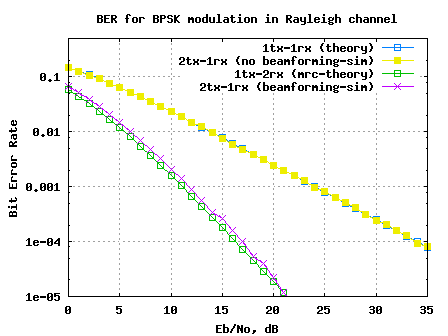
Transmit beamforming

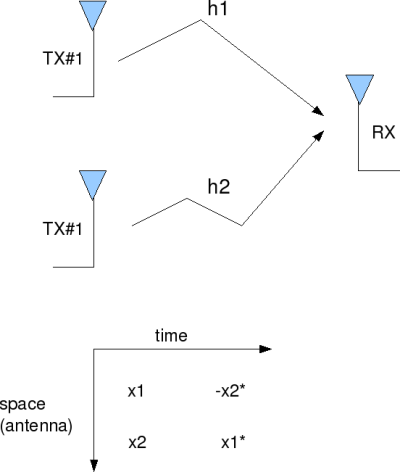
In this post lets discuss a closed-loop transmit diversity scheme, where the transmitter has the knowledge of the channel. As there is a feedback path required from the receiver, to communicate the channel seen by the receiver to the transmitter, the scheme is called closed-loop transmit diversity scheme. Recall that the transmit diversity using Space [...]

46 comments Read the full article →

Derivation of BPSK BER in Rayleigh channel

This is a guest post by Jose Antonio Urigüen who is an Electrical and Electronic Engineer currently studying an MSc in Communications and Signal Processing at Imperial College in London. This guest post has been created due to his own curiosity when reviewing some concepts of BER for BPSK in Rayleigh channnel published in the [...]

38 comments Read the full article →

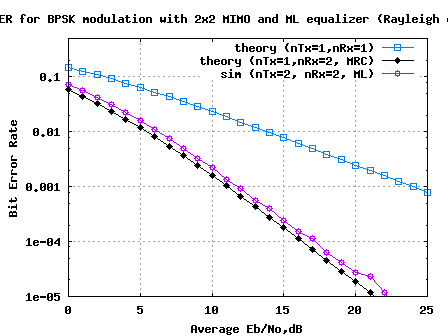
MIMO with ML equalization

We have discussed quite a few receiver structures for a 2×2 MIMO channel namely,
(a) Zero Forcing (ZF) equalization
(b) Minimum Mean Square Error (MMSE) equalization
(c) Zero Forcing equalization with Successive Interference Cancellation (ZF-SIC)
(d) ZF-SIC with optimal ordering and
(e) MIMO with MMSE SIC and optimal ordering

From the above receiver structures, we saw that MMSE equalisation with optimally [...]

55 comments Read the full article →

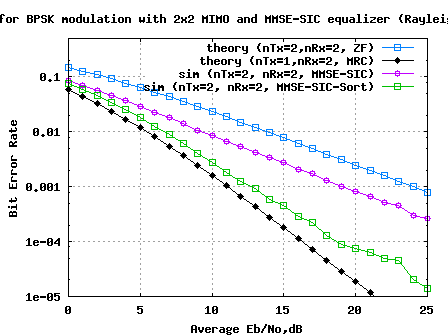
MIMO with MMSE SIC and optimal ordering

This post attempts to build further on the MIMO equalization schemes which we have discussed -
(a) Minimum Mean Square Error (MMSE) equalization,
(b) Zero Forcing equalization with Successive Interference Cancellation (ZF-SIC) and
(c) ZF-SIC with optimal ordering.
We have learned that successive interference cancellation with optimal ordering improves the performance with Zero Forcing equalization. In this post, we [...]

21 comments Read the full article →

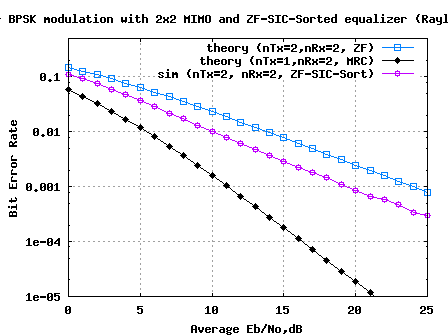
MIMO with ZF SIC and optimal ordering

In previous posts, we had discussed equalization of a 2×2 MIMO channel with Zero Forcing (ZF) equalization and later, Zero Forcing equalization with successive interference cancellation (ZF-SIC). In this post, we will explore a variant of ZF-SIC called Zero Forcing Successive Interference Cancellation with optimal ordering. We will assume that the channel is a flat [...]

9 comments Read the full article →

MIMO with Zero Forcing Successive Interference Cancellation equalizer

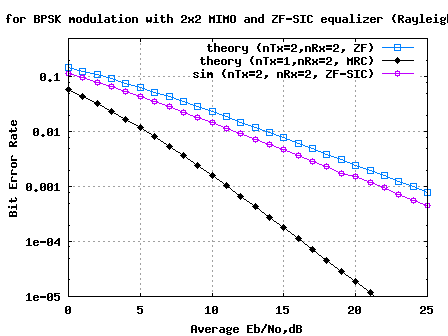
The post on MIMO with Zero Forcing equalizer discussed a probable way of equalizing a 2×2 MIMO channel. The simulated results with the 2×2 MIMO system with zero forcing equalizer showed matching results as obtained in for a 1×1 system for BPSK modulation in Rayleigh channel. In this post, we will try to improve [...]

33 comments Read the full article →

MIMO with MMSE equalizer

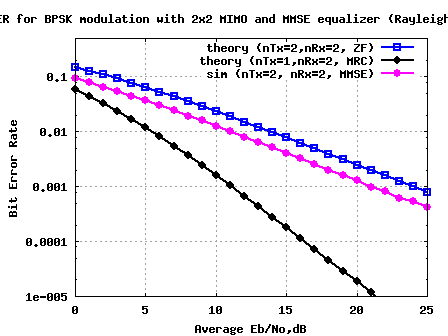
In a previous post, we had discussed a 2×2 MIMO transmission using BPSK modulation in Rayleigh channel with a Zero Forcing equalizer. The simulated results with the 2×2 MIMO system  with zero forcing equalizer showed matching results as obtained in for a 1×1 system for BPSK modulation in Rayleigh channel. In this post, we will [...]

166 comments Read the full article →

MIMO with Zero Forcing equalizer

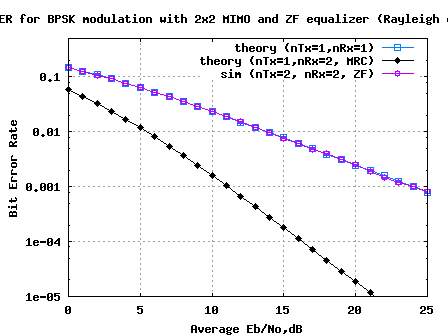
We had discussed three Single Input Multiple Output (SIMO also known as receive diversity) schemes – Selection combining, Equal Gain Combining, Maximal Ratio Combining and a Multiple Input Single Output (MISO, also known as transmit diversity) scheme – Alamouti 2×1 STBC. Let us now discuss the case where there a multiple transmit [...]

88 comments Read the full article →

Alamouti STBC

In the recent past, we have discussed three receive diversity schemes – Selection combining, Equal Gain Combining and Maximal Ratio Combining. All the three approaches used the antenna array at the receiver to improve the demodulation performance, albeit with different levels of complexity. Time to move on to a transmit diversity scheme where the information [...]

131 comments Read the full article →

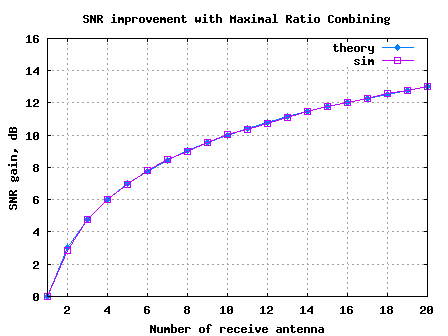
Maximal Ratio Combining (MRC)

This is the third post in the series discussing receiver diversity in a wireless link. Receiver diversity is a form of space diversity, where there are multiple antennas at the receiver. The presence of receiver diversity poses an interesting problem – how do we use ‘effectively‘ the information from all the antennas to demodulate the [...]

88 comments Read the full article →

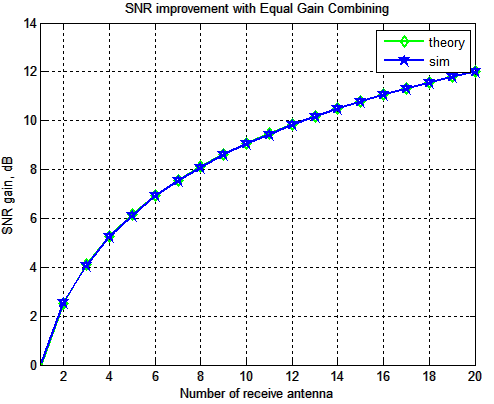
Equal Gain Combining (EGC)

This is the second post in the series discussing receiver diversity in a wireless link. Receiver diversity is a form of space diversity, where there are multiple antennas at the receiver. The presence of receiver diversity poses an interesting problem – how do we use ‘effectively‘ the information from all the antennas to demodulate the [...]

30 comments Read the full article →

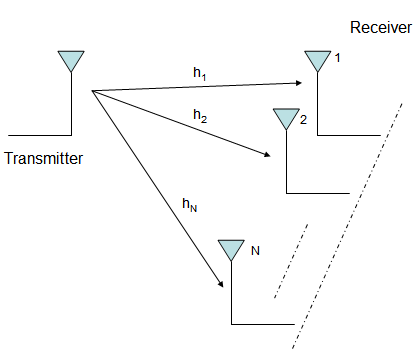
Selection Diversity

This is the first post in the series discussing receiver diversity in a wireless link. Receiver diversity is a form of space diversity, where there are multiple antennas at the receiver. The presence of receiver diversity poses an interesting problem – how do we use ‘effectively‘ the information from all the antennas to demodulate the [...]

37 comments Read the full article →

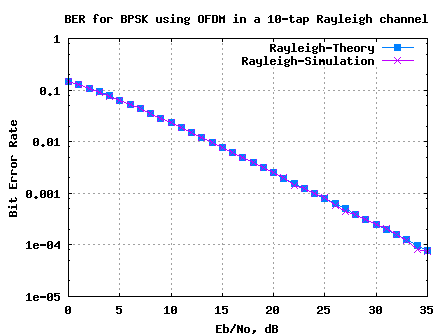
BER for BPSK in OFDM with Rayleigh multipath channel

Mr. Lealem Tamirat, in a comment on BER for BPSK in Rayleigh channel, wondered about the performance of an OFDM modulated system in a frequency selective Rayeligh fading channel. My response was that,
Though the total channel is a frequency selective channel, the channel experienced by each subcarrier in an OFDM system is a flat fading [...]

225 comments Read the full article →

BER for BPSK in Rayleigh channel

Long back in time we discussed the BER (bit error rate) for BPSK modulation in a simple AWGN channel (time stamps states August 2007). Almost an year back! It high time we discuss the BER for BPSK in a Rayleigh multipath channel.
In a brief discussion on Rayleigh channel, wherein we stated that a circularly symmetric [...]

195 comments Read the full article →