Posts tagged as:

PSK

Download free e-book on error probability in AWGN

We have quite a few articles discussing bit and symbol error rates for popular digital modulation schemes in Additive White Gaussian Noise (AWGN) channel. This post summarizes the articles discussing the theoretical and simulated error rates for the digital modulation schemes like BPSK, QPSK, 4-PAM, 16PSK and 16QAM. Further, Bit Error Rate with [...]

148 comments Read the full article →

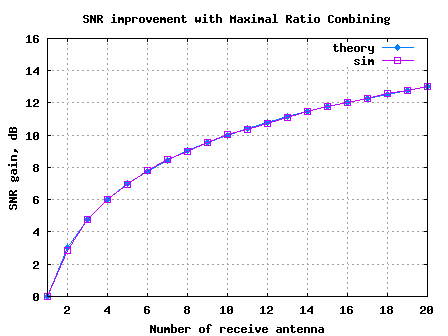
Maximal Ratio Combining (MRC)

This is the third post in the series discussing receiver diversity in a wireless link. Receiver diversity is a form of space diversity, where there are multiple antennas at the receiver. The presence of receiver diversity poses an interesting problem – how do we use ‘effectively‘ the information from all the antennas to demodulate the [...]

88 comments Read the full article →

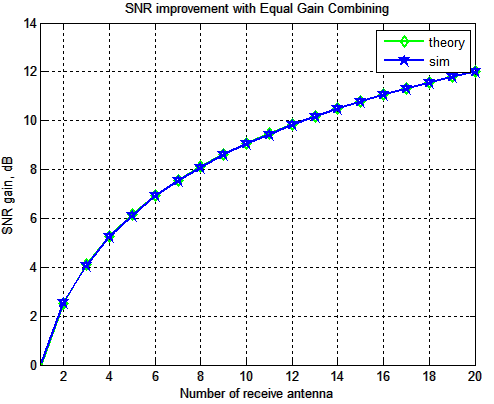
Equal Gain Combining (EGC)

This is the second post in the series discussing receiver diversity in a wireless link. Receiver diversity is a form of space diversity, where there are multiple antennas at the receiver. The presence of receiver diversity poses an interesting problem – how do we use ‘effectively‘ the information from all the antennas to demodulate the [...]

30 comments Read the full article →

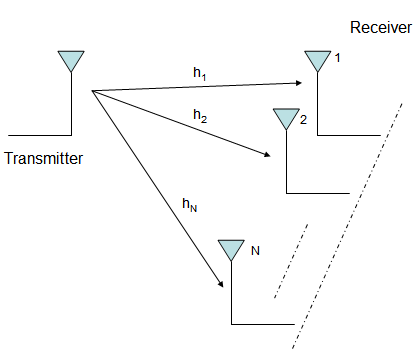
Selection Diversity

This is the first post in the series discussing receiver diversity in a wireless link. Receiver diversity is a form of space diversity, where there are multiple antennas at the receiver. The presence of receiver diversity poses an interesting problem – how do we use ‘effectively‘ the information from all the antennas to demodulate the [...]

37 comments Read the full article →

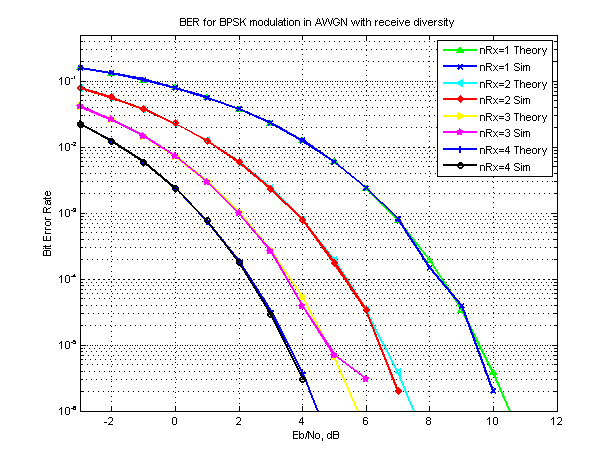
Receive diversity in AWGN

Some among you will be aware that in a wireless link having multiple antenna’s at the receiver (aka receive diversity) improves the bit error rate (BER) performance. In this post, let us try to understand the BER improvement with receive diversity. And, since we are just getting started, let us limit ourselves to additive [...]

15 comments Read the full article →

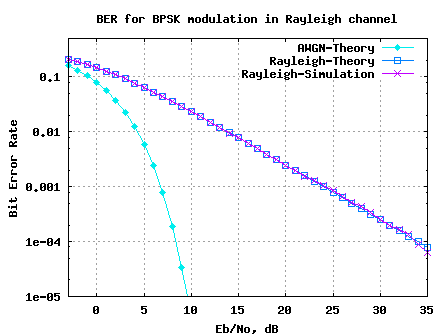
BER for BPSK in Rayleigh channel

Long back in time we discussed the BER (bit error rate) for BPSK modulation in a simple AWGN channel (time stamps states August 2007). Almost an year back! It high time we discuss the BER for BPSK in a Rayleigh multipath channel.
In a brief discussion on Rayleigh channel, wherein we stated that a circularly symmetric [...]

195 comments Read the full article →

Comparing BPSK, QPSK, 4PAM, 16QAM, 16PSK, 64QAM and 32PSK

I have written another article in DSPDesginLine.com. This article can be treated as the third post in the series aimed at understanding Shannon’s capacity equation.
For the first two posts in the series are:
1. Understanding Shannon’s capacity equation
2. Bounds on Communication based on Shannon’s capacity
The article summarizes the symbol error rate derivations in AWGN for modulation [...]

62 comments Read the full article →

Binary to Gray code conversion for PSK and PAM

In this post, let us try to understand Gray codes and their usage in digital communication. Quoting from Wiki entry on Gray code [Gray-Wiki],
The reflected binary code, also known as Gray code after Frank Gray, is a binary numeral system where two successive values differ in only one digit.
In a digital communication system, if the [...]

9 comments Read the full article →

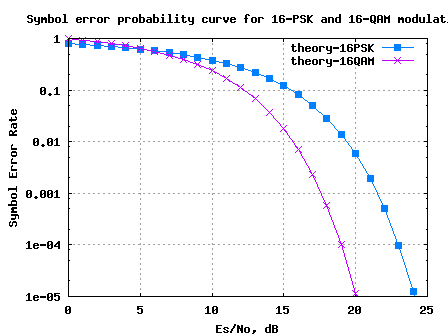
Comparing 16PSK vs 16QAM for symbol error rate

In two previous posts, we have derived theoretical symbol error rate for 16-QAM and 16-PSK modulation schemes. The links are:
(a) Symbol error rate for 16-PSK
(b) Symbol error rate for 16-QAM
Given that we are transmitting the same number of constellation points in both 16-PSK and 16-QAM, let us try to understand the better modulation scheme among [...]

43 comments Read the full article →

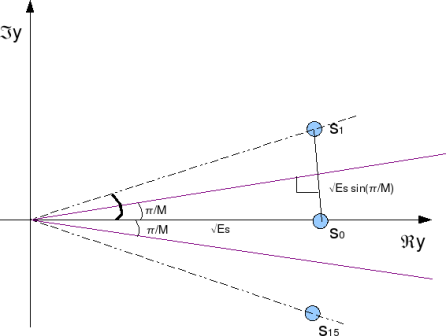
Symbol Error Rate for 16PSK

In this post, let us try to derive the symbol error rate for 16-PSK (16-Phase Shift Keying) modulation.
Consider a general M-PSK modulation, where the alphabets,
are used.
(Refer example 5-38 in [DIG-COMM-BARRY-LEE-MESSERSCHMITT])

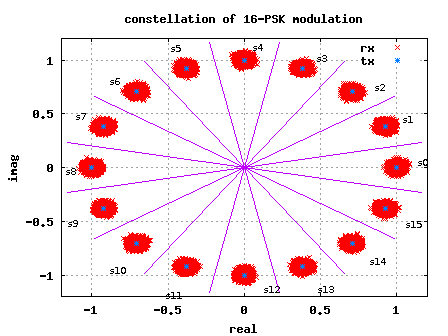
Figure: 16-PSK constellation plot

19 comments Read the full article →

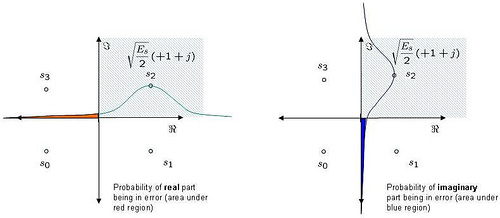
Symbol Error Rate (SER) for QPSK (4-QAM) modulation

Given that we have discussed symbol error rate probability for a 4-PAM modulation, let us know focus on finding the symbol error probability for a QPSK (4-QAM) modulation scheme.
Background
Consider that the alphabets used for a QPSK (4-QAM) is (Refer example 5-35 in [DIG-COMM-BARRY-LEE-MESSERSCHMITT]).

Download free e-Book discussing theoretical and simulated error rates for the digital [...]

67 comments Read the full article →

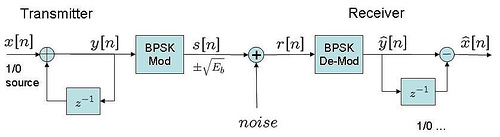
Coherent demodulation of DBPSK

In a previous post, we discussed about a probable first order digital PLL for tracking constant phase offset. The assumption was that as the phase offset is small and the bits gets decoded correctly, the phase difference between the ideal and actual constellation gives the initial value of phase. However, in typical scenarios it may [...]

17 comments Read the full article →

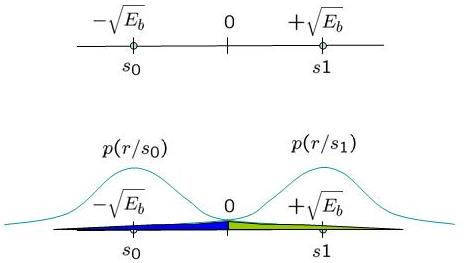
Bit Error Rate (BER) for BPSK modulation

In this post, we will derive the theoretical equation for bit error rate (BER) with Binary Phase Shift Keying (BPSK) modulation scheme in Additive White Gaussian Noise (AWGN) channel. The BER results obtained using Matlab/Octave simulation scripts show good agreement with the derived theoretical results.
With Binary Phase Shift Keying (BPSK), the binary digits 1 and [...]

283 comments Read the full article →