Symbol Error rate for QAM (16, 64, 256,.., M-QAM)

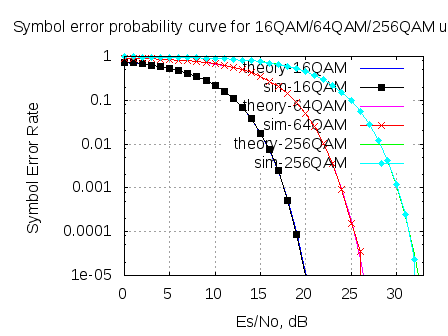
In May 2008, we derived the theoretical symbol error rate for a general M-QAM modulation (in  Embedded.comDSPDesignLine.com and dsplog.com) under Additive White Gaussian Noise. While re-reading that post, felt that the article is nice and warrants a re-run, using OFDM as the underlying physical layer. This post discuss the derivation of symbol error rate for a general M-QAM modulation. The companion Matlab script compares the theoretical and the simulated symbol error rate for 16QAM, 64QAM and 256QAM over OFDM in AWGN channel.

Enjoy and HAPPY NEW YEAR 2012 !!!

Continue reading “Symbol Error rate for QAM (16, 64, 256,.., M-QAM)”
Quiz on IEEE 802.11a specifications

The IEEE 802.11a specifications are used by many to understand a wireless communication link built using OFDM. In this post, I have put together a set of 10 multiple choice questions based on 802.11a specifications. The questions are on the building blocks in 802.11a specifications, preamble structure and so on. Upon completion of the quiz, you will be lead to a page showing the correct answers and their explanations.

Click here to download IEEE 802.11a specifications.

Note: The quiz might not be visible on RSS reader or over email. Please visit the site to access the quiz.

Good luck!

[QUIZZIN 4]

Inter Carrier Interference (ICI) in OFDM due to frequency offset

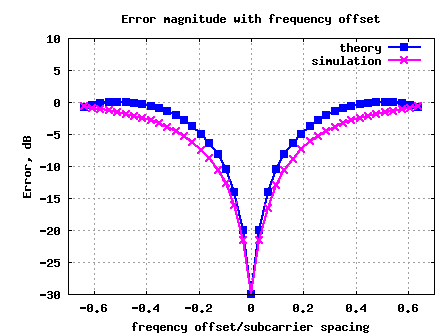
In this post, let us evaluate the impact of frequency offset resulting in Inter Carrier Interference (ICI) while receiving an OFDM modulated symbol. We will first discuss the OFDM transmission and reception, the effect of frequency offset and later we will define the loss of orthogonality and resulting signal to noise ratio (SNR) loss due to the presence of frequency offset. The analysis is accompanied by Matlab/Octave simulation scripts.

Continue reading “Inter Carrier Interference (ICI) in OFDM due to frequency offset”

BER for BPSK in OFDM with Rayleigh multipath channel

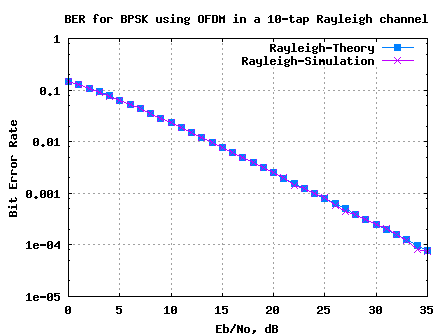
Mr. Lealem Tamirat, in a comment on BER for BPSK in Rayleigh channel, wondered about the performance of an OFDM modulated system in a frequency selective Rayeligh fading channel. My response was that,

Though the total channel is a frequency selective channel, the channel experienced by each subcarrier in an OFDM system is a flat fading channel with each subcarrier experiencing independent Rayleigh fading.

So, assuming that the number of taps in the channel is lower than the cyclic prefix duration (which ensures that there is no inter symbol interference), the BER for BPSK with OFDM in a Rayleigh fading channel should be same as the result obtained for BER for BPSK in Rayleigh fading channel.

Let us try to define a quick simulation to confirm the claim.

Continue reading “BER for BPSK in OFDM with Rayleigh multipath channel”

Negative Frequency

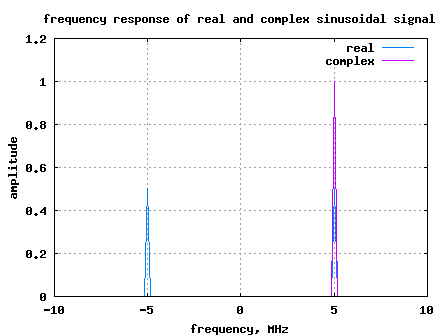
Last week, I received an email from Mr. Kishore. He was wondering about the physical significance of negative frequency. Does negative frequency really exist?

Though I have seen conflicting views on the net (thread in complextoreal.com, thread in comp.dsp), my perspective is that negative frequency exist. The concept of negative frequency helps me a lot to understand single sideband modulation (SSB), OFDM systems, I Q modulators etc (to name a few).

Continue reading “Negative Frequency”

Trying out PAPR reduction for OFDM by multiplication with j

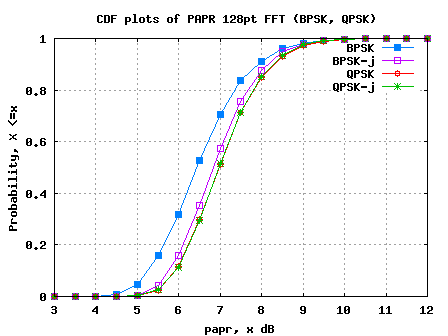
In this post, we will explore a probable way of reducing PAPR (peak to average power ratio) in OFDM by changing the phase of some of the subcarriers. This is in response to the comment to post on Peak to Average power ratio for OFDM, where Mr. Elibom suggested to reduce the PAPR by cyclically rotate some of the subcarriers and using.

Further, the presentation in the IEEE TGN, PAPR in HT-LTF (11-06/1595r1), mentions that in 40MHz mode where a 128pt FFT is used, PAPR of HT-LTF (High Throughput Long Training Field) can be reduced by multiplying the upper 20MHz subcarriers by j. Using quick Matlab simulations, we will try to validate that claim for HT-LTF and further check the PAPR for a general random BPSK and QPSK modulation.

Continue reading “Trying out PAPR reduction for OFDM by multiplication with j”

BPSK BER with OFDM modulation

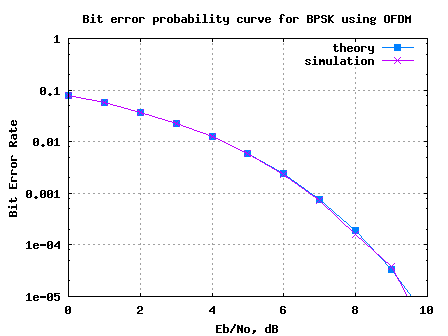
Oflate, I am getting frequent requests for bit error rate simulations using OFDM (Orthogonal Frequency Division Multiplexing) modulation. In this post, we will discuss a simple OFDM transmitter and receiver, find the relation between Eb/No (Bit to Noise ratio) and Es/No (Signal to Noise ratio) and compute the bit error rate with BPSK.

Continue reading “BPSK BER with OFDM modulation”

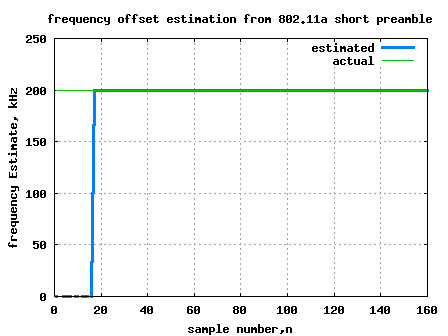
Frequency offset estimation using 802.11a short preamble

From the previous post on OFDM (here), we have understood that an OFDM waveform is made of sum of multiple sinusoidals (also called subcarriers) each modulated independently. In this post, let us try to understand the estimation of frequency offset in a typical OFDM receiver (using the short preamble specified per IEEE 802.11a specification as a reference).

Understanding frequency offset

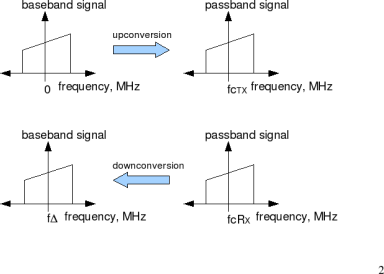
In a typical wireless communication system, the signal to be transmitted is upconverted to a carrier frequency prior to transmission. The receiver is expected to tune to the same carrier frequency for downconverting the signal to baseband, prior to demodulation.

Signal Up/Down conversion

Figure: Up/down conversion

Continue reading “Frequency offset estimation using 802.11a short preamble”

Peak to Average Power Ratio for OFDM

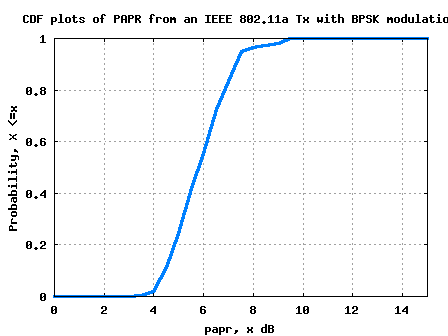
Let us try to understand peak to average power ratio (PAPR) and its typical value in an OFDM system specified per IEEE 802.11a specifications.

What is PAPR?

The peak to average power ratio for a signal is defined as
, where
corresponds to the conjugate operator.

Expressing in deciBels,
.

Continue reading “Peak to Average Power Ratio for OFDM”

Cylcic prefix in Orthogonal Frequency Division Multiplexing

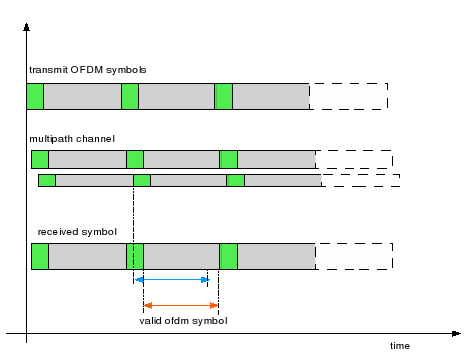
In a previous post (here), we discussed in brief, Orthogonal Frequency Division Multiplexing (OFDM) transmission. Let us know probe bit more into the motivation of cyclic prefix (aka guard interval) associated with each OFDM symbol.

What is cyclic prefix?
Let us consider one subcarrier (subcarrier +1 specified in IEEE 802.11a specification) alone. In the figure shown below, the blue line corresponds to the original sinusoidal where one cycle of the sinusoidal is of duration 64 samples ( with 20MHz sampling), corresponding to subcarrier of frequency 312.5kHz.

Continue reading “Cylcic prefix in Orthogonal Frequency Division Multiplexing”

Understanding an OFDM transmission

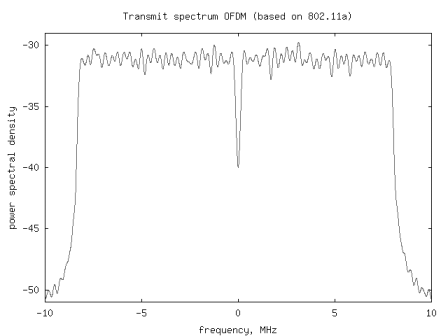
Let us try to understand simulation of a typical Orthogonal Frequency Division Multiplexing (OFDM) transmission defined per IEEE 802.11a specification.

Orthogonal pulses
In a previous post (here ), we have understood that the minimum frequency separation for two sinusoidals with arbitrary phases to be orthogonal is , where is the symbol period.

In Orthogonal Frequency Division Multiplexing, multiple sinusoidals with frequency separation is used. The sinusoidals used in OFDM can be defined as (Refer Sec6.4.2 in [DIG-COMM-BARRY-LEE-MESSERSCHMITT]:

, where

correspond to the frequency of the sinusoidal and

is a rectangular window over .

Continue reading “Understanding an OFDM transmission”