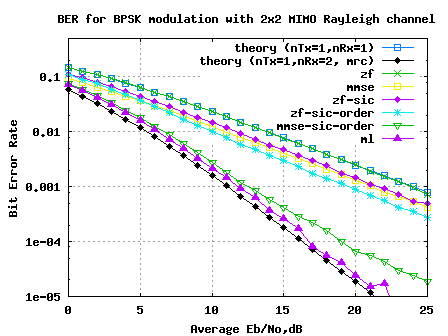
In the past, we had discussed several posts on two transmit two receive MIMO communication, where the transmission was based on V-BLAST. The details about V-BLAST can be read from the landmark paper V-BLAST: An architeture for realizing very high data rates over the rich scattering wireless channel – P. W. Wolniansky, G. J. Foschini, G. D. Golden, R. A. Valenzuela. We will assume that the channel is a flat fading Rayleigh multipath channel and the modulation is BPSK.
Category: MIMO
Describes scenarios with multiple transmit or multiple receive antennas
Transmit beamforming
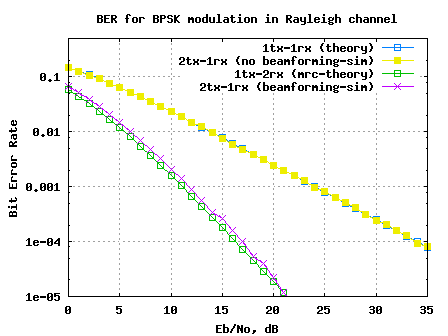
In this post lets discuss a closed-loop transmit diversity scheme, where the transmitter has the knowledge of the channel. As there is a feedback path required from the receiver, to communicate the channel seen by the receiver to the transmitter, the scheme is called closed-loop transmit diversity scheme. Recall that the transmit diversity using Space Time Coding (Alamouti STBC) does not require the knowledge of the channel. In this post, we will restrict our discussion to a 2 transmit, 1 receive case. We will assume that the channel is a flat fading Rayleigh multipath channel and the modulation is BPSK.
Alamouti STBC with 2 receive antenna
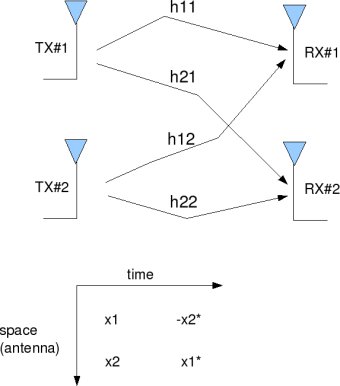
In the past, we had discussed two transmit, one receive antenna Alamouti Space Time Block Coding (STBC) scheme. In this post, lets us discuss the impact of having two antennas at the receiver. For the discussion, we will assume that the channel is a flat fading Rayleigh multipath channel and the modulation is BPSK.
Continue reading “Alamouti STBC with 2 receive antenna”
MIMO with ML equalization
We have discussed quite a few receiver structures for a 2×2 MIMO channel namely,
(a) Zero Forcing (ZF) equalization
(b) Minimum Mean Square Error (MMSE) equalization
(c) Zero Forcing equalization with Successive Interference Cancellation (ZF-SIC)
(d) ZF-SIC with optimal ordering and
(e) MIMO with MMSE SIC and optimal ordering
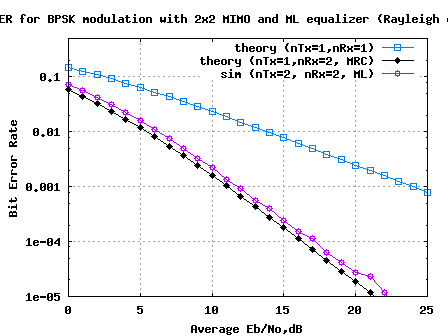
From the above receiver structures, we saw that MMSE equalisation with optimally ordered Successive Interference Cancellation gave the best performance. In this post, we will discuss another receiver structure called Maximum Likelihood (ML) decoding which gives us an even better performance. We will assume that the channel is a flat fading Rayleigh multipath channel and the modulation is BPSK.
MIMO with MMSE SIC and optimal ordering
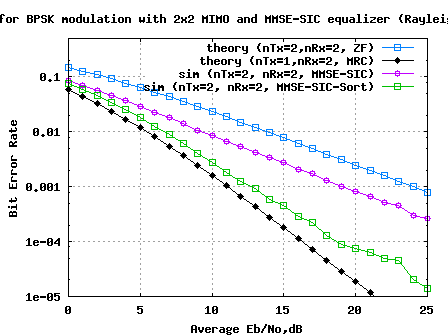
This post attempts to build further on the MIMO equalization schemes which we have discussed –
(a) Minimum Mean Square Error (MMSE) equalization,
(b) Zero Forcing equalization with Successive Interference Cancellation (ZF-SIC) and
(c) ZF-SIC with optimal ordering.
We have learned that successive interference cancellation with optimal ordering improves the performance with Zero Forcing equalization. In this post, we extend the concept of successive interference cancellation to the MMSE equalization and simulate the performance. We will assume that the channel is a flat fading Rayleigh multipath channel and the modulation is BPSK.
MIMO with ZF SIC and optimal ordering
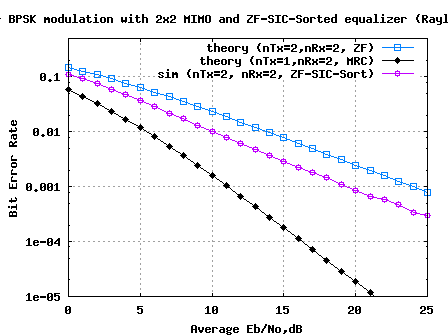
In previous posts, we had discussed equalization of a 2×2 MIMO channel with Zero Forcing (ZF) equalization and later, Zero Forcing equalization with successive interference cancellation (ZF-SIC). In this post, we will explore a variant of ZF-SIC called Zero Forcing Successive Interference Cancellation with optimal ordering. We will assume that the channel is a flat fading Rayleigh multipath channel and the modulation is BPSK.
MIMO with Zero Forcing Successive Interference Cancellation equalizer
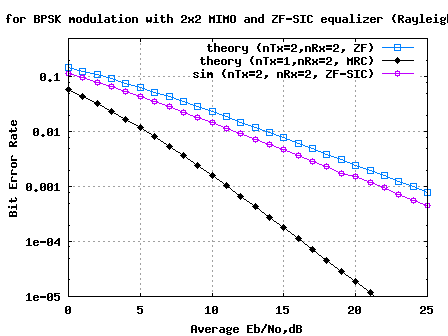
The post on MIMO with Zero Forcing equalizer discussed a probable way of equalizing a 2×2 MIMO channel. The simulated results with the 2×2 MIMO system with zero forcing equalizer showed matching results as obtained in for a 1×1 system for BPSK modulation in Rayleigh channel. In this post, we will try to improve the bit error rate performance by trying out Successive Interference Cancellation (SIC). We will assume that the channel is a flat fading Rayleigh multipath channel and the modulation is BPSK.
Continue reading “MIMO with Zero Forcing Successive Interference Cancellation equalizer”
MIMO with MMSE equalizer
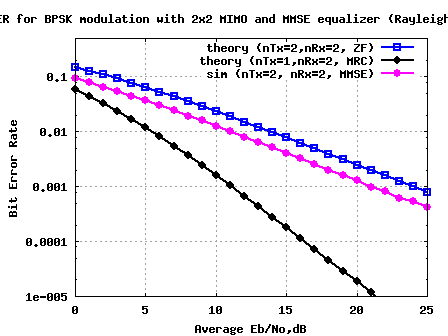
In a previous post, we had discussed a 2×2 MIMO transmission using BPSK modulation in Rayleigh channel with a Zero Forcing equalizer. The simulated results with the 2×2 MIMO system with zero forcing equalizer showed matching results as obtained in for a 1×1 system for BPSK modulation in Rayleigh channel. In this post, we will discuss a different equalization approach called Minimum Mean Square Error (MMSE) equalization. We will assume that the channel is a flat fading Rayleigh multipath channel and the modulation is BPSK.
MIMO with Zero Forcing equalizer
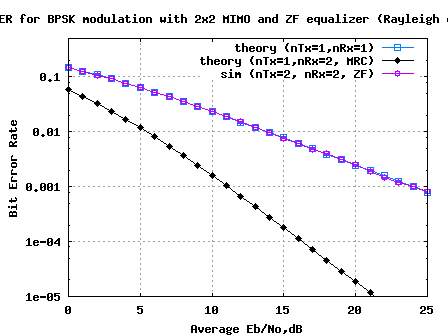
We had discussed three Single Input Multiple Output (SIMO also known as receive diversity) schemes – Selection combining, Equal Gain Combining, Maximal Ratio Combining and a Multiple Input Single Output (MISO, also known as transmit diversity) scheme – Alamouti 2×1 STBC. Let us now discuss the case where there a multiple transmit antennas and multiple receive antennas resulting in the formation of a Multiple Input Multiple Output (MIMO) channel. In this post, we will restrict our discussion to a 2 transmit 2 receive antenna case (resulting in a 2×2 MIMO channel). We will assume that the channel is a flat fading Rayleigh multipath channel and the modulation is BPSK.
Alamouti STBC
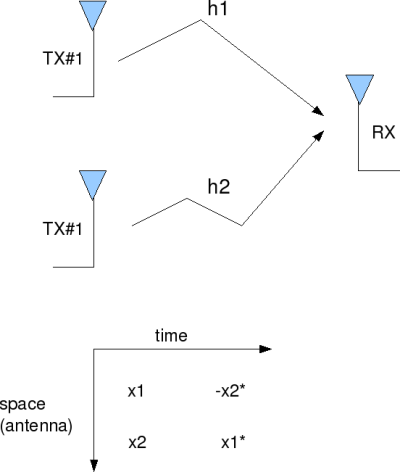
In the recent past, we have discussed three receive diversity schemes – Selection combining, Equal Gain Combining and Maximal Ratio Combining. All the three approaches used the antenna array at the receiver to improve the demodulation performance, albeit with different levels of complexity. Time to move on to a transmit diversity scheme where the information is spread across multiple antennas at the transmitter. In this post, lets discuss a popular transmit diversity scheme called Alamouti Space Time Block Coding (STBC). For the discussion, we will assume that the channel is a flat fading Rayleigh multipath channel and the modulation is BPSK.
Maximal Ratio Combining (MRC)
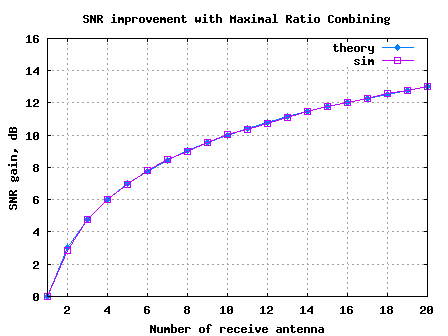
This is the third post in the series discussing receiver diversity in a wireless link. Receiver diversity is a form of space diversity, where there are multiple antennas at the receiver. The presence of receiver diversity poses an interesting problem – how do we use ‘effectively‘ the information from all the antennas to demodulate the data. In the previous posts, we discussed selection diversity and equal gain combining (EGC).
In this post, we will discuss Maximal Ratio Combining (MRC). For the discussion, we will assume that the channel is a flat fading Rayleigh multipath channel and the modulation is BPSK.
Continue reading “Maximal Ratio Combining (MRC)”
Equal Gain Combining (EGC)
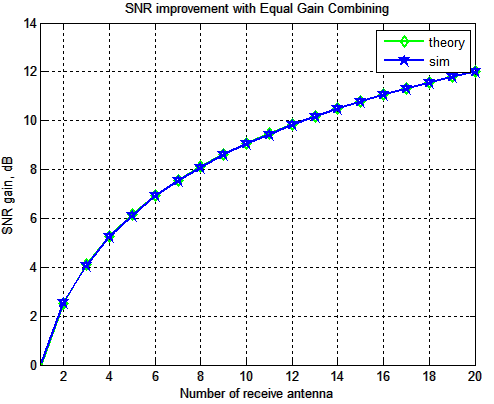
This is the second post in the series discussing receiver diversity in a wireless link. Receiver diversity is a form of space diversity, where there are multiple antennas at the receiver. The presence of receiver diversity poses an interesting problem – how do we use ‘effectively‘ the information from all the antennas to demodulate the data. In the previous post, we discussed selection diversity. In this post, we will discuss equal gain combining (EGC). For the discussion, we will assume that the channel is a flat fading Rayleigh multipath channel and the modulation is BPSK.
Selection Diversity
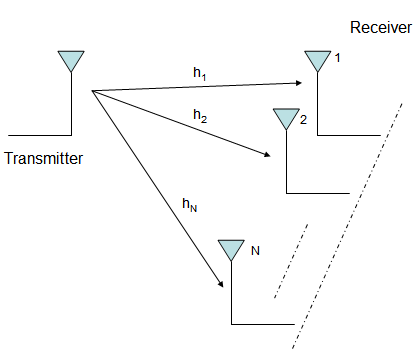
This is the first post in the series discussing receiver diversity in a wireless link. Receiver diversity is a form of space diversity, where there are multiple antennas at the receiver. The presence of receiver diversity poses an interesting problem – how do we use ‘effectively‘ the information from all the antennas to demodulate the data. There are multiple ways to approach the problem. The three typical approaches to be discussed are – selection diversity, equal gain combining and maximal ratio combining. In this post we will discuss selection diversity. For the discussion, we will assume that the channel is a flat fading Rayleigh multipath channel and the modulation is BPSK.
Receive diversity in AWGN
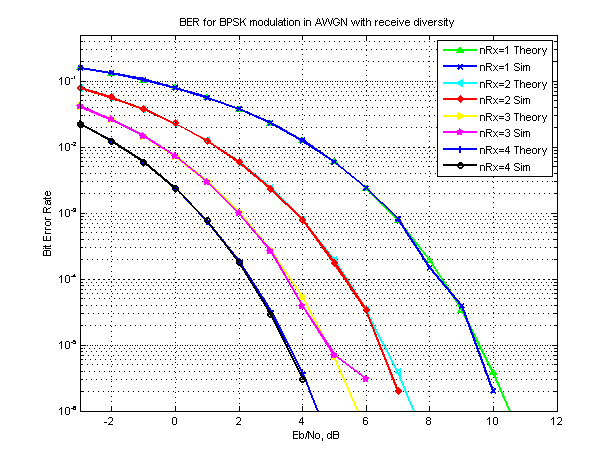
Some among you will be aware that in a wireless link having multiple antenna’s at the receiver (aka receive diversity) improves the bit error rate (BER) performance. In this post, let us try to understand the BER improvement with receive diversity. And, since we are just getting started, let us limit ourselves to additive white Gaussian noise (AWGN) channel (i.e assume that the channel gains are unity).